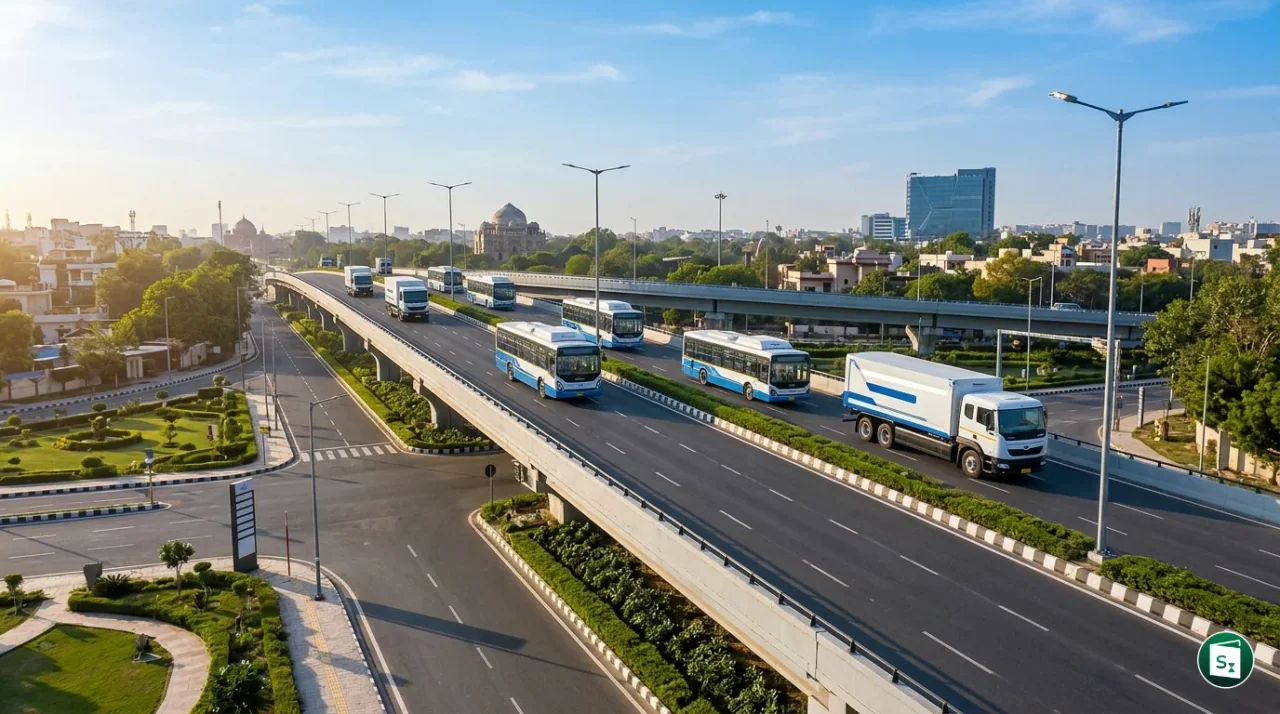
Tata Motors signed a Memorandum of Understanding with the Ministry of Road Transport and Highways on 18 June 2026 to join the Government of India’s ₹9,585 crore fleet renewal programme for Delhi-NCR. Under the agreement, the company will offer an 8% discount on the ex-showroom price of eligible trucks and buses purchased against the replacement of older commercial vehicles. The move makes Tata Motors the third major manufacturer to join the scheme, following Ashok Leyland and Switch Mobility, bringing the combined market share of participating original equipment manufacturers to roughly half of India’s truck and bus market.
What Is the Delhi-NCR Fleet Renewal Programme?
The Union Cabinet approved the two-year fleet renewal programme on 3 June 2026 with a total outlay of ₹9,585 crore. The scheme is funded through the National Capital Region Planning Board (NCRPB), a statutory body constituted in 1985 under the NCRPB Act, 1985, functioning under the Ministry of Housing and Urban Affairs. The programme is implemented jointly by the Ministry of Road Transport and Highways (MoRTH) and the Ministry of Petroleum and Natural Gas (MoPNG) in collaboration with the participating states of Delhi, Haryana, Rajasthan, and Uttar Pradesh.
The scheme offers financial incentives to owners of trucks and buses registered in Delhi-NCR that comply with Bharat Stage-IV (BS-IV) or earlier emission standards, encouraging them to upgrade to BS-VI-compliant or electric vehicles. The central government contributes ₹5,041 crore directly, while participating states provide an estimated ₹1,601 crore through tax concessions.
Target Vehicles and Eligibility Rules
The programme is expected to benefit approximately 2.07 lakh vehicle owners, comprising about 1.91 lakh trucks and 16,329 buses across the Delhi-NCR region. The following table summarises the eligibility and replacement conditions for different vehicle categories.
| Vehicle Category | Requirement | Replacement Condition |
|---|---|---|
| BS-III and older trucks/buses | Mandatory scrapping at Registered Vehicle Scrapping Facilities (RVSFs) | Must purchase and register BS-VI or EV within NCR |
| BS-IV trucks/buses | May be scrapped or sold outside NCR in non-NCAP cities/towns | Must purchase and register BS-VI or EV within NCR |
| Delhi light goods vehicles | Must be scrapped | Only electric vehicles allowed as replacement |
| Delhi buses | Must be scrapped | Only BS-VI CNG or electric buses allowed |
| Government vehicles | Excluded from scheme benefits | Not applicable |
The Bharat Stage emission standards, modelled on European norms, have evolved in India through several stages. India 2000 (equivalent to Euro 1) was introduced nationwide in 2000. BS-II norms followed in 2001 in major cities and expanded to nationwide coverage by 2005. BS-III standards took effect in 2005 in select cities and nationwide by 2010. BS-IV norms were phased in from 2010 in major cities and covered the entire country by 2017. India skipped BS-V entirely and leapfrogged directly to BS-VI nationwide from April 2020, aligning with Euro 6 standards.
The Multi-Layered Incentive Structure
The programme combines incentives from three sources: the central government, participating state governments, and vehicle manufacturers. This layered approach is designed to make the upfront cost of replacing a commercial vehicle more manageable for fleet operators.
| Incentive Source | Benefit | Duration |
|---|---|---|
| Central Government | 5% interest subvention on vehicle loans | 5 years from vehicle registration |
| Central Government | Monthly fuel vouchers up to ₹4,800 (varies by vehicle category) through oil marketing companies | 5 years |
| Central Government | Additional lump-sum benefits for electric vehicle purchases or through trading of Certificates of Deposit generated under the scrappage framework | One time |
| State Governments | Up to 100% concession on motor vehicle tax for new vehicles; 50% for used BS-VI vehicles | 10 years |
| State Governments | Waiver of registration fees for eligible vehicles | One time |
| State Governments | Waiver of pending liabilities on old vehicles enrolled under the scheme | One time |
| OEMs (Tata Motors, Ashok Leyland, Switch Mobility) | 8% discount on ex-showroom price of eligible trucks and buses | During scheme period |
Enrolment under the scheme will remain open for two years, but central government benefits will continue for five years from the date of registration of the replacement vehicle, ensuring sustained impact beyond the enrolment window. Implementation will be fully digital through an integrated portal that enables real-time eligibility checks, automated interest subvention claims, monthly fuel voucher credits, and monitoring of pollution reduction outcomes. An Empowered Committee chaired by the Cabinet Secretary will oversee the scheme’s implementation.
Industry Participation: Tata Motors Signs MoU
Tata Motors signed its MoU with MoRTH on 18 June 2026, becoming the third original equipment manufacturer to formally join the fleet renewal programme. Under the agreement, the company will provide an 8% discount on the ex-showroom price of eligible trucks and buses purchased under the scheme. For electric commercial vehicles, the discount will be capped at the amount applicable to an equivalent internal combustion engine vehicle within the same Gross Vehicle Weight (GVW) category.
Earlier in the same week, Ashok Leyland and its electric mobility subsidiary Switch Mobility had signed similar agreements with the government. Together, the three manufacturers account for approximately 50% of India’s truck and bus market, giving the scheme substantial reach among fleet operators across the region.
Tata Motors is India’s largest commercial vehicle manufacturer by market share. The company’s participation is expected to significantly boost awareness and adoption of the programme among fleet owners, particularly small and medium transport operators who form the bulk of the target group.
Why Target Trucks and Buses?
Delhi-NCR consistently ranks among the most polluted regions in the world, and the transport sector remains a major contributor. A joint study by the Automotive Research Association of India (ARAI) and The Energy and Resources Institute (TERI) found that the transport sector contributes 14% of PM2.5, 40% of carbon monoxide, and 63% of nitrogen oxide emissions in the NCR.
Within this sector, heavy commercial vehicles are disproportionately responsible for the pollution load. Trucks and buses account for only 3% of the total vehicle fleet in the region but contribute 36% of PM2.5 emissions. A single pre-BS heavy-duty vehicle emits particulate matter equivalent to approximately 14 BS-VI-compliant vehicles. Even a BS-IV vehicle emits 2.7 times more pollutants than its BS-VI counterpart. Vehicles compliant with BS-I to BS-IV standards emit 67% more carbon monoxide and 97% more particulate matter than BS-VI vehicles.
The Commission for Air Quality Management (CAQM) in Delhi-NCR had already banned the entry of non-BS-VI commercial goods vehicles into Delhi from 1 November 2025, with exemptions for essential commodities valid only until 31 October 2026. The fleet renewal programme complements this regulatory push by offering financial incentives that make compliance viable for fleet operators.
Key Takeaways
- The Union Cabinet approved the ₹9,585 crore Delhi-NCR fleet renewal programme on 3 June 2026 to replace older commercial vehicles with cleaner alternatives.
- The scheme targets approximately 2.07 lakh vehicles, including 1.91 lakh trucks and 16,329 buses across Delhi, Haryana, Rajasthan, and Uttar Pradesh.
- Tata Motors signed an MoU with MoRTH on 18 June 2026, joining Ashok Leyland and Switch Mobility, to offer an 8% discount on eligible commercial vehicles under the programme.
- The central government provides a 5% interest subvention on vehicle loans and monthly fuel vouchers up to ₹4,800 for five years, while states offer up to 100% motor vehicle tax concession and registration fee waiver for ten years.
- In Delhi, light goods vehicles purchased under the scheme must be electric, while buses must be BS-VI CNG or electric only.
- Trucks and buses make up only 3% of Delhi-NCR’s vehicle fleet but contribute 36% of PM2.5 emissions, with one pre-BS heavy vehicle emitting as much as 14 BS-VI vehicles.
- The NCRPB, a statutory body constituted in 1985 under the NCRPB Act, 1985, administers the funding for the programme under the Ministry of Housing and Urban Affairs.