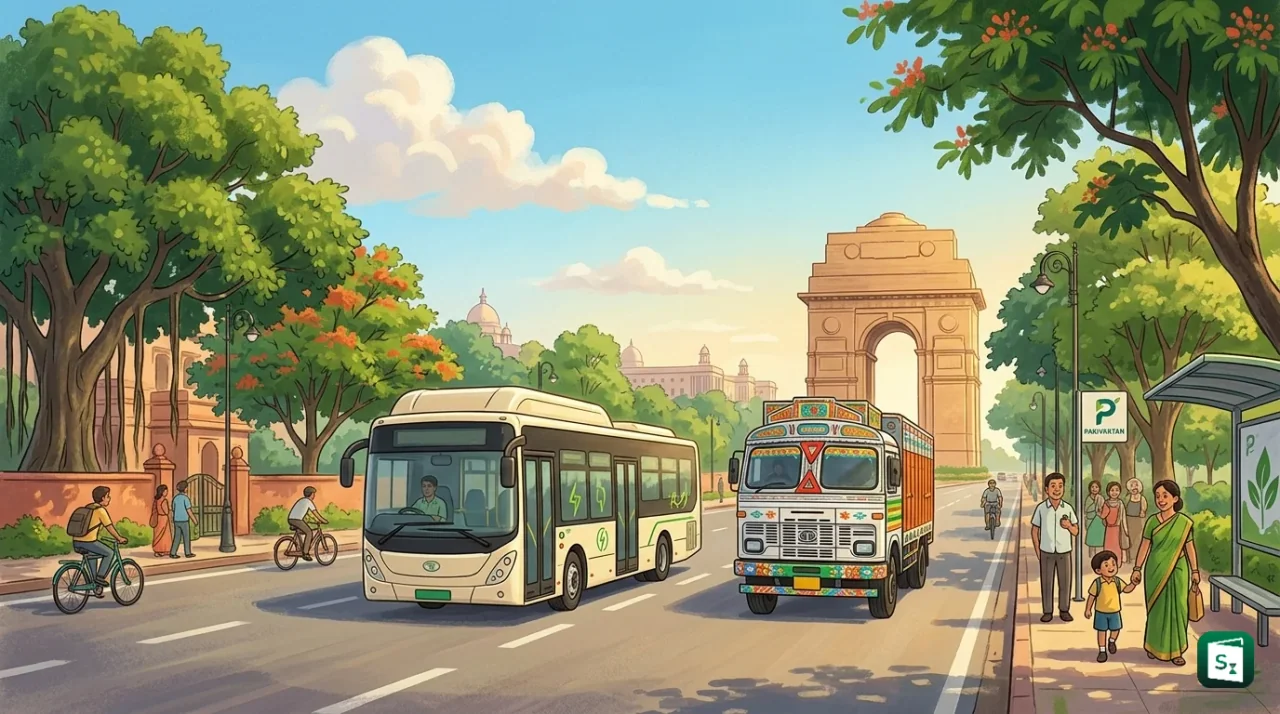
The Ministry of Housing and Urban Affairs has approved the operational guidelines for the PARIVARTAN scheme, clearing the way for replacing up to 2.07 lakh old trucks and buses across the National Capital Region with BS-VI or electric vehicles. The scheme, with a total outlay of ₹9,585 crore, targets commercial vehicles that are BS-IV or older and contribute far more to pollution than their numbers suggest. With this approval, a massive fleet modernisation effort is now set to roll out across Delhi, Haryana, Rajasthan and Uttar Pradesh.
What Is the PARIVARTAN Scheme?
PARIVARTAN stands for Programme for Accelerated Renewal and Incentivization of Vehicle Assets for Reducing Transport Air Pollution and Network Emissions. It is a targeted initiative to phase out old, highly polluting commercial vehicles operating in the National Capital Region (NCR) and replace them with cleaner alternatives.
The Union Cabinet approved the scheme on 3 June 2026 with a total outlay of ₹9,585 crore. The central government will contribute ₹5,041 crore as budgetary support, while the remaining share will come from state-level tax concessions and other contributions. The scheme will run for two years and aims to incentivise owners of approximately 2.07 lakh vehicles ( 1.91 lakh trucks and 16,329 buses ) to scrap their old vehicles and purchase new ones.
The Ministry of Road Transport and Highways (MoRTH) is the implementing ministry, and funding will be routed through the National Capital Region Planning Board (NCRPB). The NCRPB was established in 1985 under the NCRPB Act to coordinate development in the region covering Delhi and parts of Haryana, Uttar Pradesh and Rajasthan. Union Minister for Housing and Urban Affairs Manohar Lal Khattar, who approved the operational guidelines, serves as the chairperson of the NCRPB.
The scheme covers trucks and buses registered in Delhi, Haryana, Uttar Pradesh and Rajasthan that are BS-IV or older (including BS-I, BS-II and BS-III vehicles). In Delhi, light goods vehicles purchased under the scheme must be electric, while buses must be BS-VI CNG or electric only. Government vehicles are excluded from the scheme.
Why Target Trucks and Buses in NCR?
The scheme is backed by data from the Source Apportionment of Particulate Matter in the NCR study conducted by the Automotive Research Association of India (ARAI) and The Energy and Resources Institute (TERI), published in August 2018. The study found that the transport sector contributes 14% of PM2.5 , 40% of carbon monoxide and 63% of nitrogen oxide emissions in Delhi-NCR.
Within the transport sector, a striking imbalance emerges. Trucks and buses account for 36% of all transport-related PM2.5 emissions, even though they make up only 3% of the total vehicle fleet in the region. This means that a small number of heavy commercial vehicles causes a disproportionately large share of the pollution.
The gap in emission levels between old and new vehicles is stark. A single pre-Bharat Stage heavy-duty vehicle emits as much as 14 BS-VI compliant vehicles. Even a BS-IV vehicle emits 2.7 times more than a BS-VI counterpart. By replacing these older vehicles, the scheme is expected to bring a substantial and measurable reduction in the region’s air pollution levels.
Delhi-NCR has for years ranked among the most polluted regions in the world, especially during the winter months when stagnant air traps pollutants close to the ground. The problem has been linked to severe public health consequences, including respiratory and cardiovascular diseases. The PARIVARTAN scheme is designed to address one of the most actionable sources of this pollution: the ageing fleet of heavy commercial vehicles that ply the region’s roads daily.
Incentives Under the Scheme
The scheme offers a comprehensive package of financial incentives to make the transition attractive for vehicle owners. These incentives are designed to reduce both the upfront cost of purchasing a new vehicle and the ongoing operational burden.
| Incentive | Details |
|---|---|
| Motor Vehicle Tax Concession | 10-year concession notified by Delhi, Haryana, Rajasthan and Uttar Pradesh |
| Registration Fee Waiver | Full waiver on the new replacement vehicle |
| Interest Subvention | 5% subsidy on vehicle loans |
| OEM Discount | Minimum 8% discount from manufacturers on new vehicles |
| Fuel Voucher Support | Monthly vouchers up to ₹4,800 for eligible diesel and CNG replacements |
| EV Financial Assistance | One-time incentive ranging from ₹64,000 to ₹2.56 lakh for electric vehicles |
| Certificate of Deposit Trading | Owners can trade CoDs issued after scrapping their old vehicle |
| Tax Clearance Amnesty | Pending motor vehicle tax dues on scrapped BS-I to BS-IV vehicles are fully waived |
On the industry side, 11 original equipment manufacturers (OEMs) , representing more than 95% of India’s commercial vehicle market, have signed memoranda of understanding with MoRTH to extend the mandated discounts to eligible beneficiaries. This broad buy-in from manufacturers ensures that the discount component of the scheme is readily available across the NCR.
How the Scheme Will Be Implemented
Implementation will be entirely digital, using an integrated online platform that interfaces with multiple government systems. The platform will connect with VAHAN (the national vehicle registration database), V-Scrap (the vehicle scrapping portal), DigiELV (the end-of-life vehicle tracking system), the Public Financial Management System (PFMS) , participating lenders and fuel voucher systems. This end-to-end digital architecture is designed to ensure transparency, eliminate paperwork delays and prevent leakages.
To scrap their old vehicle, owners must take it to a Registered Vehicle Scrapping Facility (RVSF). These are authorised centres that meet environmental and safety standards set by the government. After scrapping, the owner receives a Certificate of Deposit (CoD), which serves as the key document to claim all incentives and discounts on the purchase of a new BS-VI or electric vehicle.
An Empowered Committee chaired by the Cabinet Secretary will monitor the scheme’s progress and address any implementation challenges. The two-year timeline is expected to provide sufficient time for owners to transition their fleet without disrupting transport operations in the region.
The Bigger Picture: India’s Vehicle Scrappage Policy
The PARIVARTAN scheme builds on the broader Voluntary Vehicle-Fleet Modernization Programme (VVMP) , commonly known as India’s Vehicle Scrappage Policy, which was announced in March 2021 and formally launched in August 2021. That policy created the regulatory framework for phasing out unfit and polluting vehicles across the country by setting up automated fitness testing centres and registered scrapping facilities.
Under the VVMP, commercial vehicles older than 15 years must pass a mandatory automated fitness test to remain on the road. Private vehicles older than 20 years face similar requirements. Vehicles that fail the test are declared End-of-Life Vehicles (ELVs) and must be scrapped. The policy provides incentives such as scrap value (4-6% of ex-showroom price), road tax rebates of up to 25% for personal vehicles and 15% for commercial vehicles, and a 5% manufacturer discount.
What makes PARIVARTAN different is its geographic and vehicle-specific focus. While the national scrappage policy is a broad framework applicable across India, PARIVARTAN zeroes in on the NCR’s most problematic vehicles: heavy trucks and buses. It also offers significantly higher incentives than the national policy, including the 5% interest subvention, monthly fuel vouchers, and large one-time EV subsidies. In effect, PARIVARTAN acts as a supercharged, region-specific version of the national scrappage policy, tailored to the unique pollution crisis of Delhi-NCR.
The scheme also aligns with India’s broader climate commitments. Transitioning to BS-VI and electric vehicles reduces greenhouse gas emissions, lowers India’s oil import bill, and supports the goal of achieving net zero emissions by 2070. Additionally, the formal scrapping of vehicles through RVSFs feeds into a circular economy, where recovered steel, aluminium, copper and plastic are recycled and reused in manufacturing, reducing the need for virgin raw materials.
Key Takeaways
- The PARIVARTAN scheme (Programme for Accelerated Renewal and Incentivization of Vehicle Assets for Reducing Transport Air Pollution and Network Emissions) targets 2.07 lakh old trucks and buses in NCR for replacement with BS-VI or electric vehicles.
- The Union Cabinet approved the scheme on 3 June 2026 with a total outlay of ₹9,585 crore , including ₹5,041 crore as central government support.
- The Ministry of Road Transport and Highways (MoRTH) will implement the scheme, with funding through the National Capital Region Planning Board (NCRPB) , established in 1985 under the NCRPB Act.
- The scheme covers BS-IV and older commercial vehicles registered in Delhi, Haryana, Uttar Pradesh and Rajasthan. In Delhi, new light goods vehicles must be electric and buses must be BS-VI CNG or electric.
- The 2018 ARAI-TERI source apportionment study found that trucks and buses contribute 36% of transport-related PM2.5 in Delhi-NCR while forming only 3% of the fleet.
- A single pre-BS heavy-duty vehicle emits as much as 14 BS-VI vehicles , and a BS-IV vehicle emits 2.7 times more than a BS-VI vehicle, justifying the targeted replacement drive.