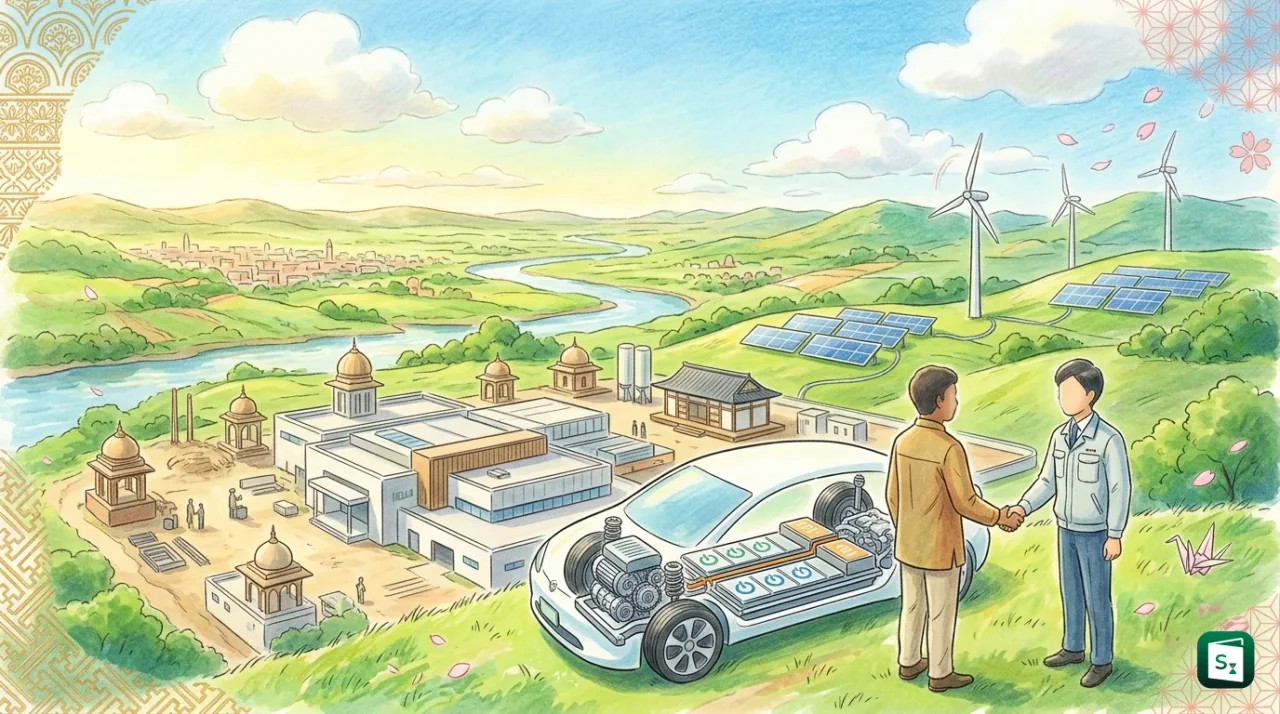
Sona BLW Precision Forgings Ltd, known as Sona Comstar, signed definitive agreements with Japan’s DENSO Corporation on July 22, 2026, to establish two joint ventures in India for developing, manufacturing, and marketing advanced electric and hybrid powertrain systems. The partnership will cover multiple vehicle segments, ranging from two-wheelers and three-wheelers to passenger cars and commercial vehicles, with India serving as the manufacturing and development hub. The deal brings together DENSO’s global leadership in electrification technology with Sona Comstar’s strong manufacturing ecosystem and deep understanding of the Indian automotive market.
Who Are the Two Companies?
Sona Comstar
Sona BLW Precision Forgings Limited, which operates under the brand name Sona Comstar, is one of India’s leading mobility technology companies. Incorporated in 1995, it began as a joint venture between the Sona Group and Mitsubishi Materials of Japan, pioneering precision-forged bevel gears in India. Over the years, the company expanded through acquisitions, including the precision forging business of ThyssenKrupp’s BLW and the motor technology company Comstar Automotive in 2019. Headquartered in Gurugram, Sona Comstar today operates 12 manufacturing and assembly facilities across India, the USA, Mexico, and China, with more than half its sales coming from international markets. It is one of the largest manufacturers of EV traction motors in India and has sold over 180,000 EV traction motors to date. The company also ventured into sensors and railway safety systems through recent acquisitions of NOVELIC and Escorts Kubota’s railway business.
DENSO Corporation
DENSO Corporation is a Japanese multinational automotive components manufacturer headquartered in Kariya, Aichi Prefecture, Japan. Founded in 1949 as Nippon Denso after spinning off from Toyota Motor Corporation, it is today the second largest auto parts supplier in the world. DENSO is a key member of the Toyota Group, with Toyota owning about 21% of the company. The company has a global footprint of 200 consolidated subsidiaries across Japan, North America, Europe, Asia, and other regions. Its product portfolio spans powertrain control systems, thermal systems, electronic systems, electrification systems, and electric motors. DENSO has been aggressively expanding its electrification business and operates an Electrification Innovation Center in Anjo, Japan, dedicated to developing products and technologies for electric and hybrid vehicles.
Structure of the Two Joint Ventures
The partnership has been structured as two separate joint ventures, each targeting a different vehicle segment and with a distinct ownership pattern.
JV for Four-Wheelers and Commercial Vehicles
The first joint venture will focus on high-voltage, liquid-cooled traction inverters, traction motors, and generators for electric and hybrid passenger vehicles, commercial vehicles, and other high-voltage applications. The two companies have entered into a Joint Development Agreement (JDA) to co-develop these products, and a separate manufacturing joint venture will be established in India to commercialise them.
In this venture, DENSO will hold a 51% equity stake and assume management control, while Sona Comstar will hold the remaining 49% and contribute its engineering capabilities, manufacturing expertise, and supply chain ecosystem. Both companies will license intellectual property and know-how to this majority-owned joint venture in return for royalty payments.
JV for Two-Wheelers and Three-Wheelers
The second joint venture targets the fast-growing electric two-wheeler and three-wheeler market. As part of this arrangement, Sona Comstar will transfer its existing electric traction motor and controller business for two-wheelers and three-wheelers into its wholly owned subsidiary through a slump sale. A slump sale is the transfer of an entire business unit as a going concern, without assigning individual values to each asset.
Following this transfer, DENSO, directly or through its affiliates, will acquire a 49% equity stake in the entity at an enterprise value of ₹1,750 crore. In this venture, Sona Comstar will retain a 51% stake and management control, the reverse of the first JV’s ownership structure. This joint venture will manufacture and develop air-cooled traction inverters, traction motors and generators, and e-Axles for electric and hybrid two-wheelers and three-wheelers.
Products and Technology Focus
The JVs will develop a range of critical electric and hybrid powertrain components.
A traction motor is the electric motor that drives the wheels of an electric vehicle, converting electrical energy from the battery into mechanical motion. An inverter converts direct current (DC) from the battery into alternating current (AC) to power the traction motor. Liquid-cooled systems use coolant fluid to manage heat in high-voltage applications, while air-cooled systems use airflow, making them more cost-effective for smaller vehicles like two-wheelers. The e-Axle integrates the motor, inverter, and gearbox into a single compact unit that directly drives the wheels, saving space and improving efficiency.
| Product Category | JV 1 (Four-wheelers and CVs) | JV 2 (Two-wheelers and Three-wheelers) |
|---|---|---|
| Cooling Type | Liquid-cooled | Air-cooled |
| Components | Traction inverters, motors, generators | Traction inverters, motors, generators, e-Axles |
| Voltage Level | High-voltage | Standard voltage |
| Primary Markets | Passenger cars, commercial vehicles | Two-wheelers, three-wheelers |
Significance for India’s EV Ecosystem
This partnership comes at a critical time for India’s electric mobility transition. The government’s PM E-DRIVE scheme, with an outlay of ₹10,900 crore, aims to accelerate EV adoption across segments. The Production Linked Incentive (PLI) scheme for automotive and advanced chemistry cell manufacturing is incentivising domestic production of EV components and batteries. India has set a target of achieving 30% electric vehicle penetration by 2030.
Sona Comstar already derives 33% of its automotive product revenues from the EV market, and this partnership is expected to significantly expand its portfolio and customer base. For DENSO, the JVs provide a strategic manufacturing base in India, one of the fastest-growing automotive markets in the world, where diverse forms of mobility from two-wheelers to heavy commercial vehicles coexist and electrification is scaling rapidly.
The combined strengths of the two companies create a vertically integrated powertrain supplier that can serve both domestic original equipment manufacturers (OEMs) and global markets from Indian manufacturing hubs, aligning with the government’s Atmanirbhar Bharat vision for self-reliance in strategic manufacturing.
Key Takeaways
- Sona BLW Precision Forgings Ltd (Sona Comstar) signed definitive agreements with DENSO Corporation of Japan on July 22, 2026, to establish two joint ventures in India.
- The first JV focuses on liquid-cooled traction inverters, motors, and generators for four-wheelers and commercial vehicles, with DENSO holding 51% stake and management control.
- The second JV targets air-cooled traction inverters, motors, generators, and e-Axles for two-wheelers and three-wheelers, with Sona Comstar holding 51% stake and management control.
- DENSO will acquire a 49% equity stake in the two-wheeler and three-wheeler JV at an enterprise value of ₹1,750 crore.
- DENSO Corporation, headquartered in Kariya, Japan, was founded in 1949 and is the second largest auto parts supplier in the world, belonging to the Toyota Group.
- The partnership supports India’s 30% EV penetration target by 2030 and aligns with the government’s PLI scheme and PM E-DRIVE scheme for electric mobility.