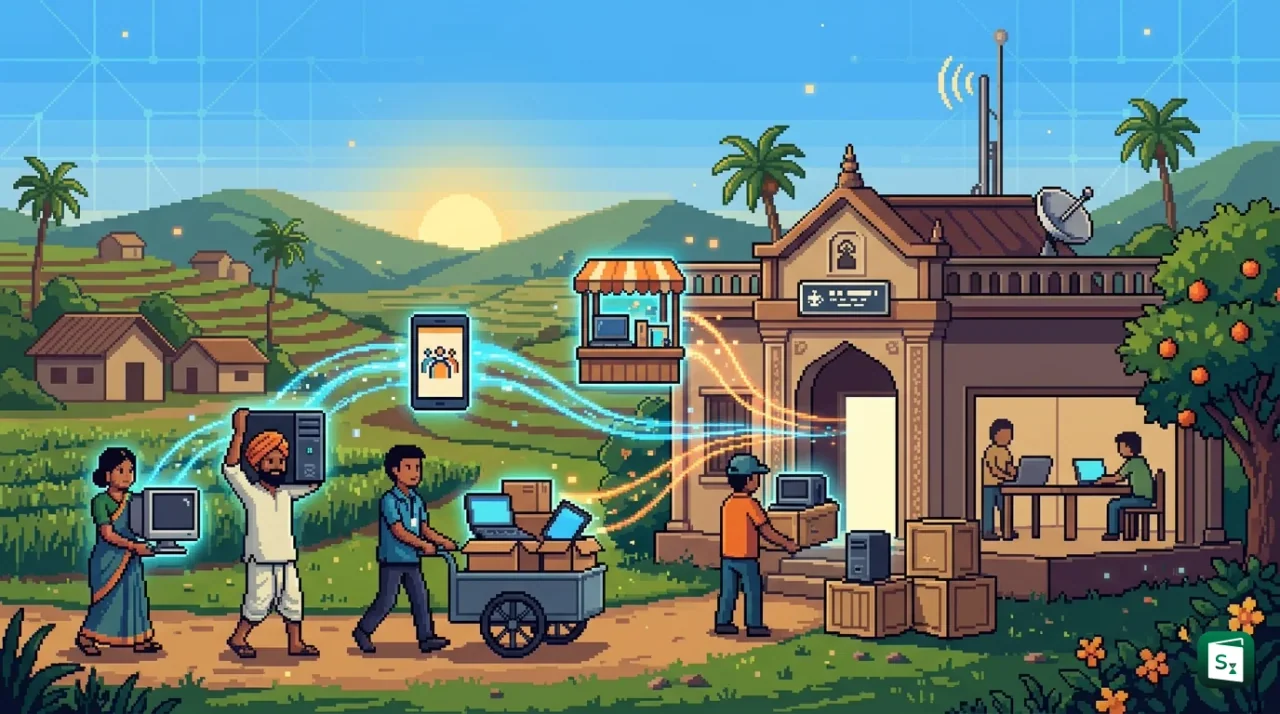
The Ministry of Panchayati Raj (MoPR) launched the DAANVEER initiative on July 29, 2026 in New Delhi, creating a structured platform for citizens, Non-Resident Indians, and organizations to donate computer hardware to nearly 2.5 lakh Gram Panchayats across India. The initiative integrates the Meri Panchayat mobile application with the DigiHaat marketplace, allowing donors to select pre-approved computer bundles and track their contributions from dispatch to installation. DAANVEER builds on India’s tradition of voluntary community contribution while introducing a transparent, end-to-end digital framework to bridge the digital infrastructure gap at the grassroots level.
What Is the DAANVEER Initiative?
DAANVEER is a citizen participation framework designed by the Ministry of Panchayati Raj to address the shortage of computers and digital devices in India’s rural local bodies. With nearly 2.5 lakh Gram Panchayats serving as the bedrock of grassroots democracy, the lack of adequate hardware has been a persistent barrier to efficient service delivery, record-keeping, and transparency. The initiative transforms voluntary contribution from an informal, trust-based act into an institutionalised, verifiable, and technology-driven process.
The initiative was launched by Shri Vivek Bharadwaj, Secretary of the Ministry of Panchayati Raj, who described it as a step towards realising the vision of Viksit Bharat. Developed in collaboration with the National Informatics Centre (NIC) and DigiHaat, DAANVEER provides a credible mechanism for citizens across the globe to contribute to the development of their native villages. The tagline “Give Back to Your Village” captures its core spirit of reconnecting the Indian diaspora and urban residents with their rural roots.
DAANVEER is entirely voluntary. It is designed not merely as a one-time donation drive but as a long-term, citizen-powered ecosystem for strengthening local institutions. State officials from Andhra Pradesh and Maharashtra, who participated in the launch, reported that several philanthropists in their states had already expressed interest in donating computers through the platform.
How DAANVEER Works: Meri Panchayat and DigiHaat
The entire DAANVEER process is managed through two integrated digital platforms.
The Meri Panchayat App, an official mobile governance platform developed by the NIC, serves as the entry point for donors. Available on Android, the app already empowers over 25 lakh elected representatives and nearly 95 crore rural residents across 2.65 lakh Gram Panchayats. It provides real-time access to Panchayat budgets, receipts, payments, development plans, and details of elected representatives. With the DAANVEER integration, the app now includes a dedicated contribution module where donors can view the list of eligible Gram Panchayats, select their preferred village, and initiate a donation.
The DigiHaat Marketplace is integrated within the app to provide a curated selection of pre-approved computer bundles that are mapped to state-specific technical specifications. Instead of donating an arbitrary device, donors choose from standardised bundles that meet the hardware requirements of the receiving Panchayat. Delivery details are automatically populated based on the selected Gram Panchayat, eliminating the need for separate paperwork.
Once a donation is made, the platform provides end-to-end tracking from dispatch to installation at the destination Gram Panchayat. Donors receive a digital certificate of appreciation in recognition of their contribution. This tracking mechanism ensures accountability and builds trust, addressing a key concern that has historically limited voluntary contributions to public institutions.
The Digital Governance Ecosystem of Panchayati Raj
DAANVEER is not an isolated initiative. It is the latest addition to a comprehensive digital governance ecosystem that the Ministry of Panchayati Raj has built over the past several years under the e-Panchayat Mission Mode Project (MMP) and the broader Digital India programme.
| Platform | Purpose | Year Launched |
|---|---|---|
| eGramSwaraj | Integrated online planning, budgeting, accounting, and monitoring for Panchayats | 2020 |
| Meri Panchayat App | Citizen-facing mobile app for accessing Panchayat data and services | 2021 |
| Gram Manchitra | GIS-based geo-spatial planning tool for Gram Panchayat Development Plans | 2022 |
| SabhaSaar | AI-powered tool that automates meeting minutes from Gram Sabha audio/video | 2025 |
| Panchayat NIRNAY | Real-time monitoring and recording of Gram Sabha meeting decisions | 2024 |
| AuditOnline | Online auditing platform for Panchayat accounts | Ongoing |
| DAANVEER | Citizen contribution platform for hardware and digital infrastructure | 2026 |
The eGramSwaraj portal, launched in April 2020, serves as the digital backbone of Panchayati Raj. It is a work-based web application that brings together decentralised planning, budgeting, accounting, monitoring, progress reporting, and asset management on a single platform. As of 2025, more than 2.54 lakh Gram Panchayats had uploaded their Gram Panchayat Development Plans on the portal, and 2.41 lakh Gram Panchayats had completed online transactions for 15th Finance Commission grants.
SabhaSaar, launched in August 2025, is an AI-powered meeting summariser linked with Bhashini, the National Language Translation Mission, enabling it to work in 14 Indian languages. Gram Manchitra provides a GIS application where Panchayat officials can visualise developmental works across sectors and align them with the Gram Panchayat Development Plan, enabling data-driven planning at the grassroots level.
Constitutional and Policy Context
Panchayati Raj Institutions (PRIs) are the third tier of India’s federal democratic structure. They were given constitutional status through the 73rd Constitutional Amendment Act, 1992, which added Part IX (Articles 243 to 243O) to the Constitution. The amendment came into effect on April 24, 1993, a day now observed as National Panchayati Raj Day. It established a three-tier system of Panchayats at the village, intermediate, and district levels, with mandatory elections every five years and reserved seats for Scheduled Castes, Scheduled Tribes, and women.
The Ministry of Panchayati Raj (MoPR) was created in May 2004 to oversee the implementation of these constitutional provisions and to strengthen grassroots democracy. It operates under the provisions of the Constitution (73rd Amendment) Act and coordinates with state governments on Panchayat-related matters. MoPR’s digital initiatives, including the e-Panchayat MMP, fall under the larger umbrella of the Digital India programme, launched in 2015 to transform India into a digitally empowered society.
The National Informatics Centre (NIC), established in 1976, is the technology partner for many of MoPR’s digital platforms. NIC operates under the Ministry of Electronics and Information Technology (MeitY) and has been instrumental in developing and maintaining the eGramSwaraj portal, Meri Panchayat App, and now the DAANVEER platform.
Significance of DAANVEER
DAANVEER addresses a critical gap in India’s rural digital infrastructure. While BharatNet has connected over 13 lakh Fibre to the Home (FTTH) connections across Gram Panchayats and mobile internet covers over 6.26 lakh villages, hardware availability has not kept pace. Computers remain scarce in many Panchayat offices, forcing staff to maintain records manually, delaying service delivery, and limiting the effectiveness of digital platforms already deployed.
The initiative also provides a structured channel for the Indian diaspora to contribute directly to village development. The Ministry of External Affairs estimates the Indian diaspora at over 3.2 crore people worldwide. DAANVEER gives them a verified, transparent mechanism to donate to their native Gram Panchayats, strengthening their emotional and developmental ties to India.
From a governance perspective, DAANVEER supports the principle of subsidiarity where resources and decision-making are pushed to the lowest effective level. A computer-equipped Gram Panchayat can issue caste certificates, income certificates, and domicile certificates faster; maintain accurate birth and death records; and enable real-time monitoring of centrally sponsored schemes such as MGNREGA, PM Awas Yojana, and National Social Assistance Programme.
The initiative aligns with the broader vision of Viksit Bharat@2047, which envisions India as a developed nation by 2047. Digital inclusion at the village level is a prerequisite for achieving this vision, as over 65% of India’s population lives in rural areas.
Key Takeaways
- The DAANVEER initiative was launched on July 29, 2026 by the Ministry of Panchayati Raj (MoPR) to upgrade digital infrastructure across India’s Gram Panchayats.
- DAANVEER enables citizens, NRIs, and organisations to donate computer hardware to nearly 2.5 lakh Gram Panchayats through the Meri Panchayat App and DigiHaat Marketplace.
- The initiative was developed in collaboration with the National Informatics Centre (NIC) and DigiHaat.
- Panchayati Raj Institutions were given constitutional status through the 73rd Constitutional Amendment Act, 1992, which added Part IX (Articles 243 to 243O) to the Constitution.
- MoPR’s digital ecosystem includes platforms such as eGramSwaraj, Gram Manchitra, SabhaSaar, and Panchayat NIRNAY, all under the e-Panchayat Mission Mode Project and the Digital India programme.
- SabhaSaar is an AI-powered meeting summariser linked with Bhashini, supporting 14 Indian languages.