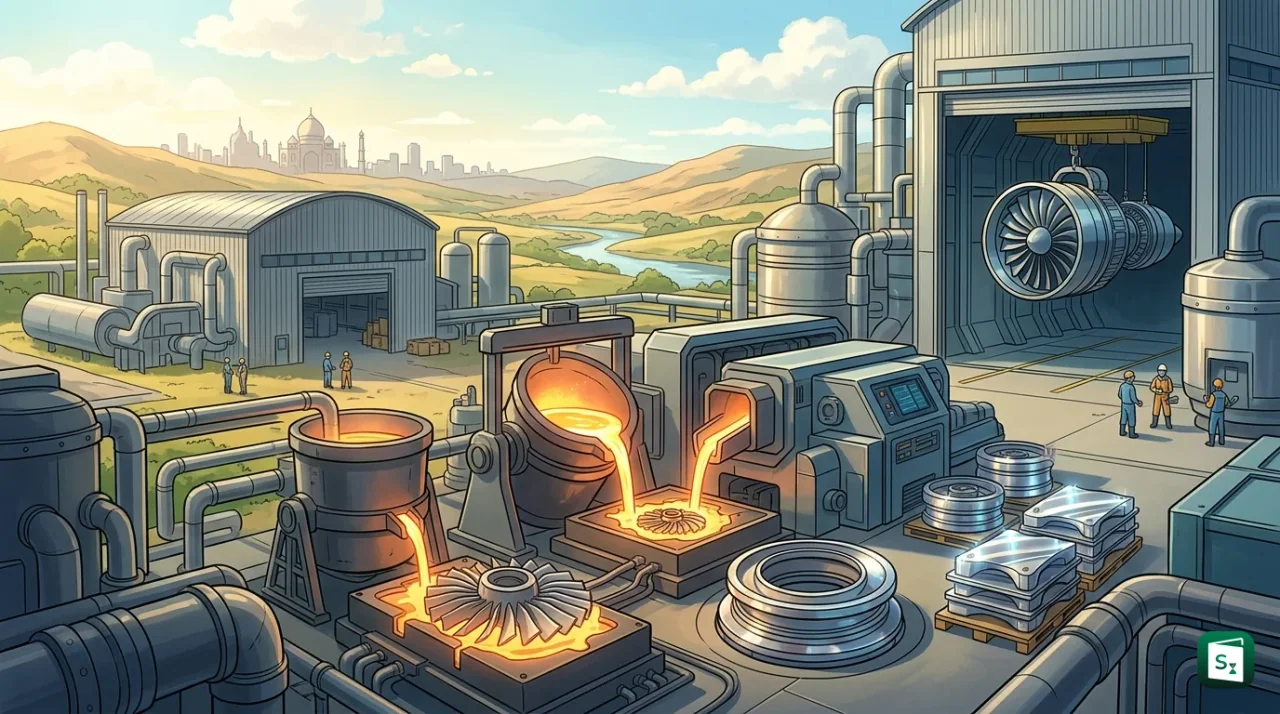
Raghu Vamsi Aerospace Group announced plans to set up an integrated nickel-based superalloy manufacturing facility in Telangana with an investment of over ₹600 crore. The plant, to be built on a 50-acre site near Hyderabad, will have an annual production capacity of 5,000 tonnes and will produce round bars, wires, forgings, castings, and tungsten carbide powders for aerospace and defence applications. The announcement was made on the opening day of the Farnborough International Airshow 2026, one of the world’s largest aerospace and defence exhibitions, held in the United Kingdom.
What Are Nickel-Based Superalloys?
Nickel-based superalloys are a class of advanced materials engineered to withstand extreme temperatures, high mechanical stress, and corrosive environments. They retain their strength and structural integrity even at temperatures exceeding 1,000 degrees Celsius, making them indispensable for components that operate in the hottest sections of jet engines, gas turbines, and rocket motors.
These alloys are primarily composed of nickel, combined with elements such as chromium, cobalt, aluminium, titanium, and molybdenum. Common commercial grades include Inconel, Hastelloy, and Waspaloy. In a jet engine, for instance, turbine blades and combustion chamber liners are made from these alloys because they must endure continuous exposure to superheated gases while rotating at tens of thousands of revolutions per minute.
Beyond aerospace, nickel-based superalloys are used in nuclear reactor components, oil and gas drilling equipment, medical implants, and emerging hydrogen energy systems. Their manufacture requires specialised processes such as vacuum induction melting, vacuum arc remelting, and powder metallurgy, which ensure the alloy is free of impurities that could cause failure in critical applications.
Why the Superalloy Facility Matters for India
India currently imports a large share of its nickel-based superalloy requirements, creating a strategic vulnerability in its aerospace and defence supply chain. The new facility will address this gap by establishing one of the country’s few fully integrated superalloy manufacturing plants, combining vacuum melting, forging, heat treatment, vacuum casting, powder metallurgy, and other advanced forming processes under a single roof.
The project will be led by Dr S. K. Jha, former Chairman and Managing Director of Mishra Dhatu Nigam Limited (MIDHANI), the public sector undertaking that has been India’s flagship producer of special steels, superalloys, and titanium alloys since its establishment in 1973. MIDHANI, which operates under the Department of Defence Production, Ministry of Defence, is headquartered in Hyderabad. Dr Jha brings decades of expertise in speciality metallurgy to the venture.
Commercial production at the facility is targeted to begin in January 2028. The company has reported that it has already received customer support for product and process qualification ahead of commercial production. The facility will serve the company’s own vertical integration needs while also supplying the broader Indian aerospace and defence ecosystem, including maintenance, repair, and overhaul (MRO) operations.
The Adibatla Aerospace Cluster: A Strategic Location
The facility will be located near Adibatla, a rapidly growing aerospace and defence manufacturing cluster on the outskirts of Hyderabad. This location is no coincidence. Telangana has emerged as one of India’s premier aerospace hubs, anchored by the presence of MIDHANI, the Defence Research and Development Organisation (DRDO) laboratories, and the Adani Aerospace Park. The Hyderabad Aerospace Park, spread over 1,000 acres, hosts global and domestic firms involved in aircraft component manufacturing, avionics, and MRO services.
The region also benefits from proximity to the Rajiv Gandhi International Airport, a dedicated air cargo complex, and a skilled workforce drawn from the city’s strong engineering and research institution base. Telangana’s policy on aerospace and defence manufacturing offers incentives that have attracted investments from companies such as Boeing, Lockheed Martin, and Safran. Over 1,000 MSMEs in precision engineering operate in and around Hyderabad, many of them nurtured by decades of working with defence public sector units.
Raghu Vamsi Aerospace: From Machine Shop to Global Player
The company behind this investment has a story that mirrors India’s own rise in aerospace manufacturing. Raghu Vamsi was founded in 1992 by G. Thrimurthulu, who started in power transmission and precision engineering. After his sudden passing in 2004, his son Vamsi Vikas Ganesula, then just 22 years old, took over the business with only ten employees. Today, the group employs over 1,200 people across ten manufacturing facilities in India, the United Kingdom, and the United States.
Raghu Vamsi has grown into a Tier-1 supplier to virtually all major global aero engine manufacturers, including GE Aerospace, Pratt and Whitney, Rolls-Royce, Honeywell, and Safran. The company manufactures complex aero engine components such as fuel nozzles, sheet metal assemblies, and high-pressure turbine parts. It has also diversified into aerospace fasteners, gears, composites, electronics, and autonomous systems.
The group has been growing at a CAGR of over 35% in recent years and posted annual revenues exceeding ₹500 crore, with about 85% coming from exports to the United States and Europe. Through strategic acquisitions and joint ventures, including the acquisition of WMT USA in 2019 and the UK-based PMC Group, Raghu Vamsi has built a truly global manufacturing footprint. Its R&D division, Arrobot, is developing indigenous micro turbojet engines, jet-powered UAVs, and other deep-technology products for the Indian Armed Forces.
India’s Growing Self-Reliance in Aerospace Materials
The superalloy facility fits into a larger government push for self-reliance in defence and aerospace manufacturing. Under the Atmanirbhar Bharat initiative, India has raised the FDI limit in defence production from 49% to 74% and introduced several production-linked incentive (PLI) schemes for aerospace and defence manufacturing. Defence production in India has risen from approximately ₹46,000 crore in 2013-14 to nearly ₹1.5 lakh crore in 2025-26.
India currently imports a significant portion of its strategic specialty alloys, including nickel-based superalloys, electric steels, and titanium alloys used in defence and aerospace. These imports come with long lead times and minimum order quantities that constrain domestic manufacturing. A domestic superalloy plant of this scale will directly address these supply chain bottlenecks.
The facility’s location in Telangana, near MIDHANI’s existing operations, also creates the potential for a concentrated speciality metals manufacturing ecosystem in the region. With MIDHANI already producing superalloys for Indian space and defence programmes, including the Gaganyaan, Aditya-L1, and Chandrayaan-3 missions, the addition of private sector capacity from Raghu Vamsi could significantly expand India’s total output of these critical materials.
Key Takeaways
- Raghu Vamsi Aerospace Group will invest over ₹600 crore to set up an integrated nickel-based superalloy manufacturing facility on a 50-acre site in Telangana.
- The plant will have an annual production capacity of 5,000 tonnes and is expected to start commercial production in January 2028.
- The facility will be led by Dr S. K. Jha, former CMD of Mishra Dhatu Nigam Limited (MIDHANI), a PSU established in 1973 under the Department of Defence Production.
- Nickel-based superalloys are used in aero engines, space systems, defence platforms, gas turbines, nuclear energy, medical implants, and hydrogen technologies.
- India currently imports a significant share of its nickel alloy requirements, making this facility strategically important for the Atmanirbhar Bharat initiative in defence and aerospace.
- The announcement was made at the Farnborough International Airshow 2026, a leading global aerospace and defence exhibition held in the UK.