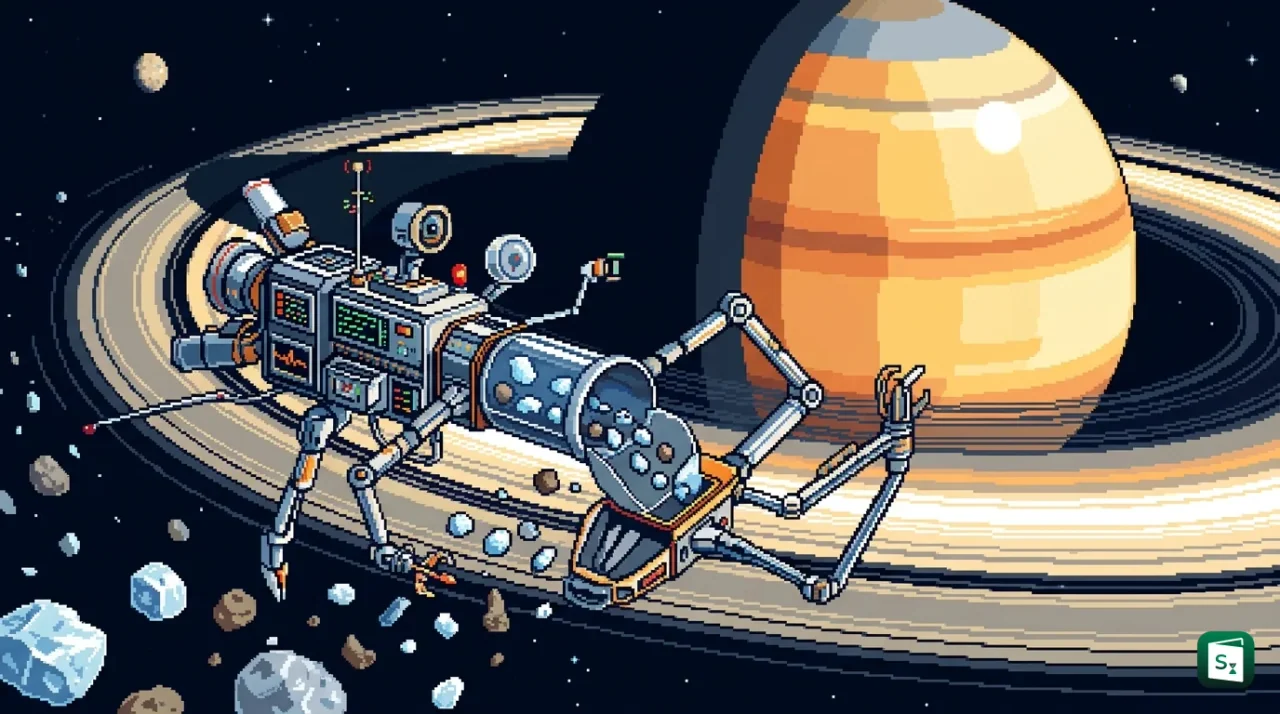
NASA has selected a bold new mission concept called PRAXIS (Planetary Rings Autonomous EXploration with In-situ Sampling) for funding under the NIAC 2026 Phase I program. Led by Dr. B Marco Quadrelli of NASA’s Jet Propulsion Laboratory, the project envisions an AI-driven robotic explorer that would fly to Saturn and, for the first time in history, directly collect and analyse particles from the planet’s iconic rings. If realised, PRAXIS could unlock answers to fundamental questions about how planetary rings form, evolve, and behave.
What Is the PRAXIS Mission?
PRAXIS stands for Planetary Rings Autonomous EXploration with In-situ Sampling. It is an early-stage mission concept that aims to send a spacecraft to Saturn’s rings to collect and analyse millimetre to centimetre-sized ring particles directly. No spacecraft has ever touched or sampled a planetary ring. Even NASA’s Cassini mission, which orbited Saturn from 2004 to 2017 and made groundbreaking discoveries, could only observe the rings from a distance or through remote sensing instruments. It never captured a physical sample.
The project is led by Dr. B Marco Quadrelli at NASA’s Jet Propulsion Laboratory (JPL) in Pasadena, California. JPL is a federally funded research and development centre managed by the California Institute of Technology for NASA.
PRAXIS has been selected under Phase I of the NIAC 2026 program. Phase I awards provide up to $175,000 for a nine-month initial study to explore the overall feasibility and viability of the concept. A total of 18 Phase I awards worth $3.2 million were announced by NASA for 2026.
Why Sampling Saturn’s Rings Matters
Saturn’s rings are among the most spectacular features in the solar system, but scientists still do not fully understand how they formed or how they evolve. The rings stretch over 2,80,000 kilometres in diameter but are remarkably thin, often less than 100 metres thick in many places. They are composed almost entirely of water ice (about 95 percent), with the remaining 5 percent made of silicates and organic material that gives them a faint reddish tint.
The particles range in size from micron-scale dust grains to house-sized boulders several metres across. They are in constant motion, colliding, breaking apart, and clumping together under their own gravity. This creates fascinating structures that Cassini revealed, including self-gravity wakes, density waves, and propeller-shaped features embedded within the rings.
The Planetary Science and Astrobiology Decadal Survey 2023-2032, a once-in-a-decade roadmap that sets science priorities for NASA, identified direct observation of mm to cm-scale ring particles as a key priority. Cassini lacked the capability to image or sample these mid-sized particles, which are critical to understanding the microphysical interactions that govern ring behaviour. PRAXIS directly addresses this gap.
How PRAXIS Plans to Collect Ring Particles
The PRAXIS concept draws on the earlier Saturn Ring Observer (SRO) Mission Study, which explored the idea of a spacecraft grazing the rings and hovering above them to image particles in motion. PRAXIS goes a step further by adding a touch-and-go sampling capability using a long, soft, deployable boom.
The mission would work in three phases. First, the spacecraft would conduct an imaging and characterisation phase from a safe distance, identifying a suitable ring particle to target. Second, it would deploy its long boom to perform a touch-and-go sampling event, gently contacting the particle’s surface to collect material. Third, after the sample is retrieved, the spacecraft would move to another section or gap of the rings to sample multiple diverse regions over the mission’s lifetime.
Because the ring particles are constantly moving and colliding, the spacecraft itself must stay away to avoid catastrophic collision. This is where AI-driven autonomy becomes essential. The system uses advanced artificial intelligence to navigate in real time, identify safe sampling targets, avoid debris, and execute precision manoeuvres without waiting for commands from Earth, which would take over an hour to arrive at Saturn’s distance.
The sampling mechanism is inspired by sport casting techniques, adapted to capture free-floating particles in a microgravity environment. The collected material would be analysed using miniaturised onboard instruments that measure particle size, porosity, and composition in real time.
What Is the NIAC Program?
The NASA Innovative Advanced Concepts (NIAC) program nurtures visionary ideas that could transform future NASA missions. It was originally established in 1998 as the NASA Institute for Advanced Concepts and was managed by the Universities Space Research Association. The program was closed in 2007 but revived in 2011 under its current name, now operating under NASA’s Space Technology Mission Directorate (STMD).
NIAC follows a three-phase structure. Phase I awards up to $175,000 for a nine-month feasibility study. Concepts that show promise can apply for Phase II, which provides up to $750,000 for two years of further development. A select few advance to Phase III, which offers up to $2 million for maturation and potential infusion into NASA missions.
PRAXIS builds its feasibility on the earlier Saturn Ring Observer (SRO) mission study, which had already demonstrated that an orbit grazing the rings is technically possible. The versatility of the PRAXIS system also makes it potentially valuable for future missions to other ring systems, including those of Uranus and Neptune, and it could be infused into the upcoming Uranus Probe mission recommended by the decadal survey.
Key Takeaways
- PRAXIS (Planetary Rings Autonomous EXploration with In-situ Sampling) is a NASA mission concept selected under the NIAC 2026 Phase I program for direct sampling of Saturn’s ring particles.
- The mission is led by Dr. B Marco Quadrelli at NASA’s Jet Propulsion Laboratory (JPL).
- It aims to collect and analyse millimetre to centimetre-sized ring particles, a capability that the Cassini mission did not have.
- The PRAXIS spacecraft would use a long deployable boom for touch-and-go sampling and AI-driven autonomy for real-time navigation and collision avoidance.
- The NIAC program was originally established in 1998, closed in 2007, revived in 2011, and now operates under NASA’s Space Technology Mission Directorate (STMD).
- NIAC Phase I awards provide up to $175,000 for a nine-month feasibility study, with a total of $3.2 million awarded across 18 concepts in 2026.