Welcome to Scoreclever ⏳ Current Affairs 🌏

  • 👉 Detailed daily current affairs on website
  • 👉 Crisp current affairs on daily PDFs
  • 👉 Easy memorization and revision with app

Recent Current Affairs related to NASA

14 News
3 September 2026 SCIENCE

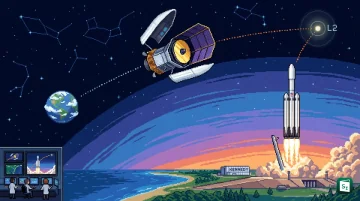
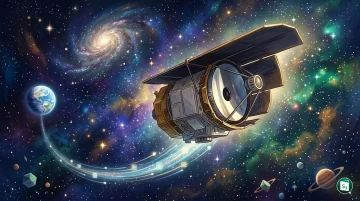
The NASA has successfully launched the “Nancy Grace Roman Space Telescope” onboard the SpaceX Falcon Heavy rocket from the Kennedy Space Center in Florida, USA. The project was developed at a cost of $4.3 billion.

The telescope is destined for the Lagrange Point 2 (L2) and has a primary lifespan of 5 years. It is to be noted that the telescope is named after Nancy Grace Roman, the first Chief of Astronomy of the NASA and the “Mother of Hubble”, making it the first NASA telescope named after a woman.

27 August 2026 SCIENCE

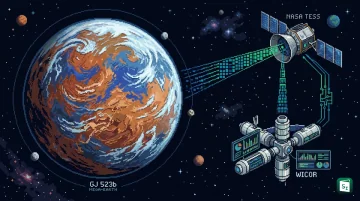
Astronomers have discovered a 170 million-year-old giant exoplanet named “GJ 523b” (informally called “mega-Earth”).

The planet, having a mass 23 times that of Earth, is over 2.5 times larger in size.

It was initially detected by the NASA Transiting Exoplanet Survey Satellite (TESS).

It is to be noted that its existence was confirmed by Max Krof from the Wisconsin Center for Origins Research (WiCOR).

12 August 2026 SCIENCE

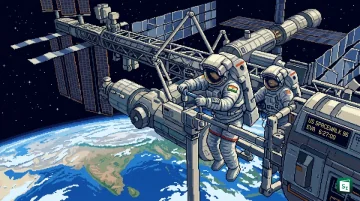
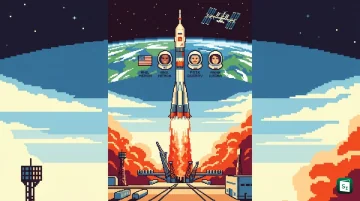
Anil Menon, an Indian-origin astronaut of the NASA, has successfully completed his inaugural spacewalk, designated as “US Spacewalk 96”, outside the International Space Station (ISS).

The Extravehicular Activity (EVA) lasted for 6 hours and 27 minutes, and was conducted alongside veteran NASA astronaut Jessica Meir. With this achievement, Menon joins Sunita Williams and Raja Chari in the group of Indian-origin astronauts who have performed spacewalks.

3 August 2026 SCIENCE

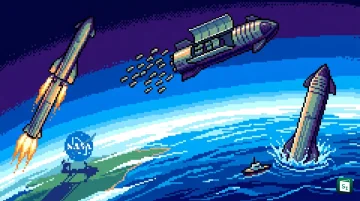
SpaceX has successfully completed the 13th integrated test flight of its Starship launch system from Starbase, Texas, USA. The mission, marking the second test flight of Starship Version 3 (V3), involved the first-ever deployment of 20 next-generation Starlink V3 satellites.

The launch system concluded the flight with a controlled splashdown in the Indian Ocean. It is to be noted that the NASA monitored the mission to evaluate its suitability for future 'Artemis' lunar missions.

31 July 2026 SCIENCE

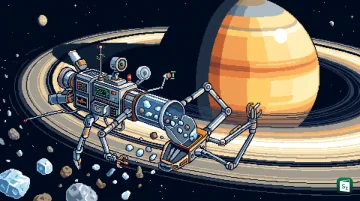
Researchers from the NASA have proposed an AI mission concept named "Planetary Rings Autonomous EXploration with In-situ Sampling (PRAXIS)". It has been proposed under Phase I of the NASA Innovative Advanced Concepts (NIAC) 2026 program.

The mission aims to enable the first-ever direct collection and analysis of particles from Saturn's rings. It is designed to deliver direct observations of millimetre- to centimetre-sized ring particles, addressing a key priority identified in planetary science decadal surveys. The project is led by Dr. B Marco Quadrelli.

24 July 2026 SCIENCE

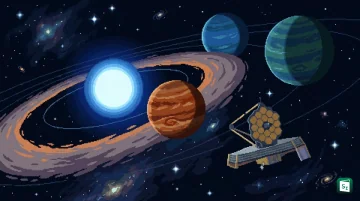
Astronomers using the James Webb Space Telescope (JWST) of NASA have discovered a new giant exoplanet named 'Beta Pictoris d'. Located 63 light-years from the Earth, the planet is estimated to be 23 million years old.

With a mass of at least 2 times that of Jupiter, it is the smallest among the 3 known giant planets in the Beta Pictoris system. It is to be noted that this makes the Beta Pictoris system the second known planetary system to feature at least 3 directly imaged planets.

15 June 2026 SCIENCE

The National Aeronautics and Space Administration (NASA) has announced the 4-member crew for the Artemis III mission, which is scheduled for a Low-Earth Orbit (LEO) mission in late 2027. The crew comprises Randy Bresnik (Commander), Andre Douglas, and Frank Rubio from the USA, alongside Luca Parmitano from the European Space Agency (ESA).

The mission will test docking procedures between Starship of SpaceX, Blue Moon lander of Blue Origin, and Orion capsule of NASA, launched by the Space Launch System (SLS). This mission aims to demonstrate operational readiness for future human lunar landings and planned lunar operations.

3 June 2026 SCIENCE

An international team of researchers led by Dr. Ronaldo Laishram from the National Astronomical Observatory of Japan (NAOJ) has discovered an ancient cosmic structure named the “Loktak Protocluster”.

Located 12.6 billion light-years away in the constellation Sextans, the structure allows astronomers to observe the universe as it existed when it was only 1.2 billion years old (9% of its current age).

It is named after Loktak Lake in Manipur, the largest freshwater lake in Northeast India, famous for its “phumdis” (floating masses of vegetation). The discovery was made by integrating data from the Japan-based Subaru Telescope and the James Webb Space Telescope (JWST) of NASA.

2 June 2026 SCIENCE

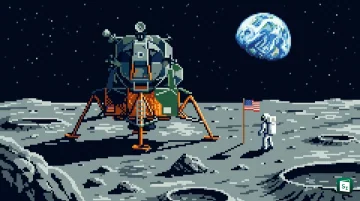
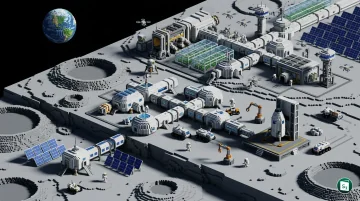
The National Aeronautics and Space Administration (NASA) has unveiled a $20 billion, 3-phased plan to establish a permanent lunar base equipped with rovers and drones.

The plan aims to set up the base by March 2027, with the objective of landing astronauts on the moon in 2028. The mission is structured into 3 phases: Moon Base-I (2026-2028), Moon Base-II (2029-2032), and Moon Base-III (2032 onwards).

1 May 2026 SCIENCE

NASA has unveiled the “Nancy Grace Roman Space Telescope”, a wide-field observatory designed to survey the universe and detect exoplanets. The telescope is named after Nancy Grace Roman, the first Chief Astronomer of NASA who is known as the ‘mother of the Hubble Space Telescope’.

It is to be noted that the project, developed over 10 years at a cost of $4 billion, will be stationed 1.5 million km from the Earth. The system is capable of transmitting 11 terabytes (TB) of data daily to the Earth.

23 April 2026 SCIENCE

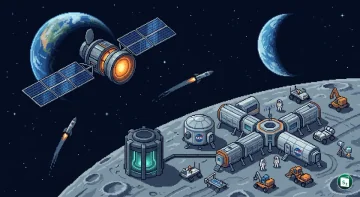
The United States has launched a strategic plan to deploy nuclear reactors in space, including an in-space reactor in Earth orbit by 2028, a fission reactor on the lunar surface by 2030, and a military version by 2031.

It is to be noted that the National Aeronautics and Space Administration (NASA) is tasked to develop a mid-power 100 kilowatts (kWe) fission reactor to support lunar habitats, providing power equivalent to 80 homes on Earth.

Explore by Topic

Topics