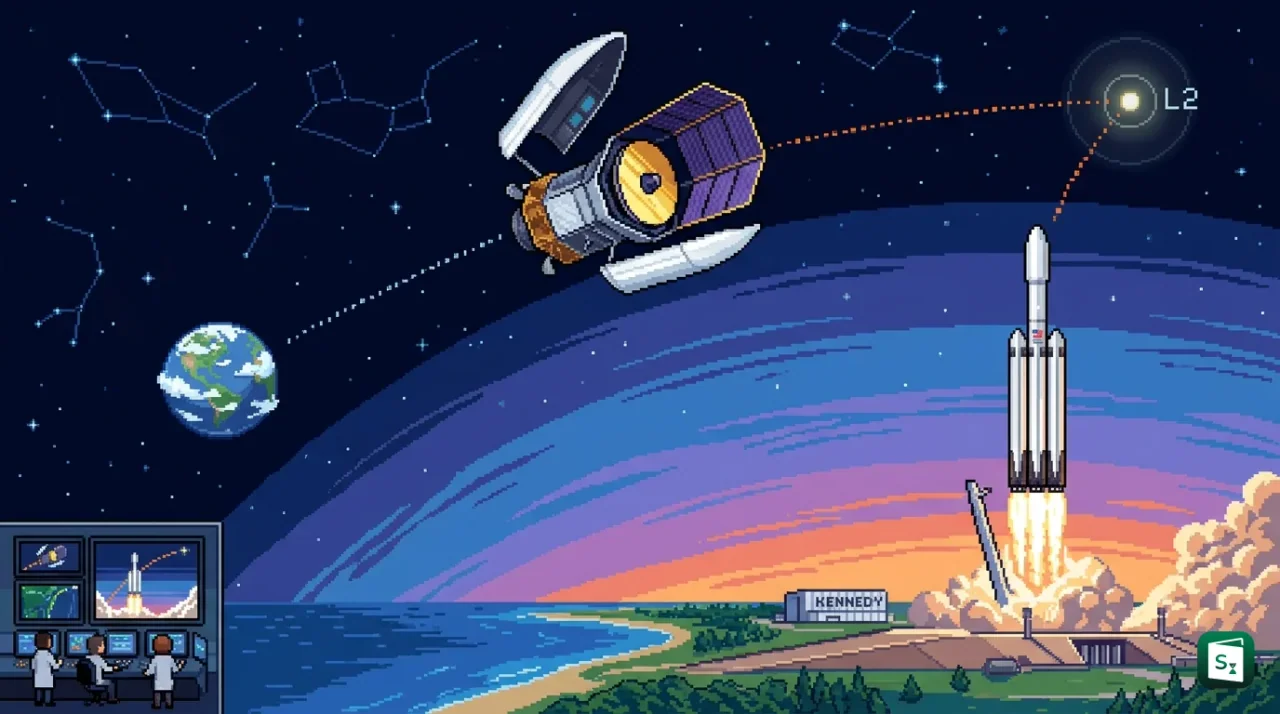
NASA’s Nancy Grace Roman Space Telescope lifted off aboard a SpaceX Falcon Heavy rocket from Launch Complex 39A at the Kennedy Space Center in Florida on August 30, 2026, at 7:26 a.m. EDT. The $4.3 billion observatory, the first NASA telescope ever named after a woman, has begun a three-month, million-mile journey to the Sun-Earth Lagrange Point 2 (L2), where it will join the James Webb Space Telescope as the agency’s newest flagship surveyor of the cosmos. Once operational, Roman will image patches of the sky 100 times larger than Hubble and survey the universe roughly 1,000 times faster, opening an unprecedented window on dark energy, dark matter, and worlds beyond our solar system.
NASA’s Nancy Grace Roman Space Telescope Lifts Off: What Happened
The Falcon Heavy’s 27 Merlin engines ignited just after sunrise on August 30, 2026, generating more than 5 million pounds of thrust as the 27-engine stack lifted the observatory off historic Pad 39A at NASA’s Kennedy Space Center in Florida. The 13th flight of SpaceX’s most powerful operational rocket placed the 18,000-pound Roman observatory into a direct trajectory toward the Sun-Earth L2 point, with the telescope separating from the rocket’s second stage 31 minutes and 31 seconds after liftoff to fly on its own.
The two reusable side boosters separated roughly two minutes after launch and returned to Cape Canaveral Space Force Station, landing on SpaceX’s Landing Zones 2 and 40. Their return marked the first and third flights for those two boosters, which had previously flown the GOES-U and Viasat-3 F3 missions. After separation, Roman’s solar panels and lower instrument sun shade successfully deployed within about 83 minutes of launch, confirming the spacecraft was healthy and power-positive as it began its cruise to deep space.
The Launch Vehicle and Trajectory
The Falcon Heavy is SpaceX’s partially reusable heavy-lift rocket, consisting of three Falcon 9-derived cores strapped together. It was only the fourth primary NASA mission launched on a Falcon Heavy, and NASA’s Launch Services Program had worked with SpaceX earlier in 2026 to accelerate the launch date so the telescope could fly nearly nine months ahead of schedule.
Ground controllers at NASA’s Goddard Space Flight Center in Greenbelt, Maryland received the first telemetry from Roman seven minutes after launch. About 70 minutes after liftoff, the Deep Space Network took over communications, first through the Canberra Deep Space Communication Complex in Australia, then the Madrid complex in Spain, and finally the Goldstone complex in California, ensuring continuous contact throughout the spacecraft’s voyage to L2.
What Is the Nancy Grace Roman Space Telescope?
The Nancy Grace Roman Space Telescope is a NASA flagship infrared observatory optimized for sweeping wide-field surveys of the universe, a capability that complements the narrower, deeper observations of the James Webb Space Telescope. The spacecraft carries a Hubble-sized 2.4-meter primary mirror (with an effective aperture of 2.36 meters) and operates across a near-infrared wavelength range of 0.5 to 2.3 micrometers, the same band as Hubble’s near-infrared camera but with a vastly wider field of view.
Roman is built around two scientific payloads. The first, the Wide Field Instrument (WFI), is a 300-megapixel near-infrared camera that captures patches of the sky more than 100 times larger than Hubble’s infrared instruments. The second, the Coronagraph Instrument, is a technology demonstration designed to directly image Jupiter-sized planets around nearby stars by suppressing the glare of their host suns. Together, these instruments make Roman equal parts survey telescope, cosmology probe, and exoplanet hunter.
From WFIRST to Roman: The Origin of the Mission
Roman was originally conceived in 2010 as the Wide Field InfraRed Survey Telescope (WFIRST), the top-ranked large space mission in the 2010 U.S. astrophysics decadal survey. In May 2020, NASA renamed the mission in honour of Nancy Grace Roman. Its mission management is led by NASA’s Goddard Space Flight Center, with participation from the Jet Propulsion Laboratory, Caltech/IPAC, the Space Telescope Science Institute, and a science team drawn from research institutions worldwide.
A distinctive feature of Roman’s hardware is its 2.4-meter primary mirror, originally fabricated for a U.S. National Reconnaissance Office spy satellite. NASA acquired the mirror and repurposed it for civilian astrophysics, dramatically lowering cost and risk. Primary industrial partners include BAE Systems Inc., L3Harris Technologies, and Teledyne Scientific & Imaging, with additional contributions from the European Space Agency (ESA), the Japan Aerospace Exploration Agency (JAXA), the French space agency CNES, and the Max Planck Institute for Astronomy in Germany.
Nancy Grace Roman: The “Mother of Hubble”
Roman is the first NASA telescope ever named after a woman. The honour goes to Dr. Nancy Grace Roman (May 16, 1925 to December 25, 2018), the American astronomer who spent two decades inside the U.S. government fighting to make the Hubble Space Telescope a reality.
Born in Nashville, Tennessee, Roman grew up as the daughter of a geophysicist and a music teacher, moving frequently across the country as her father’s career progressed. By sixth grade she had organised an astronomy club, by seventh grade she had decided to devote her life to the cosmos. She earned her bachelor’s degree in astronomy from Swarthmore College in 1946 and her doctorate from the University of Chicago in 1949, the latter on the topic of the Ursa Major Moving Group. After six years at the Yerkes Observatory, she concluded that women in mid-20th-century academia rarely received tenure and joined the radio astronomy group at the U.S. Naval Research Laboratory.
In early 1959, just six months after NASA itself was founded, Roman joined the new space agency as Head of Observational Astronomy. By 1960 she had become NASA’s first Chief of Astronomy, and ultimately held titles including Chief of Astronomy and Solar Physics and Chief of Astronomy and Relativity. She was also the first woman to hold an executive position at NASA, paving the way for generations of women in aerospace leadership.
How the Telescope Got Its Name
For nearly two decades Roman shepherded the dream of a large space telescope through Congress, scientific committees, and NASA budget battles. She led the science planning committees for what was then called the Large Space Telescope, chose charge-coupled device (CCD) detectors over older sensor technologies (a bet that became the new gold standard for astronomical imaging), and lobbied lawmakers to fund it.
When her successor, Edward J. Weiler, paid tribute to her by calling her the “Mother of the Hubble Space Telescope,” the nickname stuck. Decades later, in 2020, NASA officially honoured her legacy by naming WFIRST after her. The mission that lifted off on August 30, 2026, is, in NASA’s own words, dedicated to “the pioneer of modern space-based astronomy who made such telescopes a reality.”
Why the Mission Is a Game Changer: The Science Goals
Roman’s wide field of view and infrared sensitivity make it a fundamentally different kind of observatory from Hubble or Webb. Where Hubble produces deep but narrow portraits and Webb zooms in on small patches with extreme resolution, Roman sweeps vast swaths of the sky in a single image. By the end of its five-year primary mission, Roman is expected to catalogue roughly 20 billion stars, 2 billion or more individual galaxies, tens of thousands of supernovae, and more than 100,000 exoplanets, generating 1.4 terabytes of science data every day, the highest data rate of any NASA astrophysics mission to date.
Mapping Dark Energy and Dark Matter
Roughly 95 percent of the universe consists of dark matter and dark energy, yet neither has ever been directly detected. Roman will probe both through three primary surveys. The High Latitude Wide Area Survey will image about 2,000 square degrees to faint infrared limits, enabling weak-lensing maps that trace how dark matter clumps across cosmic time. The High Latitude Time Domain Survey will catch Type Ia supernovae, the “standard candles” used to track the accelerating expansion of the universe driven by dark energy. Together these surveys will give cosmologists the largest, deepest dataset yet assembled for testing competing models of cosmic expansion.
The Exoplanet Census via Microlensing
Roman will spend the longest stretch of its primary mission staring at the dense star fields of the Galactic Bulge Time Domain Survey, watching for tell-tale brightness flickers caused by gravitational microlensing. When a planet passes in front of a background star from our point of view, the planet’s gravity briefly magnifies the starlight, revealing worlds that would otherwise be invisible. Roman is expected to discover thousands of planets using this technique, including populations that are inaccessible to the transit method used by Kepler and TESS, such as free-floating planets and small, cool worlds orbiting far from their stars.
Direct Imaging with the Coronagraph
The Coronagraph Instrument is a technology demonstrator roughly the size of a baby grand piano, designed to block the glare of nearby stars so that the much fainter light reflected from orbiting planets becomes visible. Roman’s coronagraph is expected to detect planets that are about 100 million times fainter than their host stars and, for the first time, snap a picture of a Jupiter twin around a nearby star in visible light. If the technology performs as designed, it will pave the way for the Habitable Worlds Observatory, a future flagship capable of imaging Earth-like planets and analysing their atmospheres for biosignatures.
Built for Speed: The Observatory’s Design and Instruments
Roman’s hardware is engineered for two things above all: huge field of view and extremely stable pointing. The spacecraft carries an Outer Barrel Assembly that holds the 2.4-meter mirror, an Instrument Carrier that mounts the two science instruments, a deployable aperture cover (visor), a high-gain antenna, and an active cooling system that brings the Wide Field Instrument’s detectors down to about 89.5 Kelvin without any cryocoolers, using passive radiators instead. The whole observatory is designed to be robotically refuellable in orbit, extending its usable lifetime well beyond the baseline mission.
The Wide Field Instrument
The Wide Field Instrument is the workhorse. Its focal plane holds 18 Teledyne H4RG-10 detector arrays, each 4,096 by 4,096 pixels, totalling more than 300 megapixels. Each detector is roughly the size of a saltine cracker, and the entire focal plane delivers a field of view of about 0.281 square degrees, roughly 200 times larger than Hubble’s WFC3-IR camera and 100 times larger than Hubble’s visible-light instruments. Light from the telescope reaches the detectors through a rotating Element Wheel Assembly carrying eight imaging filters spanning 0.48 to 2.3 micrometres, plus a grism (resolving power around 460) and a prism (resolving power 80 to 180) for slitless spectroscopy across the whole field.
The WFI’s stable optics and 0.11 arcsec per pixel sampling let it cover sky 1,000 times faster than Hubble at comparable sensitivity. Over its primary mission it is expected to image more than 50 times the sky area that Hubble captured in its first 30 years, mapping the structure of the cosmos and the history of galaxy formation on a scale never before possible.
The Coronagraph Instrument
The Coronagraph Instrument is Roman’s high-contrast imager, the first such device flown in space that uses numerically optimised coronagraph masks and large-format deformable mirrors. It mounts onto the same Instrument Carrier as the WFI and uses the telescope’s optical beam to suppress starlight by factors of up to a billion to one, then re-images the residual light with electron-multiplying CCDs. The coronagraph has imaging, spectroscopy, and polarimetry modes, though only one mode is fully supported for routine science; the others are best-effort or community-use demonstrations. Together with the WFI, the coronagraph gives Roman both the wide-angle survey capability of a giant camera and the targeted high-contrast capability of a small probe.
A Three-Month Voyage to a Million Miles Away: The L2 Destination
Roman will spend roughly 100 days drifting outward from Earth before reaching its operational orbit. Its destination is the second Sun-Earth Lagrange point (L2), a gravitationally special location about 1.5 million kilometres (roughly 1 million miles) from Earth, on the opposite side of our planet from the Sun. L2 is roughly four times farther away from Earth than the Moon, and Roman will join the James Webb Space Telescope in this quiet, stable neighbourhood of deep space.
In the coming weeks after launch, Roman’s high-gain antenna and visor-like deployable aperture cover will unfurl, ground controllers will fire the first of two mid-course corrections, and the Coronagraph Instrument will be powered on. A few weeks into the cruise, the Wide Field Instrument will switch on, and the remaining months of the journey will be spent on calibration and commissioning. NASA expects to release Roman’s first science images by early 2027.
Why Lagrange Point 2?
A Lagrange point is a place where the gravitational pull of two large bodies, in this case the Sun and Earth, balances the centripetal force needed for a small object to move with them. There are five such points in the Sun-Earth system, named after the 18th-century mathematician Joseph-Louis Lagrange, who solved the so-called “three-body problem” that produced them. Three of them, L1, L2, and L3, lie along the Earth-Sun line; the other two, L4 and L5, sit at the points of equilateral triangles with the Sun and Earth.
L2 is meta-stable: a spacecraft placed there will gradually drift away unless it fires small thrusters periodically to stay in place. That is the trade-off astronomers accept, because L2 offers three huge advantages for an infrared observatory. First, the Sun, Earth, and Moon are all roughly in the same direction, so a sunshield can keep the telescope optics perpetually shaded and cold. Second, the telescope’s view of the sky is never blocked by Earth, allowing 24/7 science operations. Third, L2 keeps the observatory continuously in line-of-sight of NASA’s ground-based Deep Space Network antennas in Australia, Spain, and California, simplifying communications. Past missions at L2 include WMAP, Herschel, and Planck, and James Webb has operated there since 2022.
Roman vs. Hubble vs. Webb: How the Three Observatories Compare
Roman, Hubble, and Webb form a complementary trio of NASA flagship observatories. Hubble, launched in 1990, was the first major optical telescope in space and has produced more than 1.2 million observations and 14,000 scientific papers. Webb, launched in December 2021, focuses on extremely deep, high-resolution infrared imaging of small patches of sky. Roman slots in between them: it carries a Hubble-sized 2.4-meter mirror but pairs it with a much wider field of view than either of them, designed for statistically huge surveys rather than individual targets.
| Feature | Hubble (HST) | James Webb (JWST) | Roman |
|---|---|---|---|
| Launch Year | 1990 | 2021 | 2026 |
| Primary Mirror | 2.4 m | 6.5 m (segmented) | 2.4 m |
| Orbit | Low Earth Orbit | Sun-Earth L2 | Sun-Earth L2 |
| Wavelength Range | Ultraviolet to near-infrared | Mid-infrared optimised | Near-infrared (0.5 to 2.3 micrometres) |
| Field of View | Small (WFC3-IR about 0.0014 sq deg) | Moderate (NIRCam about 0.006 sq deg) | Large (0.281 sq deg) |
| Survey Speed | Baseline | Slower (deep imaging) | 1,000 times faster than Hubble |
| Primary Strength | Versatile imaging across bands | Ultra-deep infrared detail | Wide-area statistical surveys |
The key takeaway is that Roman is not a replacement for either of its predecessors. Hubble’s ultraviolet capability and servicing-friendly low-Earth orbit, and Webb’s sheer light-collecting power and infrared depth, remain unmatched. What Roman adds is the ability to survey enormous volumes of the sky with the sensitivity of a Hubble-class mirror, producing the kind of statistical samples that modern cosmology and exoplanet science demand.
What Comes Next
Roman’s commissioning period will last roughly three months, during which ground controllers will calibrate both instruments and validate their performance. Once science operations begin, the data torrent will be extraordinary: 1.4 terabytes per day, the highest data rate of any NASA astrophysics mission to date. To handle this firehose, NASA plans to combine machine learning, artificial intelligence tools, and crowdsourced citizen-science platforms to flag the most interesting transient events and guide follow-up observations with Hubble, Webb, and ground-based telescopes.
The mission is officially baselined at five years, with a 10-year goal if the propellant budget allows. Because Roman is robotically refuellable in orbit, an extended mission well past the 10-year mark is plausible. By the time Roman ends operations, astronomers expect it will have helped resolve two of physics’ biggest open questions, what is dark energy and what is dark matter, while simultaneously cataloguing exoplanets, supernovae, and distant galaxies in numbers that dwarf every previous survey combined. The space telescope named for the woman who fought to put the first great space telescope in orbit is, fittingly, built to expand that legacy into a new era.
Key Takeaways
- NASA launched the Nancy Grace Roman Space Telescope on August 30, 2026, at 7:26 a.m. EDT aboard a SpaceX Falcon Heavy rocket from Launch Complex 39A at the Kennedy Space Center in Florida, after a near-decade-long development costing $4.3 billion.
- It is the first NASA telescope ever named after a woman, honouring Dr. Nancy Grace Roman (1925 to 2018), NASA’s first Chief of Astronomy and the “Mother of Hubble,” who championed the original Hubble Space Telescope.
- Roman is bound for the Sun-Earth Lagrange Point 2 (L2), about 1.5 million kilometres (roughly 1 million miles) from Earth, where it will join the James Webb Space Telescope on a three-month cruise and a five-year (with a 10-year goal) science mission.
- The observatory carries a 2.4-meter primary mirror originally built for a U.S. spy satellite, paired with a 300-megapixel Wide Field Instrument with a field of view roughly 100 times larger than Hubble’s, and a Coronagraph Instrument that will directly image Jupiter-like exoplanets.
- Roman is designed to survey the universe 1,000 times faster than Hubble, sending back 1.4 terabytes of data per day, the highest data rate of any NASA astrophysics mission.
- Its three primary surveys target dark energy, dark matter, and the exoplanet census, with projected totals of about 2 billion galaxies, 20 billion stars, tens of thousands of supernovae, and more than 100,000 exoplanets catalogued by mission’s end.