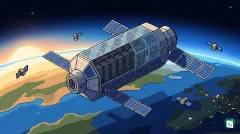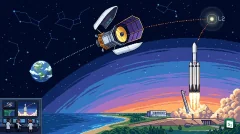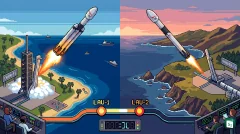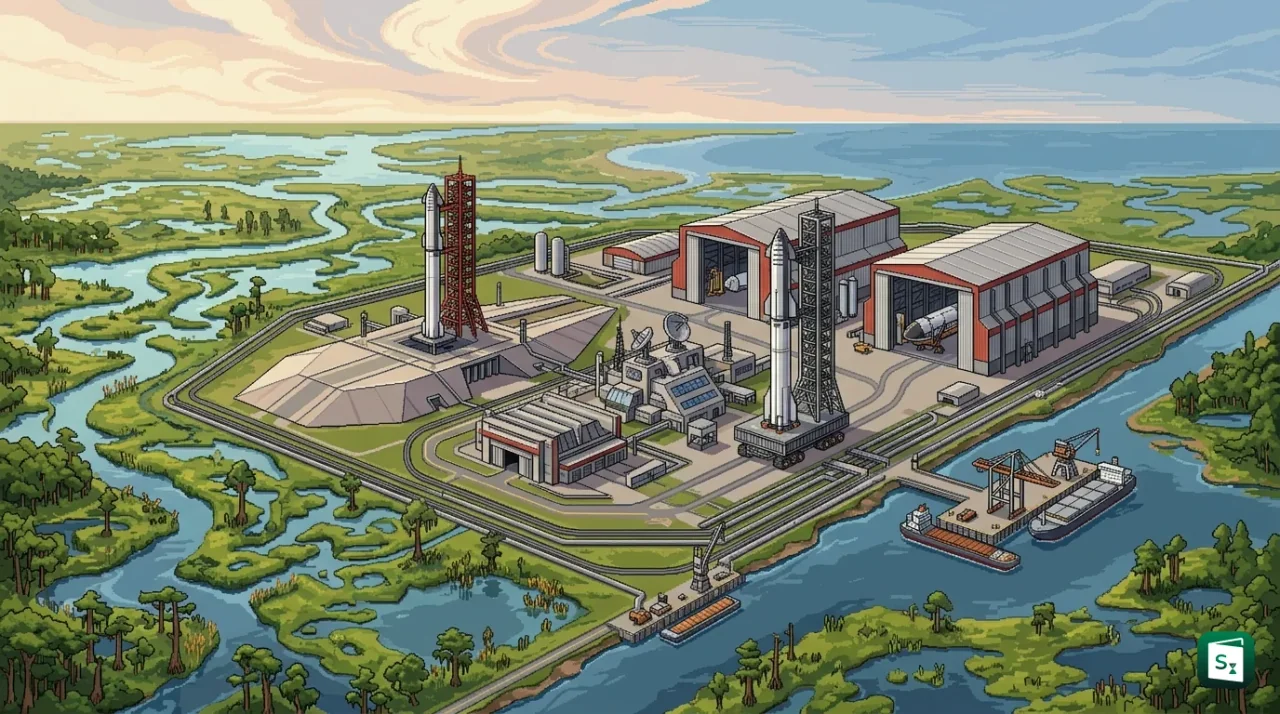
SpaceX announced on 25 August 2026 that it will invest $100 billion to build Starbase Louisiana in Vermilion Parish on the southern coast of Louisiana, its largest ever rocket launch complex. The facility near Pecan Island is designed to support thousands of Starship flights per year from 10 launch pads spread across five complexes on about 130,000 acres of former Exxon land. Governor Jeff Landry called it the single largest capital investment in Louisiana history, with construction set to begin in 2027 and the first launch targeted for 2029.
What Is Starbase and What Is SpaceX?
SpaceX, whose full name is Space Exploration Technologies Corporation, is an American aerospace company founded in 2002 by Elon Musk with the goal of reducing the cost of space transport and making life multiplanetary. It is headquartered in Starbase, Texas, and also operates major facilities in Hawthorne, California, Cape Canaveral, Florida, and Vandenberg, California. The company is known for the Falcon 9 and Falcon Heavy rockets, the Dragon spacecraft, the Starlink satellite internet constellation of more than 7,000 satellites, and now Starship.
Starship is SpaceX’s next generation fully and rapidly reusable launch system, made of two stages, the Super Heavy booster and the Starship spacecraft itself. It stands about 120 metres tall with a diameter of 9 metres, and is designed to carry crew and cargo to Earth orbit, the Moon, Mars and beyond. Unlike earlier expendable rockets, both stages are intended to return and be reused, which is central to lowering launch cost and increasing flight rate.
Starbase is the name SpaceX gives to its private development, manufacturing and launch campuses built specifically for Starship. The original Starbase Texas at Boca Chica near Brownsville in Cameron County on the southern tip of Texas began as a small test site in 2014 and grew into a large industrial complex with launch pads, production bays and test stands. On 3 May 2025, residents voted to incorporate the area as the City of Starbase, Texas, the first new city in Cameron County since 1995. That site, which now has two orbital launch pads, was SpaceX’s only private Starbase before the Louisiana announcement, while the company also flies from leased pads at Kennedy Space Center Launch Complex 39A and Space Launch Complex 40 in Florida and Space Launch Complex 4E at Vandenberg.
Starbase Louisiana will be the second private Starbase and, by far, the largest, built from the ground up as a self sustaining spaceport rather than an expanded test field.
Where Is Starbase Louisiana Located?
Starbase Louisiana will be built on the Gulf Coast of southern Louisiana in Vermilion Parish, centred on the marshland around Pecan Island and Freshwater City. The location sits about 45 miles southwest of Lafayette and roughly 10 miles inland from the Gulf of Mexico, strung along Louisiana Highway 82 with an 18-mile stretch of coastal frontage. The parish has a small year round population, only about 100 people live in Pecan Island itself, though thousands visit during hunting season.
The site covers about 130,000 acres, which is about 212 square miles, roughly the size of the city of Chicago. The land was owned since the 1950s by ExxonMobil and managed by the Vermilion Corporation for hunting and fishing leases. In 2022 Exxon had proposed a carbon capture and sequestration facility there, but the property became available after a June 2026 settlement in which Exxon agreed to turn over land to resolve coastal lawsuits filed against it over pollution and land loss. SpaceX would then acquire control through purchase or long term lease, with provisions for coastal restoration.
The coastal marsh offers several operational advantages for a launch site. The large, flat and sparsely populated area provides natural safety buffers required for rocket operations. Access to the Gulf of Mexico allows a wide range of launch trajectories over water. Proximity to natural gas supplies helps with propellant production, since Starship uses liquid methane and liquid oxygen as cryogenic propellants, fuels that must be produced, stored and handled in large quantities. The site also has potential for barge access and deep water shipping, which SpaceX plans to use to move large rocket hardware.
For the state, the location fits a longer history. Louisiana has powered the American space programme for six decades, from building Saturn V rockets at NASA’s Michoud Assembly Facility near New Orleans for the Apollo Moon programme to supporting the current Artemis programme.
What Will the $100 Billion Spaceport Include?
SpaceX describes Starbase Louisiana as a spaceport of the future designed to support thousands of Starship flights per year. At full buildout the campus will include five launch complexes, each with two launch pads and a propellant farm, for a total of 10 launch pads. Elon Musk has said the site will ultimately have more than a dozen launch towers capable of enabling more than 30 Starship flights per day, which would make it the biggest launch site on Earth.
Beyond the pads, the project is planned as a fully integrated industrial ecosystem with several core elements. The company plans to build propellant production on site, along with power generation, vehicle processing facilities, and deep water shipping capabilities. An airport is also part of the long term plan, together with residential housing for employees and their families. Company President Gwynne Shotwell said the aim is to build a self sustaining spaceport that can produce its own fuel, generate its power, process vehicles and ship hardware without relying on distant supply chains.
The scale is far larger than the existing Starbase in Texas, which occupies about 400 hectares and has two orbital launch pads at a cost estimated at more than $3 billion. By comparison, Starbase Louisiana’s 130,000 acres and 10 pads represent an increase of more than two orders of magnitude in land area and a fivefold increase in launch infrastructure, reflecting SpaceX’s goal to make spaceflight as routine as commercial aviation.
| Feature | Detail at Starbase Louisiana |
|---|---|
| Total investment | $100 billion |
| Site area | About 130,000 acres (212 sq miles), former Exxon property |
| Launch infrastructure | 5 complexes x 2 pads = 10 launch pads, each with propellant farm |
| Support facilities | Propellant production plant, power generation, vehicle processing, deep water port, airport, employee housing |
| Target launch cadence | Thousands per year, with goal of more than 30 per day at maturity |
| Construction start | By end of 2027 |
| First Starship launch | As early as 2029 |
Investment, Jobs and Economic Impact for Louisiana
The $100 billion commitment is the largest capital investment ever announced in Louisiana. The state government, led by Governor Jeff Landry and Louisiana Economic Development (LED) Secretary Susan Bourgeois, unveiled the project on 25 August 2026 at Magdalen Place in Abbeville. Landry said the investment guarantees protection for the coast and offers a permanent future of prosperity, adding that in 1803 Louisiana gave America a continent and today it will give America the stars.
Louisiana Economic Development projects the creation of 3,000 direct jobs over the next 10 years at an average annual salary of $92,600, plus about 8,100 indirect jobs for contractors, suppliers and service providers. In a promotional video Musk suggested the workforce could eventually reach nearly 10,000 employees. Hiring is expected to draw heavily from nearby communities, using Louisiana workers experienced in building complex infrastructure in coastal environments.
To secure the project, the state offered a performance based incentive package. Benefits are tied to verified capital investment and job creation milestones, with accountability measures to protect taxpayer funds if commitments are not met. Instruments mentioned include the state’s Aerospace Facilities and Activities Rebate and the High Impact Jobs programme. In addition, SpaceX is required to make a $25 million charitable donation to the Community Foundation of Acadiana.
Local fiscal terms include a Payment in Lieu of Taxes (PILOT) agreement. Under it, local taxing bodies in Vermilion Parish will receive a $20 million upfront payment and at least $25 million annually for 25 years, totalling more than $825 million in direct local payments, plus additional sales tax revenue during construction and operations. Louisiana Department of Transportation and Development (DOTD) is evaluating upgrades to Highway 82 and bridges along the route, with costs expected to be shared between the state and SpaceX. New power generation and transmission infrastructure will also be needed, and the company has agreed to cover those costs so existing ratepayers do not face higher bills, under oversight by the Louisiana Public Service Commission.
The Port of New Orleans has said the project could bring additional cargo volumes for construction materials and oversized equipment, while Greater New Orleans, Inc. noted that Louisiana’s industrial base and energy supply make it well suited to lead the next era of space manufacturing. The project also joins Source Louisiana, a state supplier platform that lets local businesses compete for contracts related to the spaceport.
How Does Starbase Louisiana Compare With Starbase Texas and Other Launch Sites?
The Louisiana campus is designed to dwarf existing commercial launch sites.
Starbase Texas (Boca Chica) has 2 orbital launch pads on about 400 hectares and serves as the current hub for Starship development, with 22 launches from the site between July 2019 and July 2026. It operates under a Federal Aviation Administration (FAA) licence that required a detailed environmental assessment, with more than 75 mitigation measures before the first orbital flight in April 2023. In May 2025 it became a formally incorporated city.
Starbase Louisiana will have 10 pads across five complexes on 130,000 acres, with on site propellant factories and power plants that Texas does not have at the same scale. Its target cadence of thousands of launches per year compares with the current United States record of just over 100 orbital launches in a year across all providers.
| Site | Location | Operator | Launch Pads for Starship | Site Area | Key Role |
|---|---|---|---|---|---|
| Starbase Texas | Boca Chica, Cameron County, Texas | SpaceX | 2 | About 400 hectares | Development and early orbital tests |
| Starbase Louisiana | Pecan Island, Vermilion Parish, Louisiana | SpaceX | 10 (5 complexes x 2) | About 130,000 acres | High cadence manufacturing and launch |
| Kennedy Space Center LC-39A | Merritt Island, Florida | SpaceX (leased from NASA) | 1 | Leased pad | Falcon 9, Falcon Heavy, Crew Dragon |
| Cape Canaveral SLC-40 | Cape Canaveral, Florida | SpaceX | 1 | Leased pad | Falcon 9 high rate operations |
| Vandenberg SLC-4E | California | SpaceX | 1 | Leased pad | Polar and sun synchronous missions |
Compared with Blue Origin, Rocket Lab and other commercial providers that operate one or two pads, Starbase Louisiana’s multi pad architecture is intended to turn launch from a scheduled event into an assembly line. The Gulf Coast location also offers a different range geometry than the Atlantic (Florida) and Pacific (Vandenberg) coasts, allowing more flexible inclinations while keeping flight paths over water.
Environmental and Regulatory Considerations
A project of this size on coastal wetlands raises clear environmental questions. The Pecan Island marsh and surrounding waters are high value habitat for migratory waterfowl, shorebirds and wading birds, and lie between two wildlife sanctuaries. The land is almost entirely wetlands, with shoreline erosion rates of 3.3 to 23 feet per year according to state data. Local activities such as hunting, crabbing, fishing and shrimping have been central to life in the area for more than a century.
SpaceX says it will not develop the full footprint and will preserve wetlands and wildlife habitat. The company is working with the Coastal Protection and Restoration Authority (CPRA), the Louisiana Department of Wildlife and Fisheries (LDWF), and other federal and state agencies on protection and restoration. Plans cited on the company’s Louisiana site include Gulf shoreline protection breakwaters to reduce wave energy, thousands of acres of marsh creation using dredged material and offshore sediment, interior marsh bank stabilization, and rebuilding marsh in remnant canals. The company states these efforts would expand projects under the state’s Coastal Master Plan and the federal Coastal Wetlands Planning, Protection and Restoration Act.
Regulatory clearance will be extensive. The project must complete reviews under the National Environmental Policy Act (NEPA), secure FAA commercial spaceport licensing for high cadence operations, obtain wetlands and Clean Water Act permits from the U.S. Army Corps of Engineers, and secure land use approvals in Vermilion Parish. Experience at Boca Chica shows the process can be lengthy, with the FAA receiving more than 18,000 public comments before issuing a finding of no significant impact in 2022 subject to dozens of conditions.
In August 2026, several conservation groups including the Louisiana Wildlife Federation, the National Wildlife Federation and the Pontchartrain Conservancy wrote to the U.S. Department of Transportation and the FAA opposing a separate FAA proposal to waive 13 environmental laws, including the Clean Air Act, Clean Water Act and Endangered Species Act, to fast track aerospace projects nationwide. They argued that routine regulatory review remains important for a site proposed on such ecologically sensitive coast. The FAA’s public comment period on that proposal was set to close on 31 August 2026. Past experience in Texas, including a 2024 notice of violation over water releases from the deluge system and debris from the first Starship flight in April 2023 that affected about 4 acres of Boca Chica State Park, is often cited by advocates as a reason for careful oversight.
State officials note that any unavoidable wetland impacts must be fully mitigated by the company and that incentive payments are performance based, meaning funds are released only after verified investment and hiring.
Why Starbase Louisiana Matters for Global Spaceflight and Business
The business case for a ten pad Starship spaceport rests on demand for more frequent and cheaper access to orbit. SpaceX already launches the majority of the world’s useful mass to space with Falcon 9, a partially reusable rocket whose first stage lands and is reflown. Starship’s full reusability is intended to cut costs further and raise flight rate by an order of magnitude. Uses driving that demand include Starlink broadband deployment, commercial satellite constellations, lunar missions under NASA’s Artemis programme, deep space cargo, and eventually Mars missions, which is SpaceX’s founding purpose.
A site capable of thousands of launches annually would industrialise spaceflight. That matters for national priorities, since heavy lift and rapid turnaround are needed for building a permanent presence in orbit, on the Moon and beyond. It also matters for the commercial launch market, where the United States competes with heavy lift vehicles from Blue Origin’s New Glenn, United Launch Alliance’s Vulcan, and foreign systems, as well as with India’s ISRO which is scaling its own launch capacity from Satish Dhawan Space Centre in Andhra Pradesh and the upcoming Kulasekarapattinam site in Tamil Nadu.
From a business viewpoint, the announcement signals a new scale of private infrastructure investment in space. SpaceX, which raised $86 billion in the largest initial public offering in history on 12 June 2026 and trades on Nasdaq under the ticker SPCX, reported annual revenue of about $23.04 billion and a market capitalisation near $1.87 trillion at the end of August 2026. A $100 billion ground investment therefore exceeds four years of current revenue and underlines a bet that launch cadence, not launch vehicle alone, will determine market leadership. For Louisiana, the project diversifies an economy long tied to oil and gas into aerospace manufacturing, with spillovers for construction, logistics, energy and high skill employment.
The Way Forward
Construction is expected to begin by the end of 2027, pending environmental, wetlands and FAA reviews, land use approvals and finalisation of incentive agreements. The first Starship launch is targeted for as early as 2029. Between now and then, key milestones to watch include the completion of the NEPA environmental impact assessment, the FAA spaceport licence, CPRA approved coastal restoration designs, and DOTD road and utility plans for Highway 82.
SpaceX is inviting job seekers to apply via starbaselajobs@spacex.com and encouraging Louisiana suppliers to register on Source Louisiana. For residents of Vermilion Parish, the near term focus will be on hunting lease transitions, workforce training, housing and infrastructure planning. For regulators, the balance will be protecting a fast eroding coast while enabling a facility that promises to make high cadence, low cost spaceflight routine.
Key Takeaways
- SpaceX announced on 25 August 2026 a $100 billion investment to build Starbase Louisiana, its largest rocket launch complex.
- The spaceport will be built in Vermilion Parish, southern Louisiana, near Pecan Island on about 130,000 acres of former ExxonMobil land on the Gulf Coast.
- At full buildout it will have five launch complexes with two pads each, for a total of 10 launch pads, designed to support thousands of Starship flights per year.
- The project is expected to create 3,000 direct jobs at an average salary of $92,600 plus about 8,100 indirect jobs, with a $25 million donation to the Community Foundation of Acadiana and $825 million in local PILOT payments over 25 years.
- Construction is planned to begin by the end of 2027 with the first Starship launch as early as 2029, pending FAA and environmental approvals.
- SpaceX (Space Exploration Technologies Corporation) was founded in 2002 by Elon Musk and is headquartered in Starbase, Texas, which became an incorporated city on 3 May 2025 and currently has 2 orbital launch pads at Boca Chica.