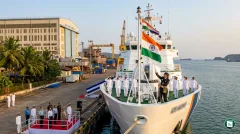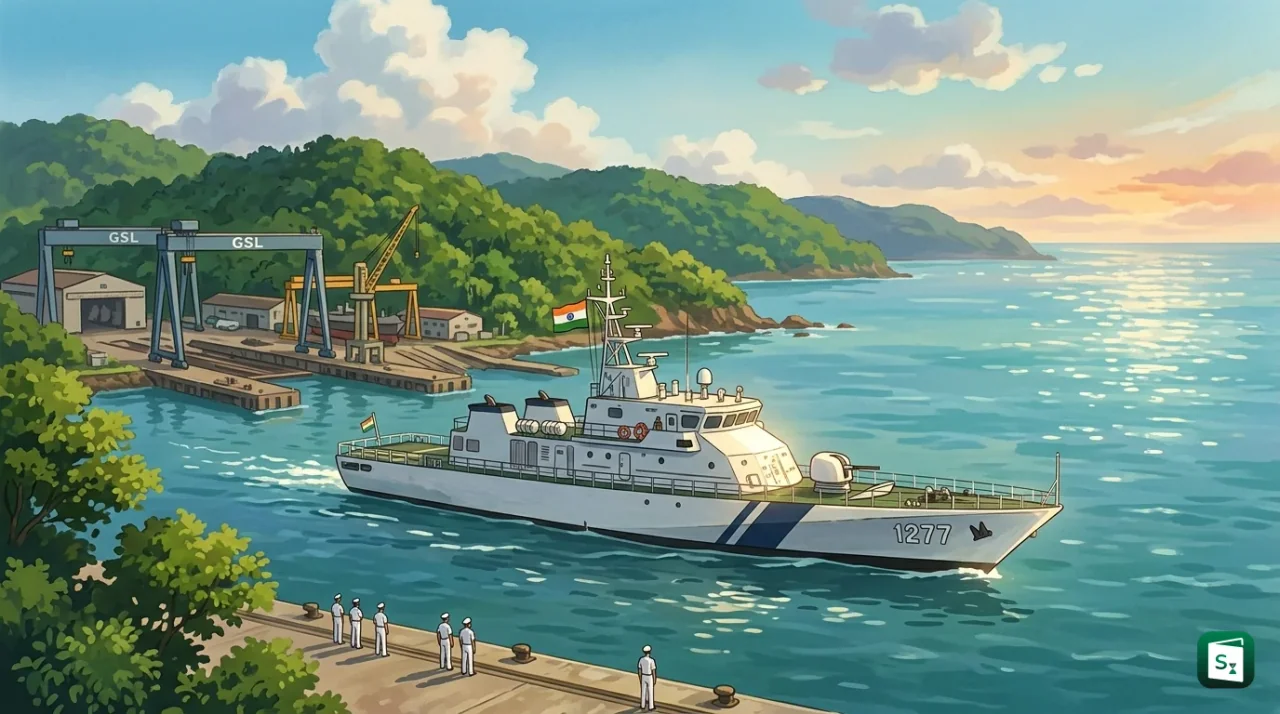
Goa Shipyard Limited handed over ICGS Ajit (Yard 1277) to the Indian Coast Guard on 25 August 2026 at Vasco da Gama, Goa, marking the seventh delivery in an eight-vessel Fast Patrol Vessel project. Built entirely in India with more than 65 percent indigenous content and a top speed of over 27 knots, the vessel boosts India’s coastal surveillance and rapid response capability. The delivery advances the ₹473 crore contract that the Ministry of Defence signed with GSL in March 2022 under the top priority Buy-Indian Designed, Developed and Manufactured (Buy-IDDM) category.
What Is a Fast Patrol Vessel and What Does ICGS Mean?
A Fast Patrol Vessel (FPV) is a small, high speed warship designed for operations close to the coast, in shallow water and around island territories. Unlike large Offshore Patrol Vessels (OPVs) that patrol the deep exclusive economic zone for weeks, an FPV is built for quick response, high manoeuvrability and frequent boarding and interdiction missions. The prefix ICGS stands for Indian Coast Guard Ship, the designation given to commissioned vessels of the Indian Coast Guard (ICG).
The Indian Coast Guard is a maritime armed force that operates under the Ministry of Defence. It was formally established in August 1978 under the Coast Guard Act, 1978, after an interim setup in 1977, and is mandated to protect India’s maritime zones, safeguard artificial islands and offshore installations, assist fishermen in distress, control marine pollution, and support customs and other agencies in anti smuggling and law enforcement at sea. The Coast Guard is headed by the Director General Indian Coast Guard and operates from headquarters in New Delhi with regional commands in the West, East, North West and Andaman and Nicobar regions.
Fast patrol vessels are the workhorses of this mandate. They conduct fisheries protection, coastal patrol, anti smuggling and anti piracy checks, search and rescue (SAR), and protection of offshore assets. Their speed allows them to intercept suspect craft, while shallow draught lets them operate where larger ships cannot. For aspirational maritime security, a higher number of FPVs directly means more hours of presence at sea and faster first response to incidents across India’s 7,516 kilometre coastline and 2 million square kilometre exclusive economic zone.
Goa Shipyard Limited: India’s Defence Shipbuilding Hub on the West Coast
Goa Shipyard Limited (GSL) is a Defence Public Sector Undertaking (DPSU) that functions under the administrative control of the Ministry of Defence. It is located at Vasco da Gama, Goa, on the banks of the Zuari River. The yard was originally established in 1957 as Estaleiros Navais de Goa by the Portuguese colonial administration to build barges for Goa’s mining industry. After Goa’s liberation in December 1961, the yard was requisitioned for warship building and reconstituted as Goa Shipyard Limited on 26 September 1967 with its own Board of Directors.
GSL is a Mini Ratna Category I company and was elevated to Schedule A status among Central Public Sector Enterprises (CPSEs) in February 2026, a recognition of its financial strength and strategic importance. Over its history it has delivered more than 200 vessels to the Indian Navy, the Indian Coast Guard and friendly foreign navies, including offshore patrol vessels, fast patrol vessels, missile boats, landing craft and survey vessels. Its modernisation, including a 6,000 tonne shiplift and expanded transfer area commissioned in 2011, tripled its capacity to build steel, aluminium and glass reinforced plastic hulls.
The current Chairman and Managing Director is Brajesh Kumar Upadhyay. GSL’s portfolio today is anchored in indigenous design. It maintains a strong in house design bureau and collaborates with organisations such as the Indian Register of Shipping (IRS) and the American Bureau of Shipping (ABS), under whose dual certification the Adamya class vessels are built. Other major defence shipyards under the Ministry of Defence include Mazagon Dock Shipbuilders Limited in Mumbai and Cochin Shipyard Limited in Kochi. Unlike Mazagon Dock, which focuses on larger frigates and submarines, and Cochin Shipyard, which built the earlier Aadesh class FPVs, GSL has specialised in mid sized patrol vessels and fast interceptors with high indigenous content.
ICGS Ajit Handed Over: The Seventh Adamya-Class Fast Patrol Vessel
ICGS Ajit (Yard 1277) was formally handed over on 25 August 2026 after the First Reading Ceremony at GSL, attended by GSL Chairman and Managing Director Brajesh Kumar Upadhyay, Director (Operations) Rear Admiral Nelson D’Souza, and senior officers of the Indian Coast Guard. The vessel is the seventh in a series of eight Adamya-class Fast Patrol Vessels being built by GSL for the Indian Coast Guard. Its sister ship, ICGS Aparajit (Yard 1278), was launched together with Ajit on 24 October 2025 and is the eighth and final vessel in the contracted series.
The name Ajit means invincible and reflects the Coast Guard’s tradition of naming patrol vessels with assertive Sanskrit names. The first vessel of the class, ICGS Adamya, was commissioned at Paradip, Odisha, on 19 September 2025, and other vessels include Akshar, Amulya, Achal and Atal, now at various stages of delivery and commissioning.
Key Specifications and Advanced Features
ICGS Ajit is designed entirely in house by GSL and built to dual certification standards. Its features represent a step change over earlier patrol craft, especially in propulsion and automation.
| Parameter | Details |
|---|---|
| Class | Adamya class Fast Patrol Vessel |
| Yard Number | 1277 |
| Length | 51.43 metres (some references state 52 metres) |
| Beam | 8 metres |
| Draught | 2.5 metres |
| Displacement | 320 to 330 tonnes |
| Propulsion | Twin marine diesel engines (each about 3,000 kW or 4,000 hp) driving Controllable Pitch Propellers (CPP) with indigenously developed gearboxes |
| Speed | Over 27 knots maximum, 14 knots cruising (first in class to use CPP in this size for the Coast Guard) |
| Range and Endurance | 1,500 nautical miles at economical speed, about 5 days endurance |
| Indigenous Content | More than 65 percent (contract required at least 50 percent) |
| Complement | 5 to 6 officers and 34 to 35 sailors (total about 39 personnel) |
| Armament | 30 mm CRN-91 naval gun, two 12.7 mm stabilised remote controlled guns with fire control system |
| Advanced Systems | Integrated Bridge System (IBS), Integrated Platform Management System (IPMS), Automated Power Management System (APMS), integrated machinery control |
A Controllable Pitch Propeller is a propeller whose blade angle can be changed while the engine keeps running at constant revolutions. This gives finer speed control, better fuel efficiency, faster reversal and superior manoeuvrability in shallow and congested waters compared with a fixed pitch propeller. Ajit and the Adamya class are the first Fast Patrol Vessels of the Indian Coast Guard to use this system, a notable indigenous advance.
Timeline of the Eight-Vessel Project
| Milestone | Date and Details |
|---|---|
| Contract Signed | 28 March 2022 between Ministry of Defence and GSL, value ₹473 crore |
| Delivery Schedule | Within 45 months of signing, covering 2023 to 2026 |
| First Launch | 28 October 2024, simultaneous launch of ICGS Adamya (Yard 1270) and ICGS Akshar (Yard 1271) using GSL’s shiplift system |
| Achal Launch | 16 June 2025, fifth vessel ICGS Achal (Yard 1274) |
| Atal Status | Launched on 29 July 2025 (Yard 1275) |
| Ajit and Aparajit Launch | 24 October 2025, seventh and eighth vessels launched together by Smt. Manju Sharma |
| First Commissioning | 19 September 2025, ICGS Adamya commissioned at Paradip |
| Ajit Handover | 25 August 2026, seventh vessel delivered |
Deliveries and commissionings are now following in quick succession, with home ports spread across Paradip, Vadinar, Karaikal and other coastal stations.
Adamya Class Versus Aadesh Class: What Has Changed?
The Aadesh class was the previous generation of Fast Patrol Vessels for the Indian Coast Guard. Built by Cochin Shipyard Limited between 2010 and 2017, the class comprised 20 vessels named Aadesh, Abheek, Abhinav and others, all commissioned between 2013 and 2017. The Adamya class succeeds it with eight vessels built by GSL. Understanding the difference helps explain why the new contract was placed under the Buy-IDDM route.
| Feature | Aadesh Class (2013 onwards) | Adamya Class (2025 onwards) |
|---|---|---|
| Builder | Cochin Shipyard Limited | Goa Shipyard Limited |
| Number Built | 20 vessels | 8 vessels (plus one for export to Seychelles as PS Lespwar) |
| Length and Beam | 50 metres by 7.6 metres | 51.43 metres by 8 metres |
| Displacement | About 303 tonnes | 320 to 330 tonnes |
| Propulsion | 3 waterjets driven by 3 MTU diesel engines (2,720 kW each) | 2 Controllable Pitch Propellers driven by 2 diesel engines (3,000 kW each) |
| Maximum Speed | Over 33 knots | Over 27 to 28 knots |
| Range | 1,500 nautical miles at 14 knots | 1,500 nautical miles at 14 knots |
| Indigenous Content | High, but conventional foreign waterjets | More than 65 percent with indigenous CPP and gearboxes |
| Automation | Integrated Bridge Management System and Integrated Machinery Control System | Advanced IBS, IPMS and APMS for higher automation |
| Design | Designed by M/s Smart Engineering and Design Solutions (SEDS), Kochi | In house design by GSL |
While the Aadesh class is slightly faster due to waterjets, the Adamya class trades a few knots for better fuel efficiency, lower maintenance and finer low speed control through the CPP system. Both classes share a similar range and complement of about 35 to 40 personnel, and both carry a 30 mm gun. The Adamya class adds stabilised remote controlled 12.7 mm guns and more integrated automation, which reduces crew workload during long patrols.
The ₹473 Crore Buy-IDDM Contract and the Defence Procurement Framework
The contract for the eight Fast Patrol Vessels was signed on 28 March 2022 by Joint Secretary (Maritime and Systems) Dinesh Kumar on behalf of the Ministry of Defence and Chairman and Managing Director Commodore B. B. Nagpal (Retd) on behalf of GSL. The total cost was ₹473 crore, averaging under ₹60 crore per vessel, for delivery within 45 months. The vessels are designed to operate in shallow waters along India’s coast and around island territories, strengthening the security architecture along the entire coastline.
Understanding Buy-Indian Designed, Developed and Manufactured
Buy-Indian Designed, Developed and Manufactured, often shortened to Buy (Indian-IDDM) or Buy-IDDM, is the highest priority category in the Defence Acquisition Procedure (DAP) 2020. The procedure, which replaced the earlier Defence Procurement Procedure (DPP) 2016, governs how the Ministry of Defence buys capital equipment. Categories are ranked by preference for indigenous sourcing, with Buy (Indian-IDDM) at the top, followed by Buy (Indian), Buy and Make (Indian), Buy (Global Manufacture in India) and Buy (Global).
Under Buy (Indian-IDDM), the product must be indigenously designed, developed and manufactured by an Indian vendor, with a minimum of 50 percent Indigenous Content (IC) calculated on the base contract price excluding taxes and duties. The vendor must own the design, source code and architecture and must not be a wholly owned subsidiary of a foreign company. Verification is done at the Technical Evaluation Committee stage, often with experts from the Defence Research and Development Organisation (DRDO) or IITs.
The key features are:
| Aspect | Buy (Indian-IDDM) Requirement |
|---|---|
| Design Ownership | Must be owned by Indian vendor, proven through indigenous design documents |
| Minimum Indigenous Content | At least 50 percent (draft DAP 2026 proposes raising this to 60 percent) |
| Vendor Eligibility | Only Indian vendors, defined as companies incorporated in India with Indian management control |
| Priority | Highest, adopted when indigenous capability exists |
The Adamya class met these tests because GSL designed the vessels in house, developed the controllable pitch propeller gearboxes domestically, and exceeded the minimum content threshold with over 65 percent indigenous content.
The draft Defence Acquisition Procedure 2026, released for stakeholder consultation, proposes to remove the Buy (Indian) category entirely and merge its intent into a stricter Buy-IDDM standard, raising the content threshold to 60 percent and requiring batch wise certification with two year verification and penalties for false claims. This reinforces the policy direction that began with the IDDM category introduced under DPP 2016 by then Defence Minister Manohar Parrikar to reward genuine research and intellectual property creation rather than licensed assembly.
For GSL, the Buy-IDDM tag also means stronger employment generation in Goa and in tiered supply chains, plus readiness for exports. A ninth hull from the same design, PS Lespwar, is being built for the Seychelles Coast Guard, illustrating export potential under the Make in India and Atmanirbhar Bharat initiatives.
Role of Fast Patrol Vessels in India’s Maritime Security
Indian Coast Guard Versus Indian Navy: Different Mandates
The Indian Navy and the Indian Coast Guard are distinct forces, though both operate under the Ministry of Defence. The Navy is India’s principal military arm at sea, tasked with war fighting, deterrence, power projection and securing sea lines of communication. The Coast Guard is a maritime law enforcement and search and rescue agency with a constabulary role in peacetime. It is the Coastal Security Coordinator after the 2008 Mumbai attacks, operating the Coastal Surveillance Network of radars and automatic identification system receivers and coordinating with state marine police, customs and intelligence agencies.
In practice they operate together. During heightened security alerts, the Navy can task Coast Guard assets, and both participate in exercises such as MILAN. A comparison table clarifies the distinction:
| Aspect | Indian Coast Guard | Indian Navy |
|---|---|---|
| Primary Role | Law enforcement, search and rescue, pollution control, anti smuggling | Military defence, sea denial, force projection |
| Jurisdiction | Territorial waters, contiguous zone and Exclusive Economic Zone | Beyond EEZ and high seas, wartime operations |
| Force Size | About 180 vessels and 78 aircraft (aiming for 200 ships and 100 aircraft by 2030) | Larger fleet with destroyers, frigates, submarines and aircraft carriers |
| Headquarters | New Delhi, under DGICG | New Delhi, under Chief of Naval Staff |
Fast Patrol Vessels sit squarely in the Coast Guard’s core duties.
How ICGS Ajit Adds to Operational Capability
ICGS Ajit will be deployed for protection, monitoring, control and surveillance of India’s waters. Specific tasks include protection of offshore assets and island territories, fisheries protection, deterrence of smuggling and poaching, anti piracy patrols and search and rescue within the Indian Search and Rescue Region, where the Coast Guard runs 3 Maritime Rescue Coordination Centres at Mumbai, Chennai and Port Blair and 36 sub centres.
With a shallow draught of 2.5 metres, the vessel can enter estuaries, creeks and coastal waters where larger offshore patrol vessels cannot operate. Its 1,500 nautical mile range allows it to cover island groups in the Andaman and Nicobar Islands and Lakshadweep, where surveillance demands are growing. The integrated bridge and platform management systems reduce operator fatigue and enable better situational awareness during night patrols and boarding operations.
The timing aligns with expanding maritime demands. India has offshore energy installations in the Arabian Sea and Bay of Bengal, growing commercial shipping, and vulnerable island territories. The Coast Guard deploys 55 to 60 ships and 10 to 12 aircraft daily on patrol. Each new FPV adds patrol days and quick response slots, multiplying the fleet’s ability to cover the coast without diverting larger ships from exclusive economic zone duties.
The Way Forward for Indigenous Shipbuilding
With seven of eight vessels delivered, the Adamya project is in its final stage. The last vessel, ICGS Aparajit (Yard 1278), is expected to be handed over soon, completing the ₹473 crore programme within its 45 month window. Beyond this contract, the Coast Guard’s modernisation plan targets about 200 surface platforms and 100 aircraft by 2030, with new orders for next generation offshore patrol vessels already placed with Mazagon Dock Shipbuilders for six 3,000 tonne vessels at a cost of about ₹1,614 crore.
For GSL, the successful delivery reinforces its position after the Schedule A upgrade and with an order book exceeding ₹16,000 crore, projected to grow further with future frigate and patrol vessel orders. The yard’s experience with indigenous CPP systems, dual class certification and high automation will feed into larger platforms and export orders. The Coast Guard’s Union Budget allocation rose to about ₹9,676 crore in 2025, a 26.5 percent increase, signalling continued support for indigenous acquisitions.
Policy will also shape the next cycle. If the draft DAP 2026 is adopted, future patrol vessel contracts will face a 60 percent indigenous content threshold and stricter verification of design ownership, making proven indigenous designs like the Adamya class the benchmark. Sustained budget, timely delivery and retention of intellectual property will be critical to keep India’s shipyards competitive and to ensure the Coast Guard reaches its fleet targets without delay.
Key Takeaways
- ICGS Ajit (Yard 1277), the seventh Adamya-class Fast Patrol Vessel, was handed over by Goa Shipyard Limited to the Indian Coast Guard on 25 August 2026 at Vasco da Gama, Goa.
- The vessel belongs to an eight vessel contract worth ₹473 crore signed on 28 March 2022 under the Buy-Indian Designed, Developed and Manufactured (Buy-IDDM) category with delivery in 45 months.
- ICGS Ajit measures 51.43 metres in length with 320 to 330 tonnes displacement, a speed of over 27 knots and a range of 1,500 nautical miles, and is the first of its class in the Coast Guard to use Controllable Pitch Propellers with indigenous gearboxes.
- The ship has more than 65 percent indigenous content and is fitted with a 30 mm CRN-91 gun, two 12.7 mm stabilised remote controlled guns, Integrated Bridge System, IPMS and APMS.
- Goa Shipyard Limited, established in 1957 as Estaleiros Navais de Goa and reconstituted in 1967, is a Defence Public Sector Undertaking under the Ministry of Defence and was upgraded to Schedule A CPSE in February 2026.
- The Indian Coast Guard, established in August 1978 under the Coast Guard Act, 1978, operates under the Ministry of Defence and the Adamya class succeeds the 20 vessel Aadesh class built by Cochin Shipyard Limited.