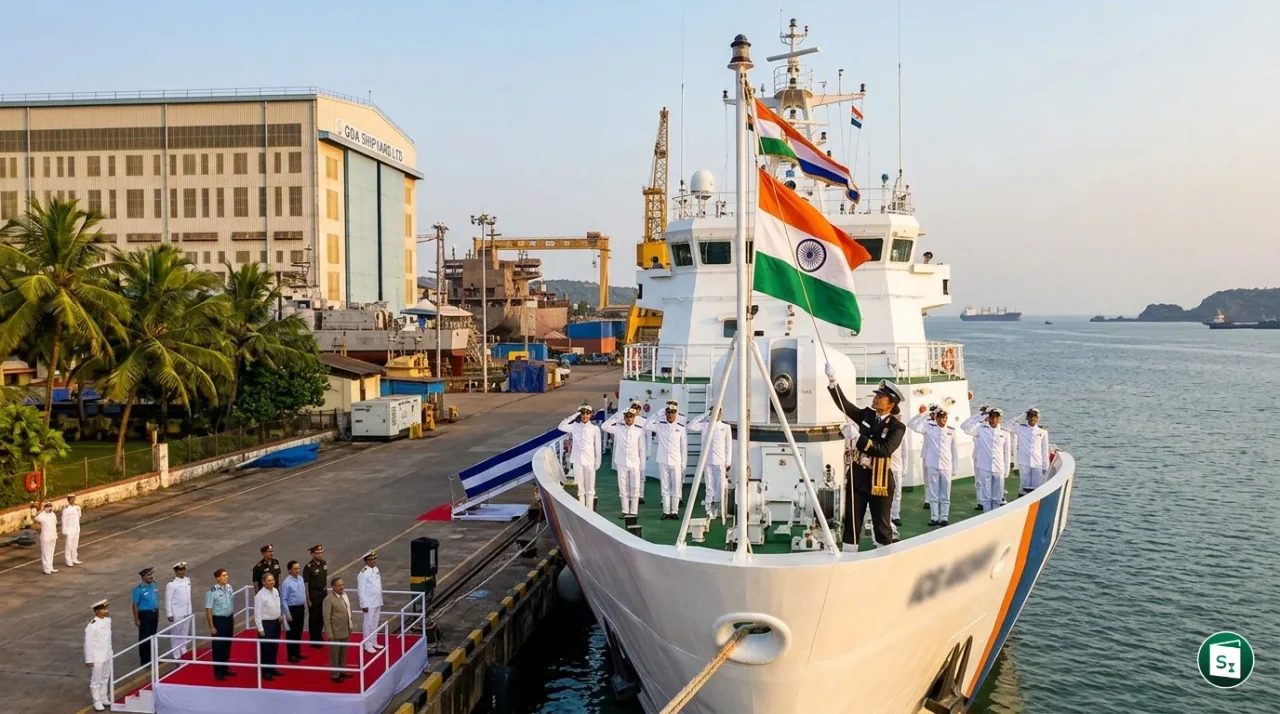
The Indian Coast Guard commissioned ICGS Akshay, the fourth vessel in the Adamya-class Fast Patrol Vessel (FPV) series, at the Goa Shipyard Limited facility in Vasco, Goa on June 27, 2026. The 52-metre warship, built with over 60% indigenous content, represents a major step in India’s push for self-reliance in defence manufacturing under the Aatmanirbhar Bharat initiative. With advanced propulsion and weapon systems, ICGS Akshay will strengthen coastal surveillance, search and rescue, and maritime law enforcement across India’s vast coastline.
ICGS Akshay: The Fourth Adamya-Class Vessel
ICGS Akshay, designated Yard 1273 in the eight-vessel series, was formally inducted into service by Parama Sen, Additional Secretary (Personnel), Department of Expenditure, Ministry of Finance. The commissioning ceremony was attended by Inspector General Bhisham Sharma, Commander of the Coast Guard Region (West); Inspector General Jyotindra Singh, Deputy Director General (HRD); and senior officials from Goa Shipyard Limited.
The vessel will be commanded by Commandant (Junior Grade) Deepak Choubey and will have a complement of six officers and 35 sailors. Its name Akshay, meaning “Indestructible”, reflects the Coast Guard’s enduring commitment to safeguarding the nation’s maritime interests.
The Adamya class is built to replace and supplement the older Aadesh-class patrol vessels that have been in service. With a length of 52 metres, a beam of 8 metres, and a displacement of 320 tonnes, these vessels are designed for high-speed coastal operations and extended endurance missions.
Key Technical Specifications
| Parameter | Specification |
|---|---|
| Length | 52 metres |
| Beam | 8 metres |
| Draught | Less than 2.5 metres |
| Displacement | 320 tonnes |
| Maximum Speed | 27 knots (50 km/h) |
| Cruising Speed | 14 knots |
| Range | 1,500 nautical miles |
| Endurance | 5 days |
| Crew | 6 officers and 35 personnel |
| Indigenous Content | More than 60% |
The vessel is powered by two 3,000 kW diesel engines driving indigenously developed Controllable Pitch Propellers (CPPs). This propulsion system is a first for Indian Coast Guard vessels and allows superior manoeuvrability, fuel efficiency, and operational flexibility compared to fixed-pitch propeller systems commonly found on earlier patrol boats.
The Adamya-class vessels were designed in-house by Goa Shipyard Limited and have been built under stringent dual-class certification from the American Bureau of Shipping and the Indian Register of Shipping, ensuring compliance with international safety and performance standards.
Advanced Propulsion and Weapon Systems
ICGS Akshay is the first class of Indian Coast Guard vessels to be equipped with a Controllable Pitch Propeller (CPP) based propulsion system. Unlike fixed-pitch propellers, CPPs allow the vessel to change the angle of its propeller blades to optimise thrust without changing engine speed. This translates into better fuel economy, reduced wear on engines, and superior handling during complex manoeuvres such as berthing and station-keeping.
Weaponry and Onboard Systems
| System | Description |
|---|---|
| Main Gun | 1 x 30mm CRN-91 naval gun |
| Secondary Weapons | 2 x 12.7mm stabilised remote-controlled machine guns |
| Navigation | Integrated Bridge System (IBS) |
| Platform Management | Integrated Platform Management System (IPMS) |
| Power Management | Automated Power Management System (APMS) |
The CRN-91 naval gun is a licence-produced version of the Russian 2A42 30mm cannon, manufactured by the Ordnance Factory Board. It provides effective firepower against small surface craft and coastal threats. The two 12.7mm stabilised remote-controlled machine guns, produced by Ordnance Factory Tiruchirappalli (OFT), allow the crew to engage targets with precision even in rough sea conditions.
Diverse Operational Roles
Fast Patrol Vessels like ICGS Akshay are designed as multi-mission platforms. Their primary operational roles include Exclusive Economic Zone (EEZ) surveillance to monitor India’s 2.01 million square kilometres of maritime zone, coastal patrol and security along India’s 7,516 km coastline, and anti-smuggling and anti-piracy operations to interdict illegal cargo. The vessel also undertakes Search and Rescue (SAR) missions for distressed vessels and fishermen, marine environmental protection including oil spill response, fisheries protection and monitoring, and humanitarian assistance and disaster relief during cyclones and maritime emergencies.
The vessel also has a secondary wartime role of providing communication links and escorting convoys under the operational control of the Indian Navy.
The 8-FPV Project: Fleet Modernisation at Scale
The commissioning of ICGS Akshay is part of a larger Rs 473 crore contract signed between the Ministry of Defence and Goa Shipyard Limited in March 2022 for the construction of eight Adamya-class Fast Patrol Vessels. The contract falls under the Buy (Indian-IDDM) category, meaning the vessels were indigenously Designed, Developed, and Manufactured.
Progress of the Adamya-Class Fleet
| Vessel | Yard No. | Launched | Commissioned | Home Port |
|---|---|---|---|---|
| ICGS Adamya | 1270 | October 2024 | September 2025 | Paradip |
| ICGS Akshar | 1271 | October 2024 | October 2025 | Karaikal |
| ICGS Amulya | 1272 | January 2025 | December 2025 | Paradip |
| ICGS Akshay | 1273 | January 2025 | June 2026 | To be assigned |
| ICGS Achal | 1274 | June 2025 | May 2026 | Vadinar |
| ICGS Atal | 1275 | July 2025 | Yet to be commissioned | - |
| ICGS Ajit | 1277 | October 2025 | Under construction | - |
| ICGS Aparajit | 1278 | October 2025 | Under construction | - |
The project has seen rapid progress, with all eight vessels launched within 12 months of each other using GSL’s state-of-the-art Ship Lift System, which allowed simultaneous launch of multiple vessels. The remaining three vessels Atal, Ajit, and Aparajit are in advanced stages of construction and are expected to join the fleet by mid-2027.
Goa Shipyard Limited: A Cornerstone of Defence Shipbuilding
Goa Shipyard Limited (GSL) is a premier Defence Public Sector Undertaking (DPSU) under the administrative control of the Ministry of Defence. Established originally in 1957 as “Estaleiros Navais de Goa” by the Portuguese colonial administration, the yard was later taken over by the Government of India after Goa’s liberation in 1961 and reconstituted as a public sector company in 1967.
Headquartered in Vasco da Gama, Goa, on the banks of the River Zuari, GSL has built over 200 vessels for the Indian Navy, Indian Coast Guard, and export clients. The shipyard achieved a landmark Rs 2,850 crore revenue in FY 2025 and holds an order book worth over Rs 16,000 crore. It is currently executing concurrent projects for 22 vessels, including advanced frigates, offshore patrol vessels, and pollution control vessels.
The shipyard is recognised for its in-house design and R&D capabilities, making it one of the few Indian shipyards that can design and build vessels entirely from its own drawing board. Under the leadership of Chairman and Managing Director Brajesh Kumar Upadhyay, GSL has seen its gross revenue double, crossing the Rs 2,000 crore milestone in recent years.
The Indian Coast Guard: Guardian of the Seas
The Indian Coast Guard (ICG), known as Bharatiya Tatrakshak, was established as an interim organisation on February 1, 1977 and formally constituted as an independent armed force on August 18, 1978 through the Coast Guard Act, 1978. It operates under the Ministry of Defence with its headquarters in New Delhi and its motto is “Vayam Rakshamah” (We Protect).
The force is headed by the Director General, currently Paramesh Sivamani, who is the 26th DG ICG. The DG holds a rank equivalent to a Vice Admiral of the Indian Navy. The ICG is organised into five regional commands: Western Region (Mumbai), Eastern Region (Chennai), North-East Region (Kolkata), North-West Region (Gandhinagar), and Andaman and Nicobar Region (Port Blair).
The ICG is responsible for protecting India’s 7,516 km coastline and 2.01 million square kilometre Exclusive Economic Zone, making it the primary agency for maritime law enforcement, coastal security, search and rescue, and marine environment protection. The force currently operates a fleet of over 150 surface platforms and 70 aircraft, with a planned expansion to 200 surface platforms and 100 aircraft by 2030.
Key Takeaways
- ICGS Akshay, the fourth Adamya-class Fast Patrol Vessel, was commissioned into the Indian Coast Guard on June 27, 2026 at Goa Shipyard Limited in Vasco, Goa.
- The vessel is 52 metres long, displaces 320 tonnes, and achieves a maximum speed of 27 knots powered by Controllable Pitch Propeller technology, a first for the Indian Coast Guard.
- It is armed with a 30mm CRN-91 naval gun and two 12.7mm stabilised remote-controlled machine guns, and carries over 60% indigenous content.
- The Rs 473 crore contract for eight Adamya-class FPVs was signed in March 2022 under the Buy (Indian-IDDM) category. Four vessels are now operational.
- Goa Shipyard Limited (GSL), established in 1957 and headquartered in Vasco da Gama, Goa, is a Defence Public Sector Undertaking under the Ministry of Defence.
- The Indian Coast Guard, established on February 1, 1977, operates under the motto “Vayam Rakshamah” with its headquarters in New Delhi, headed by Director General Paramesh Sivamani.