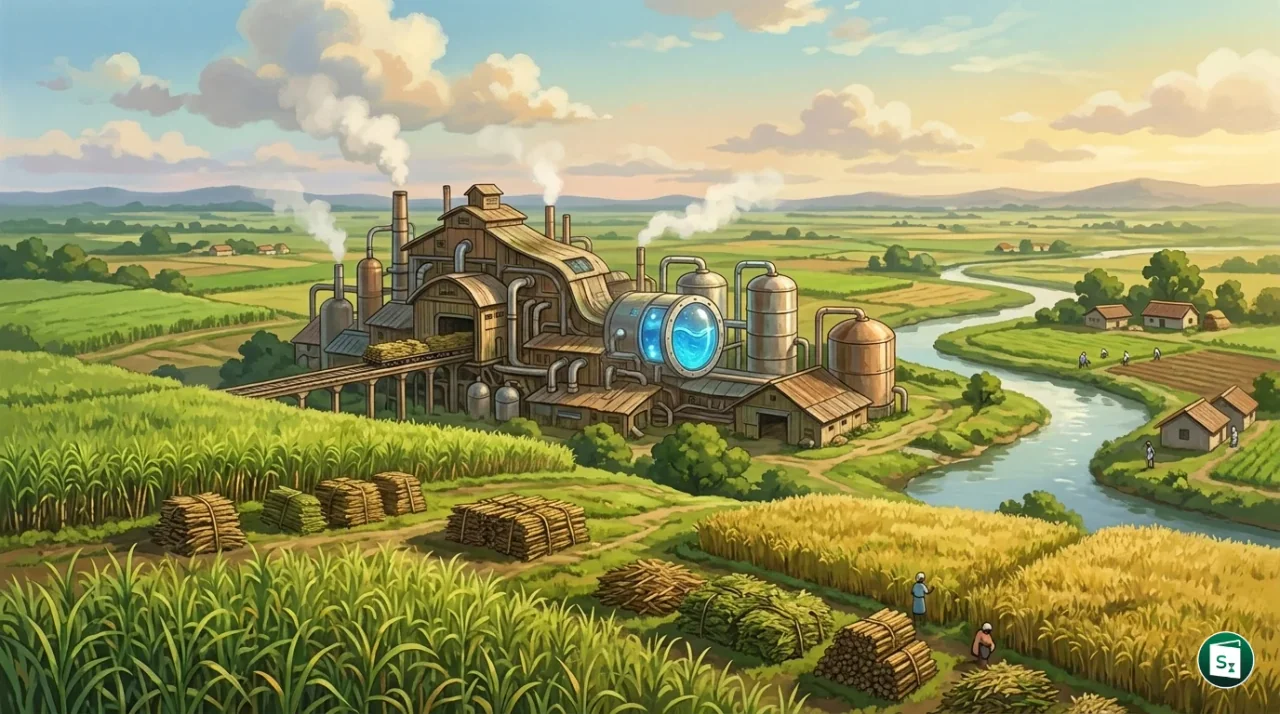
The Ministry of Petroleum and Natural Gas has approved financial assistance of Rs 150 crore for India’s first private-sector Hybrid Second-Generation (2G) Ethanol Biorefinery in Dhanaura, Uttar Pradesh. The 91 Kilo Litres Per Day (KLPD) plant will convert agricultural residues such as sugarcane bagasse into sustainable ethanol, marking a significant step towards reducing the country’s dependence on food-based feedstocks for biofuel production. The assistance is provided through the Centre for High Technology (CHT) under the PM JI-VAN Yojana.
What Is 2G Ethanol?
Ethanol, a renewable biofuel produced by fermenting sugars, has traditionally been made from food crops such as sugarcane molasses and grains. This is known as first-generation (1G) ethanol. While India has built a strong foundation on 1G ethanol to achieve its 20% blending target (E20) ahead of schedule, this approach has structural limits. It competes with food production, strains water resources, and depends on agricultural commodity prices.
Second-generation (2G) ethanol, also called advanced biofuel, is produced from lignocellulosic biomass, the fibrous, non-edible parts of plants. The feedstocks include agricultural residues such as rice straw, wheat stubble, sugarcane bagasse, corn cobs, and cotton stalks. These materials are often burned in fields after harvest, causing severe air pollution in northern India. 2G ethanol technology turns this waste into a valuable fuel source without affecting food supply.
The technology for 2G ethanol is more complex and capital-intensive than 1G production, which is why government support through schemes such as PM JI-VAN is critical to making these projects commercially viable.
The Project: India’s First Private Hybrid 2G Biorefinery
The approved biorefinery will be set up at Wave Sugar in Dhanaura, a town in the Amroha district of Uttar Pradesh. With a capacity of 91 KLPD, it is among India’s first privately developed commercial-scale 2G ethanol biorefineries. Earlier 2G projects under PM JI-VAN have been led by public sector oil marketing companies: Indian Oil Corporation (Panipat), BPCL (Bargarh, Odisha), HPCL (Bathinda, Punjab), and Numaligarh Refinery (Assam). This project marks the entry of private enterprise into advanced biofuel manufacturing at commercial scale.
The project brings together three entities. Spray Engineering Devices Limited (SED), based in Mohali, is responsible for the overall engineering, development, and execution of the biorefinery. Ankur Scientific Energy Technologies provides its indigenous oxygen-enriched biomass gasification technology. LanzaTech, a global carbon recycling company, contributes its proprietary gas fermentation platform.
How the Hybrid Technology Works
The biorefinery uses a two-stage hybrid process that combines thermochemical and biological conversion methods. In the first stage, agricultural residues such as sugarcane bagasse are fed into a gasifier developed by Ankur Scientific. The biomass is heated in a controlled oxygen environment to produce synthesis gas (syngas), a mixture of carbon monoxide, hydrogen, and carbon dioxide.
In the second stage, this syngas is passed into LanzaTech’s gas fermentation reactor. Naturally occurring microorganisms, similar to yeast used in brewing, consume the carbon-rich gases and convert them into ethanol through their metabolic processes. The ethanol is then distilled and dehydrated to meet fuel-grade purity standards.
This hybrid configuration offers a key advantage. Unlike traditional 2G ethanol plants that rely on enzymatic hydrolysis to break down biomass, the gasification-fermentation route can handle a wider variety of feedstocks without complicated pre-treatment. The same biorefinery can process different types of crop residues based on seasonal availability. Additionally, the platform creates a pathway for future production of green chemicals, sustainable aviation fuel (SAF) intermediates, and other renewable molecules beyond ethanol.
PM JI-VAN Yojana: The Policy Framework
The Pradhan Mantri JI-VAN (Jaiv Indhan Vatavaran Anukool Fasal Awashesh Nivaran) Yojana was notified by the government in March 2019 to provide financial support for setting up 2G ethanol projects using lignocellulosic biomass and other renewable feedstocks. The scheme is implemented by the Centre for High Technology (CHT), a dedicated technology cell under the Ministry of Petroleum and Natural Gas established in 1987 and registered as a society in 1992. CHT is headquartered in Noida, Uttar Pradesh.
The scheme has a total financial outlay of Rs 1,969.50 crore. It supports two categories of projects:
| Category | Number of Projects | Max Financial Assistance |
|---|---|---|
| Commercial scale | 12 | Up to Rs 150 crore each |
| Demonstration scale | 10 | Up to Rs 15 crore each |
For commercial projects, financial assistance is capped at the lower of 20% of the project cost or Rs 5 crore for every 10 lakh litres of annual nameplate capacity, subject to the Rs 150 crore ceiling.
The scheme was modified in August 2024 with key changes. The timeline was extended by five years, making it operational until FY 2028-29. The scope was broadened to include advanced biofuels from a wider range of feedstocks including forestry residues, industrial waste, synthesis gas, and algae. Additionally, “bolt-on” and “brownfield” projects became eligible, allowing existing sugar mills or distilleries to add 2G ethanol production modules.
Public sector projects already supported under the scheme include Indian Oil Corporation’s 2G paddy straw-based plant at Panipat, Haryana (the first to be dedicated to the nation in 2022), BPCL’s project at Bargarh, Odisha, HPCL’s at Bathinda, Punjab, and Numaligarh Refinery’s bamboo-based biorefinery at Numaligarh, Assam.
India’s Ethanol Blending Journey
India’s Ethanol Blended Petrol (EBP) Programme, launched in 2003, has been one of the government’s most successful energy transition initiatives. The National Policy on Biofuels 2018 set an indicative target of 20% ethanol blending by 2030, which was later advanced to 2025-26 given the rapid progress.
The milestones have been impressive. Blending rose from just 1.5% in 2014 to 10% in June 2022 (five months ahead of the November 2022 target). By 2025, India achieved the 20% blending target, a full five years ahead of the original 2030 deadline. From April 2026, the sale of E20 petrol (petrol containing 20% ethanol) has been made mandatory across the country.
| Milestone | Year | Achievement |
|---|---|---|
| EBP Programme launched | 2003 | 5% blending target |
| National Policy on Biofuels | 2018 | 20% blending target by 2030 |
| 10% blending achieved | June 2022 | 5 months ahead of schedule |
| 20% blending achieved | 2025 | 5 years ahead of 2030 target |
| E20 mandate in effect | April 2026 | All petrol sold must contain 20% ethanol |
The programme has delivered substantial economic and environmental benefits. India has saved over Rs 1.4 lakh crore in foreign exchange by reducing crude oil imports. Farmers have received more than Rs 1.18 lakh crore in payments for ethanol feedstocks. Carbon dioxide emissions have been reduced by approximately 698 lakh tonnes.
However, most of this progress has come from 1G ethanol produced from sugarcane and grains. As India looks to sustain and potentially exceed the 20% blending level, scaling up 2G ethanol production becomes essential. It offers a way to increase ethanol output without diverting food crops or putting pressure on agricultural land and water resources. This is where the Dhanaura biorefinery and similar projects gain strategic importance.
The Way Forward
The Dhanaura biorefinery represents a shift in India’s biofuel strategy from public-sector-led to public-private partnership model in advanced biofuels. By proving the commercial viability of hybrid 2G technology in the private sector, the project could encourage more private investment in this space, which has so far been dominated by oil marketing companies.
The project also addresses the long-standing problem of agricultural residue burning. Uttar Pradesh is one of India’s largest producers of sugarcane and paddy, generating vast quantities of bagasse and straw. Farmers often burn these residues to clear fields quickly, contributing to the severe air pollution episodes in Delhi-NCR during winter months. A commercial market for crop residues as biorefinery feedstock provides an economic incentive for farmers to collect and sell their waste instead of burning it.
SED has described the project as a key pillar of its Smart Village Initiative, a vision to develop decentralized bio-industrial ecosystems where agriculture, renewable energy, and advanced manufacturing converge. Beyond ethanol, the biorefinery’s technology platform can be adapted to produce sustainable aviation fuel (SAF), green chemicals, and other high-value renewable products.
As India moves towards its Net Zero by 2070 commitment, biofuels will play a crucial role in decarbonizing hard-to-abate sectors such as aviation and heavy transport. The success of projects like the Dhanaura biorefinery will determine how quickly the country can transition from food-based biofuels to a more sustainable, waste-based bio-economy.
Key Takeaways
- The Ministry of Petroleum and Natural Gas approved Rs 150 crore financial assistance for India’s first private-sector Hybrid 2G Ethanol Biorefinery in Dhanaura, Uttar Pradesh.
- The biorefinery has a capacity of 91 Kilo Litres Per Day (KLPD) and will produce ethanol from agricultural residues such as sugarcane bagasse using gasification and gas fermentation technologies.
- The PM JI-VAN Yojana was launched in March 2019 with a total outlay of Rs 1,969.50 crore and is implemented by the Centre for High Technology (CHT) under the Ministry of Petroleum and Natural Gas.
- The scheme was modified in August 2024, extending its timeline till FY 2028-29 and expanding eligibility to bolt-on and brownfield projects.
- India achieved 20% ethanol blending in petrol (E20) in 2025, five years ahead of the original 2030 target, and mandated E20 sale from April 2026.
- Second-generation (2G) ethanol is produced from lignocellulosic biomass such as crop residues and does not compete with food crops, unlike first-generation (1G) ethanol.