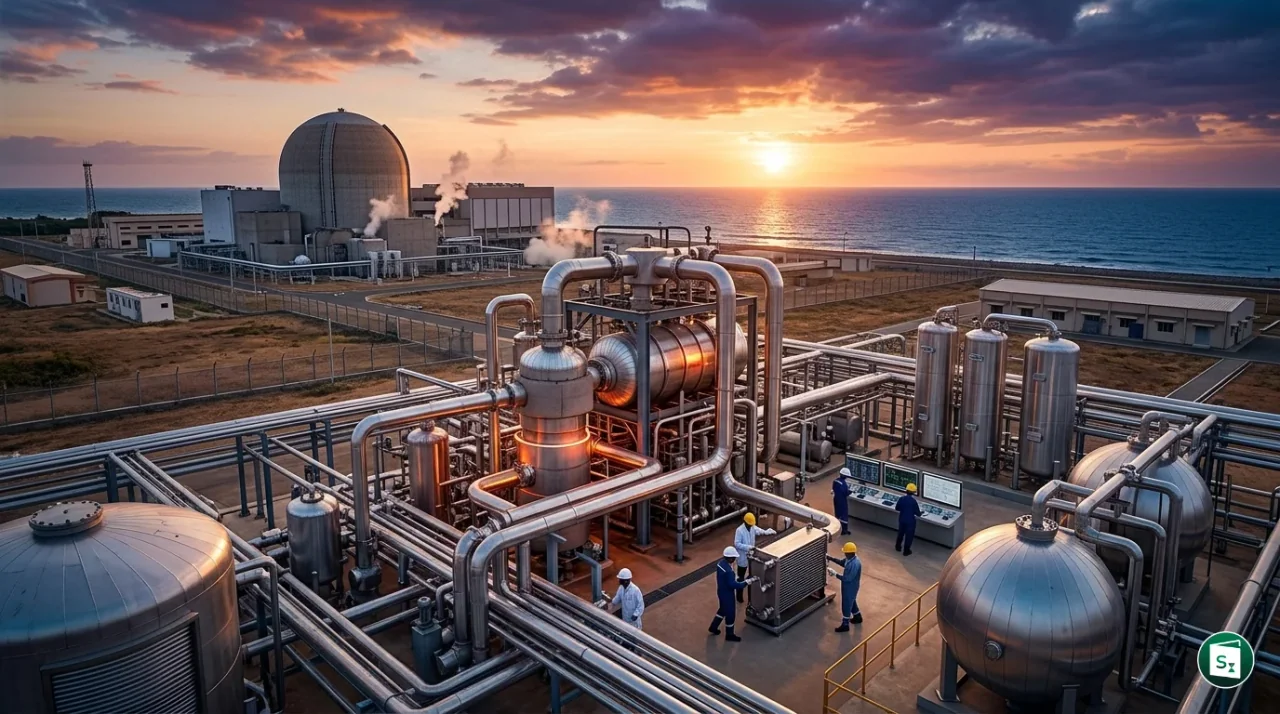
The Department of Atomic Energy (DAE) has inaugurated the world’s first hydrogen production facility that uses the Copper-Chlorine (Cu-Cl) thermochemical cycle, powered entirely by nuclear process heat from the Fast Breeder Test Reactor (FBTR) at the Indira Gandhi Centre for Atomic Research (IGCAR) in Kalpakkam, Tamil Nadu. Inaugurated by DAE Secretary and Atomic Energy Commission Chairman Ajit Kumar Mohanty in the presence of IGCAR Director Sreekumar G. Pillai, the facility marks a historic convergence of nuclear energy and clean hydrogen production. Unlike conventional methods that rely on fossil fuels, this plant produces hydrogen with zero greenhouse gas emissions, opening a new pathway for carbon-free energy in India.
Understanding the Copper-Chlorine Thermochemical Cycle
Most hydrogen today is produced through steam methane reforming (SMR), a process that uses natural gas and releases large amounts of carbon dioxide. The Cu-Cl thermochemical cycle offers a fundamentally different approach. Instead of burning fossil fuels, it uses high-temperature heat to drive a series of chemical reactions that split water into hydrogen and oxygen.
The Cu-Cl cycle is a four-step thermochemical process that operates at a maximum temperature of around 530 degrees Celsius. This is significantly lower than many other thermochemical cycles, giving it a distinct advantage in terms of energy efficiency and material requirements. The cycle involves four key reactions. First, solid copper reacts with hydrochloric acid gas at 430 to 475 degrees Celsius to produce hydrogen gas and copper chloride. Second, copper chloride reacts with steam at around 400 degrees Celsius to form copper oxychloride and hydrochloric acid. Third, copper oxychloride is decomposed at about 500 degrees Celsius to release oxygen gas and regenerate copper chloride. Finally, in an ambient-temperature electrolysis step, copper chloride is reduced back to copper metal, completing the loop.
The net result is simple: water goes in, and hydrogen and oxygen come out. All intermediate chemicals are recycled within the closed loop, making the process clean and sustainable when powered by a carbon-free heat source. The Cu-Cl cycle is one of the most promising thermochemical routes identified by the Generation IV International Forum (GIF), a collaboration of over a dozen countries developing next-generation nuclear reactors.
Why Nuclear Heat?
The Cu-Cl cycle requires sustained high-temperature heat to drive its endothermic reactions. Nuclear reactors, particularly fast reactors like the FBTR, are ideal for this purpose because they produce intense heat as a byproduct of fission. By using this heat directly instead of converting it first to electricity, the overall energy efficiency is much higher than electrolysis-based hydrogen production. The DAE facility at IGCAR is the first in the world to demonstrate this integration at a working scale.
The Fast Breeder Test Reactor: Heart of the Facility
At the core of this facility is the Fast Breeder Test Reactor (FBTR), a 40 MWt sodium-cooled, loop-type fast breeder reactor located at IGCAR. The FBTR achieved its first criticality on 18 October 1985 and is India’s only operating fast reactor research facility. It uses a unique mixed plutonium-uranium carbide fuel (70% plutonium carbide and 30% uranium carbide), making it the first reactor in the world to use this type of fuel.
The FBTR was designed and built jointly by IGCAR and BARC, with initial technical collaboration from the French Atomic Energy Commission based on the Rapsodie reactor design. Over the decades, it has generated invaluable operational data on sodium coolant technology, fast neutron physics, and fuel behaviour under high radiation. This experience directly enabled the design and construction of the 500 MWe Prototype Fast Breeder Reactor (PFBR), which marks India’s entry into the second stage of its three-stage nuclear programme.
The reactor operates with liquid sodium as the coolant, circulating at temperatures between 380 and 515 degrees Celsius. The heat generated in the core is transferred through a primary and secondary sodium loop and then to a steam generator. In this new hydrogen facility, a portion of this process heat is diverted to drive the Cu-Cl thermochemical reactions. This is the first time anywhere in the world that a fast breeder reactor has been used to produce hydrogen directly from its thermal output.
IGCAR: India’s Fast Reactor Hub
The Indira Gandhi Centre for Atomic Research (IGCAR) was established in 1971 at Kalpakkam, about 80 kilometres south of Chennai. It is the second largest establishment of the DAE after BARC and is dedicated to the research and development of sodium-cooled fast breeder reactor (FBR) technology. IGCAR has developed comprehensive expertise in reactor physics, thermal hydraulics, sodium technology, advanced materials, fuel cycle research, and high-temperature engineering. The centre also operates the KAMINI reactor, a 30 kWt uranium-233 fuelled miniature reactor used for neutron radiography and activation analysis.
Expanding Nuclear Energy Beyond Electricity
India’s three-stage nuclear power programme, conceptualised by Dr Homi J. Bhabha in the 1950s, was designed to achieve long-term energy self-sufficiency by leveraging the country’s modest uranium reserves and abundant thorium deposits. Stage I uses natural uranium-fueled Pressurised Heavy Water Reactors (PHWRs) to produce electricity and plutonium-239. Stage II employs Fast Breeder Reactors (FBRs) that use plutonium-based fuel to breed more fissile material while converting thorium-232 into uranium-233 for use in Stage III. Stage III will deploy advanced thorium-based reactors, completing the cycle.
Until now, the focus of India’s nuclear programme has been almost exclusively on electricity generation. The hydrogen production facility at IGCAR represents a strategic expansion into non-electric applications of nuclear energy. Nuclear reactors produce both electricity and high-temperature process heat, and the latter can be used directly in industrial processes such as hydrogen production, desalination, and district heating without first converting it to electricity.
This is particularly significant for India’s decarbonisation goals. Hard-to-abate sectors such as steel, fertiliser, cement, and heavy transport are difficult to electrify directly. Hydrogen produced from nuclear heat can serve as a clean fuel and chemical feedstock for these industries, offering a viable pathway to reduce emissions where renewable electricity alone cannot reach.
India’s Hydrogen Ecosystem: The Bigger Picture
The inauguration of this facility aligns with India’s broader push to become a global hub for hydrogen production. The National Green Hydrogen Mission, approved by the Union Cabinet in January 2023 with an outlay of ₹19,744 crore, targets a production capacity of 5 million metric tonnes (MMT) of green hydrogen per year by 2030. This is expected to attract over ₹8 lakh crore in investments and create more than 6 lakh jobs.
The mission is implemented by the Ministry of New and Renewable Energy (MNRE) and includes the Strategic Interventions for Green Hydrogen Transition (SIGHT) programme, which provides financial incentives for electrolyser manufacturing and green hydrogen production. Pilot projects have been launched in steel, shipping, and transport sectors.
While the National Green Hydrogen Mission focuses on hydrogen produced from renewable energy (green hydrogen), the nuclear route offers a complementary path. Nuclear hydrogen is also carbon-free but does not suffer from the intermittency of solar and wind power. A nuclear reactor can produce hydrogen around the clock, making it suitable for base-load industrial demand. The IGCAR facility demonstrates that nuclear hydrogen can be a reliable, continuous source of clean fuel alongside the renewable-driven green hydrogen ecosystem.
Significance and the Way Forward
The Cu-Cl hydrogen production facility at IGCAR is a technology demonstrator, not a commercial plant. Its primary purpose is to validate the integration of nuclear process heat with thermochemical hydrogen production under real operating conditions. The data gathered from this facility will be critical for scaling up the technology to commercial levels. The DAE has indicated that the lessons learned will inform the design of future nuclear-assisted hydrogen plants coupled with advanced reactor systems.
This project also reinforces India’s commitment to Atmanirbhar Bharat (self-reliant India) by showcasing indigenous technological capability. The Cu-Cl process was developed entirely in-house by BARC, and the engineering integration with the FBTR was executed by IGCAR. No foreign technology transfer was involved.
For the Indian nuclear programme, this facility opens a new revenue stream for nuclear reactors beyond electricity sales. As India builds more FBRs in the coming decades, each reactor could potentially co-produce hydrogen, improving the economics of nuclear power and accelerating the country’s clean energy transition. The PFBR at Kalpakkam, once fully operational, and future commercial FBRs could be designed with hydrogen production as an integrated function.
Globally, the success of this facility positions India at the forefront of nuclear hydrogen research. Countries such as Canada, the United States, and Japan have been researching the Cu-Cl cycle for years, but India has become the first to commission a working facility. This gives India a first-mover advantage in a technology that could become a cornerstone of the global clean energy system.
Key Takeaways
- The DAE has inaugurated the world’s first hydrogen production facility based on the Copper-Chlorine (Cu-Cl) thermochemical cycle using nuclear process heat from the FBTR at IGCAR, Kalpakkam, Tamil Nadu.
- The Cu-Cl cycle operates at a maximum temperature of 530 degrees Celsius and uses four chemical reactions to split water into hydrogen and oxygen, with all intermediate chemicals recycled.
- The FBTR is a 40 MWt sodium-cooled fast breeder reactor that achieved criticality in October 1985 and is India’s only operating fast reactor research facility.
- The hydrogen production technology was developed indigenously by BARC, established in 1954 (as AEET) and headquartered in Trombay, Mumbai.
- IGCAR was established in 1971 and is the DAE’s second largest establishment, dedicated to fast breeder reactor technology.
- The facility expands India’s three-stage nuclear programme beyond electricity generation into non-electric applications such as clean hydrogen production.
- This aligns with the National Green Hydrogen Mission (2023), which targets 5 MMT annual green hydrogen production by 2030 with an outlay of ₹19,744 crore.