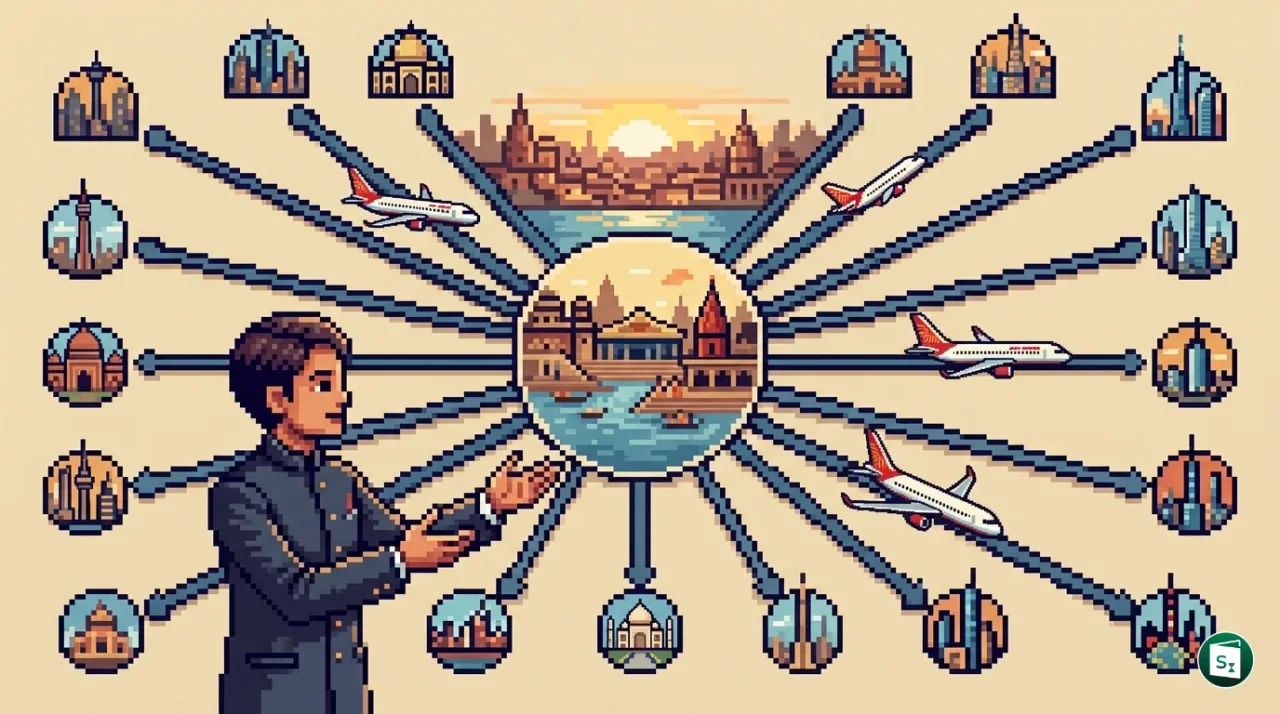
India launched its first hub-and-spoke flight service on June 25, 2026, with Civil Aviation Minister K Ram Mohan Naidu inaugurating Air India flight AI1111 at the Lal Bahadur Shastri International Airport in Varanasi, Uttar Pradesh. Branded as Easy Connect, the service permits passengers to complete international immigration and baggage check-in at Varanasi before flying to Delhi, where they can seamlessly connect to 17 overseas destinations. The rollout marks the operational beginning of the government’s hub-and-spoke aviation model, which aims to transform how travellers from India’s smaller cities access international air travel.
What Is the Hub-and-Spoke Model?
The hub-and-spoke model is a network design where a central airport, called the hub, serves as a transfer point for flights arriving from multiple smaller airports, called spokes. Instead of operating direct point-to-point flights between every pair of cities, airlines funnel traffic through a hub, allowing passengers from many smaller cities to reach a wider range of destinations using fewer flights.
In the Indian context, a city like Varanasi acts as a spoke, while Delhi’s Indira Gandhi International Airport serves as the hub. Passengers flying from Varanasi to London, for example, take a feeder flight to Delhi and then connect to an international flight at the same airport, with all immigration and customs procedures completed at the point of origin.
The Ministry of Civil Aviation (MoCA) issued the standard operating procedures for the hub-and-spoke model in April 2026 after extensive stakeholder consultations. The SOP laid down clear protocols for passenger processing, baggage handling, immigration, customs, and transit operations. Under these rules, immigration and customs clearance happen at the first port of departure, while baggage is transferred airside at the hub airport without requiring passengers to collect and re-check it.
Easy Connect: How the Service Works
Air India’s Easy Connect service operates under the dedicated AI11XX flight numbering series, creating a distinct identity for hub-and-spoke operations. The inaugural flight AI1111 departs Varanasi daily at 09:50 and arrives in Delhi at 11:00. Within four hours of landing in Delhi, passengers can connect to 17 international destinations across Europe, West Asia, and Southeast Asia.
| Region | Destinations |
|---|---|
| Europe | London Heathrow, Frankfurt, Milan, Rome, Zurich, Vienna, Copenhagen |
| Southeast Asia | Singapore, Bangkok, Phuket, Kuala Lumpur, Manila, Ho Chi Minh City |
| West Asia | Dubai, Riyadh, Jeddah |
| South Asia | Colombo, Kathmandu |
For passengers, the service works as follows. They check in at Varanasi for their entire journey and receive boarding passes for both the domestic and international legs. Baggage is tagged through to the final overseas destination. Immigration formalities are completed at Varanasi itself, so passengers transit through Delhi as international travellers without needing to clear immigration again.
Indian passport holders using the service must enroll in the DigiYatra app and upload their boarding passes before departure. Web check-in is not available for Easy Connect flights, and passengers are required to arrive at the spoke airport at least three hours before departure to allow time for the additional processing. Customs declaration facilities are currently not available at spoke airports, so passengers carrying high-value dutiable goods are advised to use alternate flights.
Why Varanasi Was Chosen as the First Spoke City
Varanasi was selected as the launch city for several strategic reasons. The city is the parliamentary constituency of Prime Minister Narendra Modi, and its airport has already been designated as an international airport. Lal Bahadur Shastri International Airport is the second-busiest airport in Uttar Pradesh and handled more than 43 lakh passengers in 2025-26. It was awarded the best airport in the Asia-Pacific region in the 2 to 5 million passenger category by the Airports Council International in 2020.
The airport is currently undergoing a massive Rs 2,870 crore expansion that will transform its capacity. The project includes a new 75,000 square metre terminal building designed with architectural elements inspired by the Kashi Vishwanath Temple, extension of the runway from 2,750 metres to 4,075 metres, a new apron to park 20 aircraft, and a first-of-its-kind underpass for National Highway 31 running beneath the runway. Once completed, the airport’s annual passenger handling capacity will increase from 3.9 million to 9.9 million.
Speaking at the launch, Minister Naidu said the airport would be upgraded to match Delhi’s facilities within 13 months, with the new terminal expected to be inaugurated by December 2026. The terminal will feature 72 check-in counters, eight aerobridges, modern baggage handling systems, and multi-level car parking.
Reducing Dependence on Foreign Transit Hubs
The hub-and-spoke model addresses a fundamental weakness in India’s aviation ecosystem. According to Air India, nearly 2.5 crore passengers travel on long-haul international routes to and from India every year. Of these, about 2 crore are connecting travellers who change planes midway. Alarmingly, around 1.7 crore of these connecting passengers, or 85%, currently transit through foreign airports in the Gulf and Southeast Asia rather than through Indian hubs.
This means that Indian travellers flying from cities like Varanasi, Amritsar, or Patna to destinations in Europe or North America often first fly to Dubai, Doha, or Singapore, clear immigration there, and then board a connecting flight. This outflow of transit traffic represents a significant economic loss for India in terms of airport revenues, passenger spending, and aviation sector growth.
The Easy Connect model is designed to reverse this trend by offering a seamless alternative. By enabling passengers to complete all formalities at their home airport and transit through Indian hubs, the government aims to retain this traffic within the country. Air India CEO Campbell Wilson noted that families from tier 2 and tier 3 cities should not have to navigate unfamiliar transit environments abroad. They should be able to begin their international journey from their home city and connect seamlessly on their own soil.
The Ministry of Civil Aviation has set a long-term vision of making India the aviation hub of choice for domestic passengers by 2030 and a global aviation hub by 2047.
Plans for Nationwide Expansion
Varanasi is only the beginning. Minister Naidu announced that six more cities will be brought under the hub-and-spoke model within the next six weeks. Air India has outlined plans to roll out Easy Connect services from 11 additional spoke cities in the coming months, including Amritsar, Ahmedabad, Chennai, Goa, Guwahati, Hyderabad, Kochi, Mumbai, Patna, Vadodara, and Visakhapatnam.
Four major airports have been identified as primary hubs for the first phase: Delhi, Mumbai, Bengaluru, and Rajkot. As the lead carrier, Air India will anchor and coordinate the phased implementation of the model across these hubs. Other airlines such as IndiGo and Akasa Air are also expected to join the framework as the ecosystem expands.
The hub-and-spoke network is also expected to integrate with the UDAN regional connectivity scheme, which has already helped develop airport infrastructure in tier 2 and tier 3 cities. By linking UDAN airports to international hubs, the government aims to create a comprehensive connectivity grid that serves even the remotest parts of the country.
Key Takeaways
- Civil Aviation Minister K Ram Mohan Naidu inaugurated India’s first hub-and-spoke flight on June 25, 2026, at Lal Bahadur Shastri International Airport, Varanasi.
- The service, designated Air India flight AI1111 under the Easy Connect initiative, connects Varanasi to 17 international destinations via Delhi within a four-hour connection window.
- Under the hub-and-spoke model, passengers complete immigration and through check-in at the spoke airport and transit through the hub as international travellers without re-checking baggage.
- Nearly 1.7 crore out of 2 crore connecting passengers from India currently transit through foreign hubs. The model aims to retain this traffic within Indian airports.
- Six more spoke cities will be added within six weeks, with plans to eventually cover 11 additional cities including Amritsar, Ahmedabad, Chennai, and Hyderabad.
- Lal Bahadur Shastri International Airport is undergoing a Rs 2,870 crore expansion, including a new terminal and runway extension, to increase capacity from 3.9 million to 9.9 million passengers per annum.
- The Ministry of Civil Aviation issued the SOP for hub-and-spoke operations in April 2026, requiring DigiYatra enrolment for Indian nationals using the service.