On 26 June 2026, Union Minister for Ports, Shipping and Waterways Sarbananda Sonowal inaugurated the new Captain of Ports Terminal Building in Panaji, Goa. The Rs 48.87 crore waterfront facility, built by the Goa State Infrastructure Development Corporation (GSIDC), strengthens the state’s maritime administration and navigational infrastructure. Alongside the inauguration, Sonowal announced that the Goa Water Metro project, valued at Rs 3,146 crore, has been moved to Phase-I implementation priority, marking a significant step towards sustainable urban mobility on Goa’s waterways.
A Landmark Maritime Facility for Goa
The new Captain of Ports Terminal Building is a G+3 structure spanning more than 4,405 square metres. Located along the banks of the Mandovi River, the building takes its architectural inspiration from a ship docked at the waterfront. It has been built on a pile foundation using a composite steel-and-reinforced-concrete structure to enhance durability along the riverfront.
The terminal replaces the old Captain of Ports office, which had become inadequate for the department’s expanding operational requirements. The new facility houses the Captain of Ports Department along with modern passenger facilities, a double-height public lobby, conference facilities, marine and hydrographic offices, navigational control infrastructure, a radio communications centre, and public amenities. It also features a rooftop amphitheatre and an indoor restaurant with a seating capacity of about 450, enabling the facility to host public and maritime events while generating additional revenue.
Speaking at the inauguration, Sonowal described the facility as the “Gateway to the Riverbanks of Goa” and said it reflects the state’s rich maritime heritage while creating a foundation for sustainable connectivity, tourism, and inland water transport. He linked the project to Prime Minister Narendra Modi’s vision of “Vikas Bhi, Virasat Bhi” (Development as well as Heritage).
The inauguration was attended by Goa Chief Minister Pramod Sawant, Union Minister of State for Power and New and Renewable Energy Shripad Naik, Goa Minister for Captain of Ports Digambar Kamat, Goa Minister for River Navigation Subhash Phal Dessai, Members of Parliament, and senior government officials.
What Is the Captain of Ports Department?
The Captain of Ports Department is the nodal agency responsible for the development and regulation of inland waterways and minor ports in Goa. Goa has about 555 km of inland waterways, of which 255 km are navigable through the Mandovi and Zuari rivers and their tributaries.
The department carries out periodic hydrographic surveys, dredging of rivers, maintenance of lighthouses and beacons, and provides navigational aids and landing facilities for both passenger and cargo vessels. It implements key legislations including the Indian Ports Act, 1908, the Inland Vessels Act, 1917, and state-specific acts such as the Goa, Daman and Diu Barge Tax Act, 1973. The department also registers mechanised and non-mechanised vessels, covering cargo, fishing, passenger, and tourist vessels, at its offices in Panaji and Mormugao.
About GSIDC: The Project Developer
The terminal was developed by the Goa State Infrastructure Development Corporation Limited (GSIDC), a wholly owned government company of the Government of Goa. GSIDC was established in 2001 under the Companies Act, 1956 and operates as a Special Purpose Vehicle (SPV) for the speedy implementation of infrastructure projects across the state.
GSIDC handles projects spanning roads, bridges, flyovers, bus stands, water supply augmentation, hospitals, tourism facilities, and maritime infrastructure. It acts as a coordinating agency between client departments, consultants, and contractors to execute projects on a fast-track basis. The corporation is headquartered at EDC House in Panaji and is modeled on lines similar to infrastructure corporations in other states, such as MSRDC in Maharashtra.
The Goa Water Metro: From Later Phase to Phase-I Priority
The most significant policy announcement during the event concerned the Goa Water Metro project. Sonowal stated that the project, which was earlier envisaged for a later phase, has now been brought under Phase-I implementation priority. This decision followed a formal request from Chief Minister Pramod Sawant during a recent visit to New Delhi.
The project was originally part of a broader central government plan for water metro systems across several states. While Maharashtra and West Bengal were placed in the first phase, Goa was initially slotted into the second phase. The Ministry has now elevated Goa’s status, allowing the state to move forward on an accelerated timeline alongside Maharashtra.
River Navigation Minister Subhash Phal Dessai noted that Goa’s daily passenger movement on waterways is currently around 50,000, and the water metro could increase this to 1 lakh once both commuters and tourists are included. The government plans to create a special purpose vehicle for implementation.
How the Water Metro Will Work
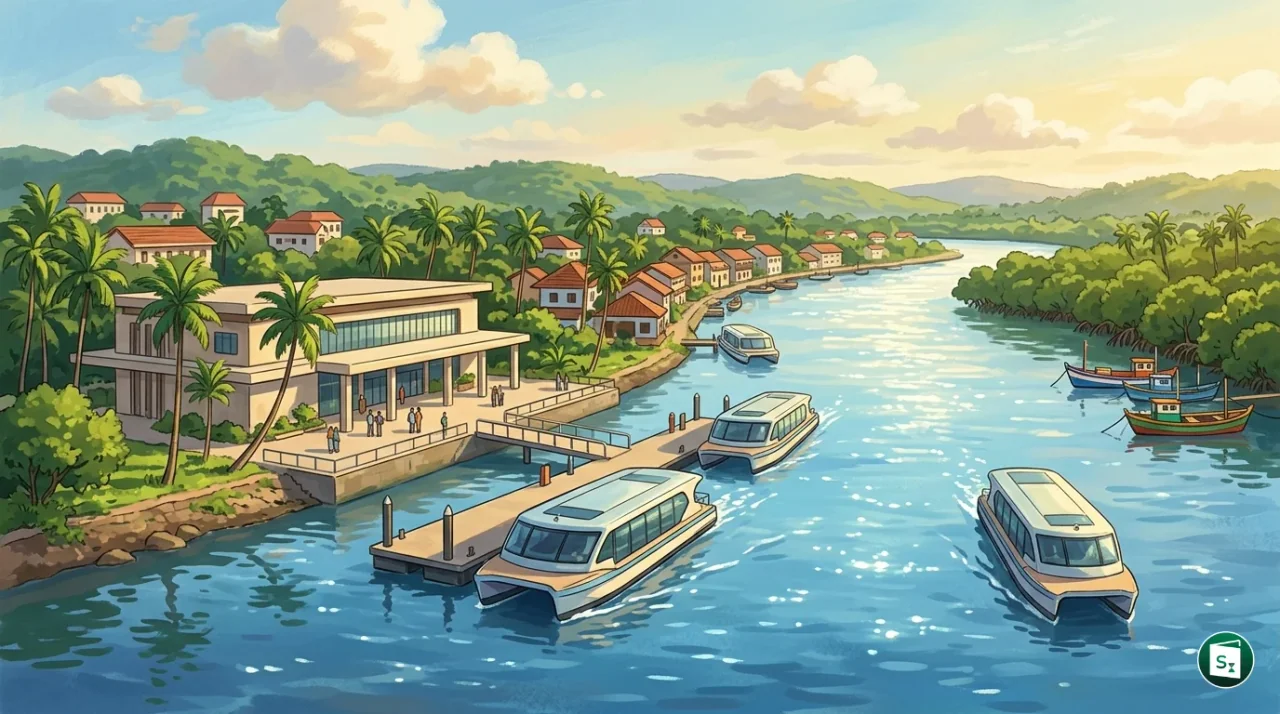
The proposed Goa Water Metro envisages a 111 km river transit network connecting nine major terminal hubs across the state. A feasibility study covering 28 locations identified eight viable routes for a fleet of 87 high-speed vessels.
Proposed corridors include:
- Panaji to Narve
- Betim to Old Goa
- Vasco to Cortalim
- Panaji to Chapora
Daily ridership is projected to grow from over 43,240 passengers initially to more than 60,600 by 2041. The system is designed as an environmentally friendly alternative to road transport and is expected to ease congestion on Goa’s roads, improve last-mile connectivity, and boost tourism by allowing visitors to explore coastal areas, forts, temples, and churches from the waterways.
The vessels would operate alongside existing ferries and would not affect fishing activities. Stations will be built along river banks, with floating pontoons to handle tidal variations, similar to the Kochi model.
Kochi Water Metro: The Model for Goa
The Goa Water Metro is inspired by the Kochi Water Metro in Kerala, which is India’s first and Asia’s largest integrated water transport system. Kochi’s system operates electric-hybrid boats across 12 terminals on 6 routes, covering 28 km. It has served over 5.5 million passengers since its commercial launch in April 2023.
| Feature | Kochi Water Metro | Goa Water Metro (Proposed) |
|---|---|---|
| Network length | 76 km (full) | 111 km |
| Terminals | 38 (full), 12 (operational) | 9 major hubs |
| Vessels | 78 electric-hybrid boats | 87 high-speed vessels |
| Daily ridership (projected) | 34,000 (current) | 43,240+ |
| Battery type | Lithium Titanate Oxide (LTO) | To be decided |
Kochi’s water metro uses Lithium Titanate Oxide (LTO) batteries that can be charged in 10 to 15 minutes and are among the safest commercially available battery technologies. The system is integrated with the Kochi Metro rail network and offers seamless intermodal connectivity.
A Broader Maritime Push for Goa
The terminal inauguration and water metro announcement are part of a larger maritime development push for the state. Sonowal announced that projects worth over Rs 2,000 crore would be brought to Goa to boost its maritime sector. This builds on infrastructure projects worth over Rs 1,300 crore already completed by the Mormugao Port Authority (MPA) since 2014.
MPA, which operates one of India’s 12 major ports, has emerged as a leader in sustainable port operations. It was declared India’s first accredited green port in 2025 under the Green Port Certification Programme and was among the three Indian ports selected by the World Bank for port greening projects. MPA has operationalised a 3 MW solar power plant, with plans to expand it to 5 MW.
Key upcoming projects include:
- Redevelopment of Berth No. 9
- Development of Vasco Harbour
- Capital dredging and other strategic initiatives
The Minister also noted that the proposed Goa Maritime Board would be constituted before 30 September 2026. Once formed, the Board will work jointly with MPA to prepare a master plan for the development of Goa’s coastline.
The old Captain of Ports building will be repurposed. According to Captain of Ports Octavio Rodrigues, the ground and first floors will be used for surveying vessels and other departmental purposes, while the top floor will house a disaster management cell.
Alignment with National Maritime Vision
The new Captain of Ports Terminal aligns with the government’s broader vision under the Sagarmala Programme and the Maritime India Vision 2030. The Sagarmala Programme, launched in March 2015, is a flagship initiative of the Ministry of Ports, Shipping and Waterways aimed at promoting port-led development in India. It focuses on port modernisation, connectivity enhancement, port-linked industrialisation, and coastal community development. As of 2026, over 840 projects worth approximately Rs 5.8 lakh crore are being implemented under the programme.
The Maritime India Vision 2030, released in 2021, includes over 150 strategic initiatives to modernise ports, expand shipping capacity, and strengthen inland waterways, while embedding sustainability and skill development at its core.
Sonowal also highlighted national maritime achievements under Prime Minister Modi, including the near-doubling of major port capacity, reduction of vessel turnaround time from 95 hours to 41 hours, and the increase in operational inland waterways from 3 to 32.
Key Takeaways
- Union Minister Sarbananda Sonowal inaugurated the new Captain of Ports Terminal Building in Panaji on 26 June 2026.
- The Rs 48.87 crore waterfront facility was developed by GSIDC, a wholly owned government company established in 2001.
- The G+3 building spans 4,405 square metres, is designed like a docked ship, and overlooks the Mandovi River.
- The Goa Water Metro project, worth Rs 3,146 crore, has been elevated to Phase-I implementation priority after being initially placed in the second phase.
- Modeled on the Kochi Water Metro (India’s first water metro), Goa’s system envisages a 111 km network with 87 vessels and nine major terminal hubs.
- Projects worth over Rs 2,000 crore have been announced for Goa’s maritime sector, building on Rs 1,300 crore of completed work by MPA since 2014.
- Mormugao Port Authority became India’s first accredited green port in 2025 under the Green Port Certification Programme.