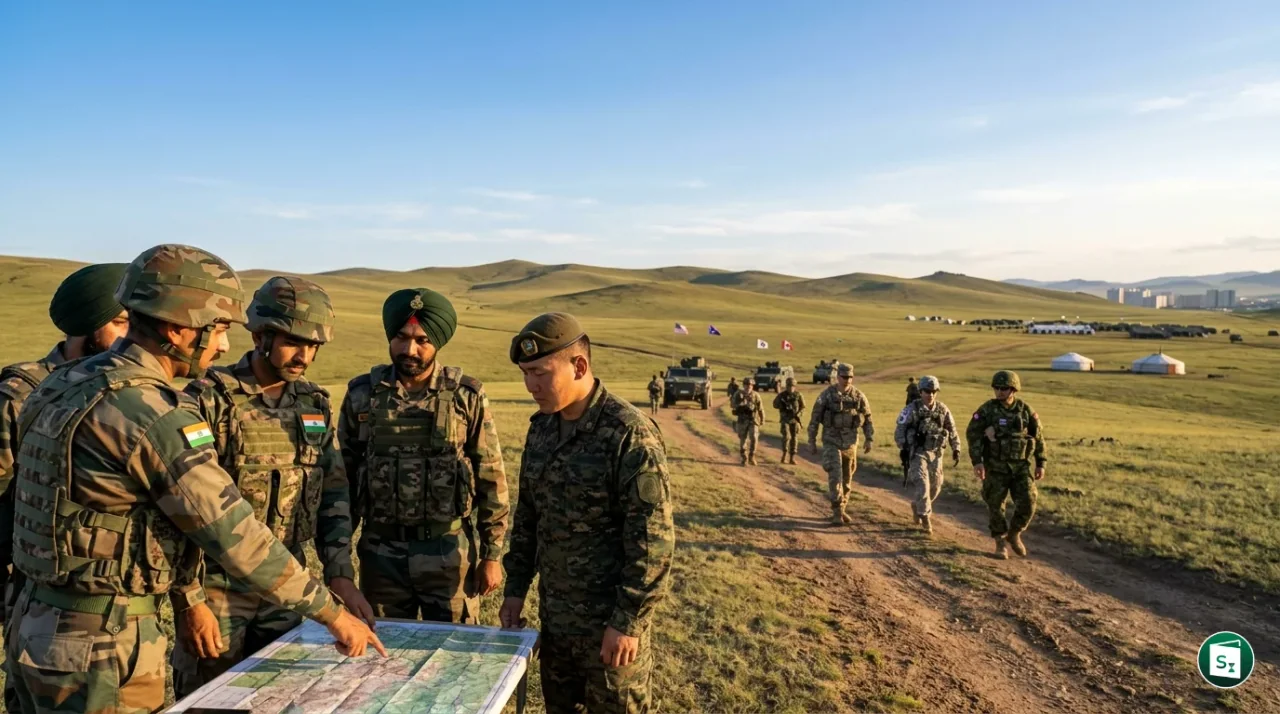
The Indian Army has deployed a 40-member contingent to Mongolia for the 23rd edition of Exercise Khaan Quest 2026, a multilateral peacekeeping drill being held from June 20 to July 3 at the Five Hills Training Area in Ulaanbaatar. The exercise brings together over 1,100 troops from 18 countries under a United Nations mandate to enhance interoperability in peace support operations. India’s participation, led by troops from the JAT Regiment, reinforces its longstanding commitment to UN peacekeeping and strategic defence cooperation with Mongolia.
What Is Exercise Khaan Quest?
Exercise Khaan Quest is an annual multinational peacekeeping exercise hosted by the Mongolian Armed Forces (MAF) at the Five Hills Training Area near Ulaanbaatar. It began in 2003 as a bilateral training event between the United States and Mongolia, and expanded into a multilateral exercise from 2006 onwards. The 2026 edition marks the 23rd iteration of the exercise and also coincides with the 20th anniversary of its transformation into a multinational peacekeeping platform.
The exercise is structured around Chapter VII of the United Nations Charter, which empowers the UN Security Council to authorise enforcement action in situations involving threats to international peace and security. All participating contingents train to common UN standards so that multinational forces can operate seamlessly under a unified command structure during real-world peacekeeping deployments.
The 23rd Edition at a Glance
The 2026 edition of Khaan Quest features over 1,100 military personnel from 18 countries, making it one of the largest peacekeeping training exercises in the region. The opening ceremony was inaugurated by Batlut Damba, Mongolia’s Defence Minister, and Lieutenant General Ganbyamba Sunrev, Chief of Defence Staff of the Mongolian Armed Forces.
| Aspect | Detail |
|---|---|
| Edition | 23rd |
| Duration | June 20 to July 3, 2026 |
| Location | Five Hills Training Area, Ulaanbaatar, Mongolia |
| Total Participants | Over 1,100 troops |
| Participating Nations | 18 countries including India, US, South Korea, Germany, Japan, and others |
| Host | Mongolian Armed Forces |
| Exercise Type | Command Post Exercise and Field Training Exercise |
| UN Mandate | Chapter VII of the UN Charter |
India’s Contingent and the JAT Regiment
The Indian Army contingent consists of 40 personnel drawn from a battalion of the JAT Regiment, supplemented by personnel from other Arms and Services. The JAT Regiment is one of the oldest and most decorated infantry regiments of the Indian Army, with its origins tracing back to 1795 when the Calcutta Native Militia was raised. The regiment was formally established as the 9th Jat Regiment in January 1922 during the British Indian Army’s reorganisation. Its Regimental Centre is located at Bareilly, Uttar Pradesh, and its motto is “Sangathan Va Veerta” (Unity and Valour) .
The regiment has an outstanding battle record, having fought in both World Wars, the India-Pakistan conflicts of 1947, 1965, and 1971, and the Kargil War of 1999. It remains one of the most highly decorated regiments in the Indian Army, with gallantry awards including two Ashok Chakras, one Victoria Cross, and eight Maha Vir Chakras.
India’s participation in Khaan Quest follows a consistent pattern of sending different regiments each year.
Training Agenda and Tactical Drills
The exercise comprises both a Command Post Exercise (CPX) and a Field Training Exercise (FTX), designed to simulate realistic peacekeeping scenarios under UN mandates. The drills focus on joint planning and coordinated execution among multinational forces.
| Tactical Drill | Purpose |
|---|---|
| Static and Mobile Checkpoints | Establishing security perimeters and monitoring movement |
| Cordon and Search Operations | Clearing hostile areas and searching for threats |
| Patrolling | Maintaining security presence and gathering intelligence |
| Civilian Evacuation | Extracting civilians from hostile or conflict zones |
| Counter-IED Drills | Detecting and neutralising improvised explosive devices |
| Combat First Aid | Providing immediate medical care in combat conditions |
| Casualty Evacuation | Transporting injured personnel to medical facilities |
| Convoy Protection | Securing supply and troop movement routes |
The training environment is designed to build inter-operability among forces with diverse military traditions and equipment. Participating contingents practise these drills to common UN standard operating procedures, ensuring that troops from different countries can operate cohesively under a unified command structure. The Indian contingent has been actively engaged in all these training lanes alongside soldiers from partner nations.
Humanitarian Assistance and Civil Protection
A significant component of the exercise involves Humanitarian Assistance and Disaster Response (HADR) scenarios. Troops train in protecting UN assets and personnel, managing crowd control situations, and providing humanitarian assistance to civilians affected by conflict. These modules mirror the complex ground realities that peacekeepers face in actual UN missions across Africa, the Middle East, and Asia.
Women, Peace and Security
For the first time in recent editions, the 2026 exercise includes a dedicated ‘Women, Peace and Security’ segment. This module highlights gender-sensitive peacekeeping approaches, including protection of civilians, community engagement, and inclusive strategies for conflict and post-conflict environments. The segment aligns with UN Security Council Resolution 1325, which recognises the disproportionate impact of armed conflict on women and calls for their equal participation in peace processes.
India’s previous participation in Khaan Quest has included women officers and soldiers. In the 2025 edition, the Indian contingent from the Kumaon Regiment included one Woman Officer and two Women Soldiers, reflecting the Indian Army’s growing integration of women in combat and peacekeeping roles.
India’s Commitment to UN Peacekeeping
India has one of the longest and most distinguished records in UN peacekeeping. Since its first deployment in 1950 to the Korean War, India has contributed over 2.5 lakh troops to more than 50 UN missions across Africa, the Middle East, Asia, and the Caribbean. India is among the largest troop-contributing countries (TCCs) in the history of UN peacekeeping, with over 6,000 personnel currently deployed in missions including MONUSCO in the Democratic Republic of the Congo, UNMISS in South Sudan, and UNIFIL in Lebanon.
The Indian Army has also suffered the highest number of casualties among all TCCs, with 179 Indian peacekeepers having laid down their lives while serving under the UN flag. India’s participation in exercises like Khaan Quest ensures that its troops remain trained in the latest peacekeeping doctrines and are ready to operate alongside multinational forces in complex operational environments.
Chapter VII of the UN Charter
The exercise is conducted specifically under Chapter VII of the UN Charter, which deals with “Action with Respect to Threats to the Peace, Breaches of the Peace, and Acts of Aggression.” Chapter VII gives the UN Security Council the authority to authorise enforcement measures, including the use of military force, to restore international peace and security. Peacekeeping operations under Chapter VII are more robust in nature, allowing forces to use force beyond self-defence in carrying out their mandates. This distinguishes them from traditional Chapter VI peacekeeping operations, which rely on consent and negotiation.
India-Mongolia Defence Cooperation
India and Mongolia share a long history of diplomatic relations, established in 1955. The bilateral defence partnership has grown significantly in recent years through regular military exchanges, joint exercises, and high-level visits. The 12th Joint Working Group (JWG) meeting between the Defence Ministries of both countries was held in Ulaanbaatar in May 2026, co-chaired by Joint Secretary (International Cooperation) Amitabh Prasad and State Secretary of the Ministry of Defence of Mongolia Brigadier General Gankhuyag Davagdorj.
The two nations conduct a dedicated bilateral military exercise called Nomadic Elephant, which was first held in 2004. The 17th edition of Nomadic Elephant concluded in Ulaanbaatar on June 13, 2026, just days before the start of Khaan Quest. The exercise alternates between India and Mongolia and focuses on counter-terrorism operations in mountainous and semi-urban terrain under a UN mandate. The 16th edition was held in Umroi, Meghalaya in 2024.
| Bilateral Exercise | Details |
|---|---|
| Nomadic Elephant | Annual bilateral exercise since 2004; 17th edition held in May-June 2026 |
| Focus Areas | Counter-terrorism, peacekeeping operations, mountainous and semi-urban warfare |
| Venue | Alternates between India and Mongolia |
| Khaan Quest (Multilateral) | India has participated regularly; sends different regiments each year |
Mongolia occupies a strategically important location between Russia and China, and India’s engagement with Ulaanbaatar is a key component of its Act East Policy and Extended Neighbourhood strategy. Defence diplomacy through exercises like Khaan Quest and Nomadic Elephant strengthens military-to-military ties, builds mutual trust, and enhances India’s strategic footprint in Central Asia.
Key Takeaways
- Exercise Khaan Quest 2026 is the 23rd edition of the multilateral peacekeeping exercise hosted by Mongolia at the Five Hills Training Area in Ulaanbaatar.
- The exercise began in 2003 as a bilateral drill between the US and Mongolia, and became a multilateral exercise from 2006.
- Over 1,100 troops from 18 countries are participating in the 2026 edition, which runs from June 20 to July 3, 2026.
- The Indian Army contingent comprises 40 personnel led by troops from the JAT Regiment, whose Regimental Centre is at Bareilly, Uttar Pradesh.
- The exercise is conducted under Chapter VII of the UN Charter, which authorises the UN Security Council to take enforcement action against threats to international peace.
- India and Mongolia also conduct a bilateral exercise called Nomadic Elephant (since 2004), focused on counter-terrorism in mountainous terrain under a UN mandate.