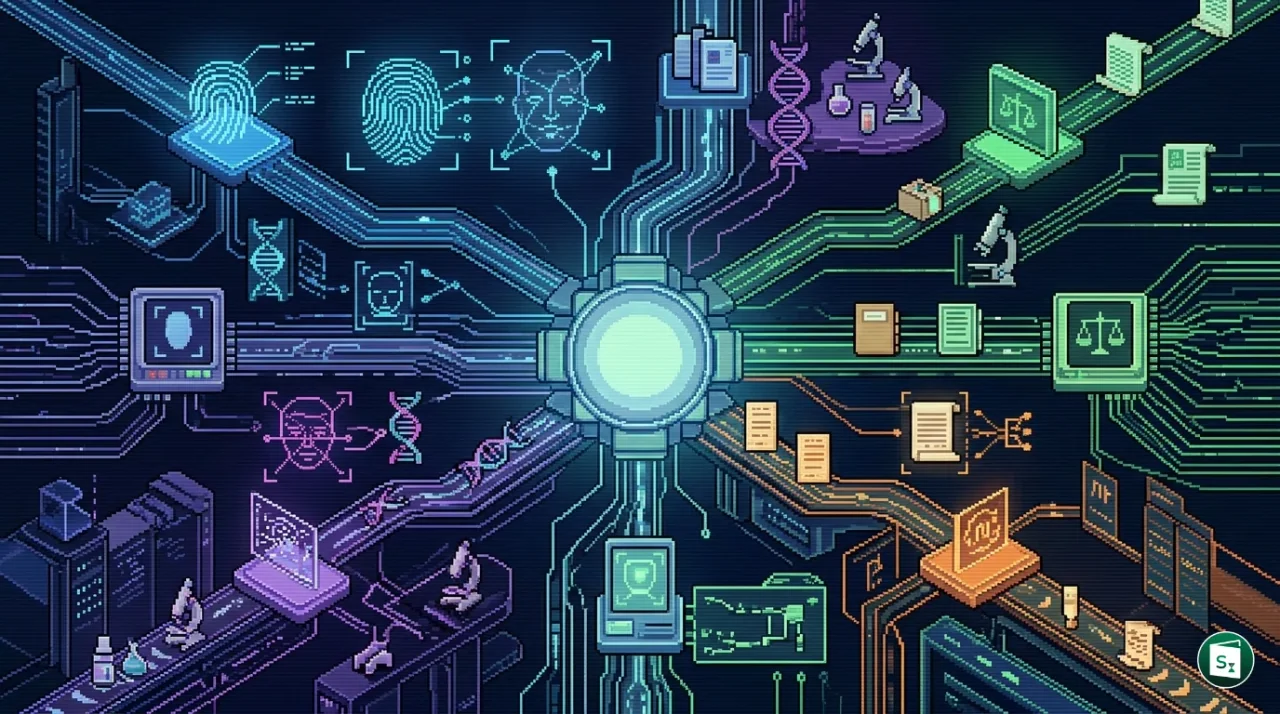
Union Home Minister Amit Shah launched four digital policing applications on June 19, 2026, at the 26th All India Fingerprint Conference held at the NCRB headquarters in New Delhi. The applications NCRB-Abhigyan, Criminal Procedure Identification (CrPI), e-Prosecution 2.0, and e-Forensics 2.0 are designed to create an end-to-end digital pipeline from crime scene investigation to courtroom conviction. These platforms bring the power of artificial intelligence, biometric identification, and real-time data sharing to every stage of the criminal justice process, aligning with the government’s objective of ensuring justice within three years of an FIR being registered.
The Four Applications at a Glance
The four applications, all developed by the National Crime Records Bureau (NCRB), together form a comprehensive digital ecosystem. Each addresses a specific link in the criminal justice chain, from field identification to forensic analysis and courtroom prosecution.
| Application | Primary Function | Technology Used | Target Users |
|---|---|---|---|
| NCRB-Abhigyan | Real-time fingerprint matching in the field against the national criminal database | AFIS/NAFIS, portable fingerprint scanners, mobile connectivity | Field police, beat officers, checkpost staff |
| CrPI | Multi-modal biometric identification of criminals | Fingerprint, facial recognition, iris matching, DNA profiling | Investigators, forensic officers, intelligence agencies |
| e-Forensics 2.0 | Digital platform connecting forensic labs with investigating agencies | Cloud-based case management, digital forensic report exchange | Forensic Science Laboratories (FSLs), Central FSLs, Investigating Officers |
| e-Prosecution 2.0 | Digital coordination from charge-sheet to court | End-to-end case tracking, digital records | Public prosecutors, judges, police, courts |
NCRB-Abhigyan: Mobile Fingerprint Identification for Field Police
The NCRB-Abhigyan mobile application is the most visible of the four launches. The name “Abhigyan” is a Sanskrit word that means recognition or identification. It puts the power of the National Automated Fingerprint Identification System (NAFIS) directly into the hands of field police officers through their smartphones.
How It Works
A police officer at a checkpoint or a crime scene can now use a portable fingerprint scanner connected to a smartphone to capture a suspect’s fingerprints through the Abhigyan app. The application matches these prints against NAFIS in approximately 35 seconds and returns the individual’s criminal history, if any. This replaces the earlier system where officers had to wait days for manual forensic laboratory reports.
The app uses two-step authentication to ensure that only authorised personnel can access the sensitive national database. It operates with certified devices and works across all states and union territories.
Significance
Amit Shah noted during the conference that NAFIS is currently being used at only about 10 percent of its potential. The Abhigyan app is designed to change this by making NAFIS accessible in the field, encouraging officers to upload fingerprints from every crime scene and suspect check. This two-way system means the database grows stronger with each use, creating a virtuous cycle of better identification and more robust crime control.
CrPI: India’s Multi-Modal Biometric Identification Platform
The Criminal Procedure Identification (CrPI) system is a nationwide integrated biometric and identification database that goes beyond fingerprints to include multiple identification markers. It was developed under the provisions of the Criminal Procedure (Identification) Act, 2022, which expanded the scope of biometric collection from arrestees and convicts.
Four Biometric Modalities
What makes CrPI unique is its integration of four distinct biometric modalities into a single identification pipeline:
- Fingerprint Matching: Uses the NAFIS database of over 1.29 crore fingerprint records of accused persons, convicts, and prison inmates. Each individual is assigned a unique 10-digit National Fingerprint Number (NFN) where the first two digits represent the state code of first arrest.
- Facial Recognition: Employs AI-driven facial mapping from CCTV footage, digital images, mugshots, and surveillance data to identify suspects even when they attempt to disguise their appearance.
- Iris Matching: Uses high-accuracy iris pattern recognition from scans collected under the CrPI Act at police stations and prisons.
- DNA Profiling: Matches DNA samples such as blood, saliva, and hair with NCRB’s national DNA database, which had already crossed one lakh profiles by June 2026.
Operational Impact
CrPI enables investigators to identify unknown suspects from partial or incomplete biometric evidence, trace habitual offenders across state borders, and match crime scene evidence with criminal profiles. This multi-modal approach significantly reduces the risk of misidentification and makes it far harder for criminals to evade detection by using false identities.
e-Forensics 2.0 and e-Prosecution 2.0: Strengthening the Judicial Chain
The other two applications address the later stages of the criminal justice process, where forensic evidence is translated into legal proof and cases move through the court system.
e-Forensics 2.0
The e-Forensics 2.0 platform is a digital interface between forensic science laboratories and investigating agencies. It enables the secure and seamless exchange of forensic reports, case status updates, and evidence tracking in real time. The earlier version, e-Forensics 1.0, connected forensic labs to the ICJS network. The 2.0 upgrade adds cloud-based case management, automated report generation, and integration with the CCTNS database.
India currently has over 34.48 lakh forensic cases recorded in its e-Forensics database, spread across central and state forensic science laboratories. e-Forensics 2.0 aims to eliminate the delays that often occur in the lab-to-police pipeline, ensuring that forensic reports reach investigating officers and courts without bottlenecks.
e-Prosecution 2.0
The e-Prosecution 2.0 application digitizes the coordination among police, public prosecutors, and the judiciary. It enables end-to-end case management from the filing of a charge-sheet to the final court verdict. Public prosecutors can access case files digitally, track case progress, and receive automated updates about hearing dates and pending actions.
This application is critical to the government’s stated target of completing the criminal justice process from FIR to conviction within three years. By digitizing the prosecution workflow, e-Prosecution 2.0 reduces the paperwork delays that currently contribute to the over 4 crore pending cases in Indian courts.
The Broader Context: India’s Criminal Justice Reforms
The launch of these four applications is part of a larger transformation of India’s criminal justice system that began with the replacement of the three colonial-era criminal laws in 2023. The Bharatiya Nyaya Sanhita (BNS), the Bharatiya Nagarik Suraksha Sanhita (BNSS), and the Bharatiya Sakshya Adhiniyam (BSA) came into force on July 1, 2024, replacing the Indian Penal Code (1860), the Code of Criminal Procedure (1973), and the Indian Evidence Act (1872) respectively.
The Integrated Criminal Justice System (ICJS)
The four new applications operate within the framework of the Integrated Criminal Justice System (ICJS), an e-governance initiative led by the Ministry of Home Affairs with NCRB as the implementing agency. ICJS connects five pillars of the criminal justice system through a unified digital platform:
| Pillar | Digital Platform | Function |
|---|---|---|
| Police | CCTNS | Crime and criminal tracking across 17,840 police stations |
| Courts | e-Courts | Digitized judicial processes connecting 22,000 courts |
| Prisons | e-Prisons | Inmate management with data on 2.29 crore prisoners |
| Forensics | e-Forensics | Forensic case management and evidence tracking |
| Prosecution | e-Prosecution | Digital prosecution case management |
The ICJS follows the principle of “One Data, Once Entry” , which ensures that data entered once into any pillar becomes instantly accessible to all other authorised stakeholders across the system.
The Three-Year Justice Target
Amit Shah reiterated at the conference that the government’s goal is to complete the entire criminal justice process from FIR registration to conviction within three years. He noted that several cases under the new criminal laws have already resulted in convictions, including life imprisonment, within 90 days of the laws coming into effect. The four new applications are designed to accelerate this further by removing manual bottlenecks at every stage of the process.
NAFIS: The Backbone of Fingerprint-Based Identification
The National Automated Fingerprint Identification System (NAFIS) serves as the foundational database for both the Abhigyan app and the fingerprint matching component of CrPI. Managed by the NCRB’s Central Fingerprint Bureau (CFPB) , NAFIS is a pan-India, web-based, searchable database of crime and criminal-related fingerprints available 24x7 to law enforcement agencies.
Key Facts About NAFIS
- NAFIS was officially launched in August 2022 by Amit Shah during the National Security Strategies Conference in New Delhi.
- It assigns a unique 10-digit National Fingerprint Number (NFN) to every arrested individual. This number stays with the person for life and links all their FIRs across states.
- The first two digits of the NFN represent the state code of the individual’s first arrest.
- As of June 2026, the NAFIS repository contains over 1.29 crore fingerprint records.
- NAFIS is integrated with the CCTNS backend, allowing seamless data sharing across all police stations.
- Despite its scale, NAFIS is utilized at only about 10 percent of its potential, a concern Amit Shah highlighted at the conference.
Historical Evolution
India’s fingerprint science legacy dates back to 1897, when the world’s first Fingerprint Bureau was established in Calcutta. Indian sub-inspectors Azizul Haque and Hemchandra Bose co-developed the classification system under Sir Edward Henry, now globally known as the Henry Classification System. The Central Fingerprint Bureau was later placed under the NCRB when it was established in 1986, and India’s first automated fingerprint system FACTS 1.0 was launched in 1992.
About NCRB
The National Crime Records Bureau (NCRB) was established in 1986 under the Ministry of Home Affairs and is headquartered in New Delhi. It was formed by merging the Directorate of Coordination and Police Computer (DCPC), the Inter-State Criminals Data Branch, and the Central Fingerprint Bureau of the CBI, based on the recommendations of the Task Force 1985 and the National Police Commission (1977) .
Key Takeaways
- Union Home Minister Amit Shah launched four NCRB applications NCRB-Abhigyan, CrPI, e-Prosecution 2.0, and e-Forensics 2.0 at the 26th All India Fingerprint Conference on June 19, 2026, in New Delhi.
- NCRB-Abhigyan is a mobile app that enables field police to match fingerprints against the NAFIS database in approximately 35 seconds using a smartphone and portable scanner.
- CrPI integrates four biometric modalities: fingerprint, facial recognition, iris matching, and DNA profiling into a single identification platform.
- e-Forensics 2.0 connects forensic science laboratories with investigating agencies, while e-Prosecution 2.0 digitizes coordination among police, prosecutors, and the judiciary.
- NAFIS has over 1.29 crore fingerprint records but is currently used at only about 10 percent of its potential, as noted by Amit Shah.
- The National Crime Records Bureau (NCRB), established in 1986 under the Ministry of Home Affairs, is headquartered in New Delhi and manages NAFIS, CCTNS, and the ICJS.
- The new applications support the government’s target of completing the criminal justice process from FIR to conviction within three years, as part of the reforms introduced through the BNS, BNSS, and BSA enacted in 2023.