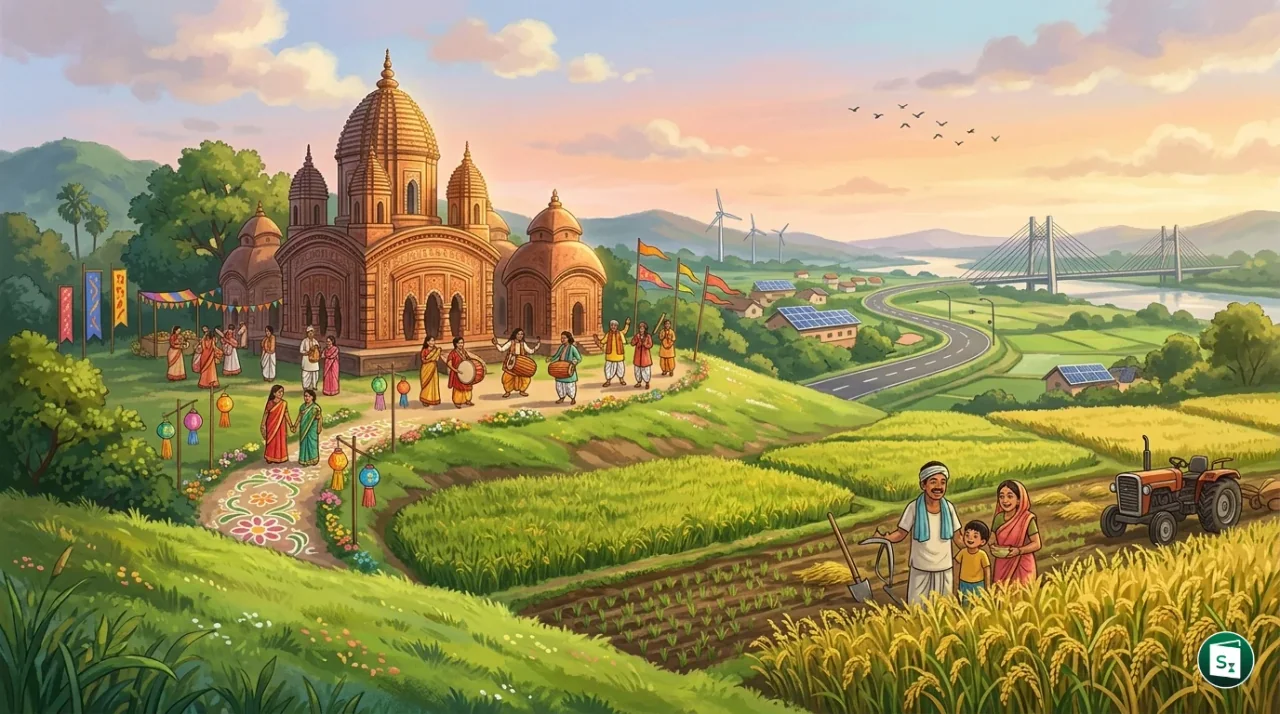
Prime Minister Narendra Modi attended the first official Paschimbanga Divas (West Bengal Day) celebrations at Tarakeswar in Hooghly district on June 20, 2026, marking his first visit to the state after the BJP government came to power in the recent assembly elections. During the event, he released the 23rd instalment of the Pradhan Mantri Kisan Samman Nidhi (PM-KISAN) scheme, transferring over 18,880 crore rupees to more than 9.44 crore farmers across the country. The celebrations, held under the theme “West Bengal: Heritage, Harmony and Development”, also saw the Prime Minister inaugurating and laying the foundation stone for development projects worth hundreds of crores of rupees spanning railways, agriculture, fisheries, and rural infrastructure.
What Is Paschimbanga Divas?
Paschimbanga Divas, also called West Bengal Day, is observed on June 20 to commemorate the historic vote in the Bengal Legislative Assembly in 1947 that led to the creation of West Bengal as a separate state within the Indian Union. On June 20, 1947, legislators from the Hindu-majority western districts of undivided Bengal voted in favour of partitioning the province and joining India, while their counterparts from the eastern districts voted to join Pakistan. This decision paved the way for the creation of West Bengal, with East Bengal later becoming East Pakistan and, after 1971, the independent nation of Bangladesh.
The day is closely linked with Syama Prasad Mookerjee, the founder of the Bharatiya Jana Sangh, who led the movement for a separate homeland for Bengali Hindus within India. Mookerjee strongly opposed the “United Bengal” plan proposed by Muslim League leader Huseyn Shaheed Suhrawardy, which sought to keep Bengal undivided and independent of both India and Pakistan. In April 1947, Mookerjee organised a landmark conference in Tarakeswar that passed a resolution demanding the partition of Bengal, a decision that ultimately shaped the state’s future.
Why Tarakeswar Was Chosen
Tarakeswar, located in the Hooghly district, holds deep historical significance for this movement. It was here, from April 4 to 7, 1947, that the Bengal Provincial Hindu Mahasabha held a conference where Mookerjee articulated the demand for a separate West Bengal within India. The Tarakeswar conference is regarded as a turning point in the campaign that culminated in the June 20 vote.
The BJP government led by Chief Minister Suvendu Adhikari officially declared June 20 as West Bengal’s foundation day after assuming power. The previous government under the Trinamool Congress had observed “Poila Baishakh”, the first day of the Bengali calendar, as West Bengal Day. The change marks a significant shift in how the state’s political identity and historical narrative are officially recognised.
The 23rd Instalment of PM-KISAN
During the Paschimbanga Divas event, Prime Minister Modi released the 23rd instalment of the Pradhan Mantri Kisan Samman Nidhi (PM-KISAN) scheme, transferring over 18,880 crore rupees directly into the bank accounts of more than 9.44 crore farmers across India through the Direct Benefit Transfer (DBT) mechanism. Of this, more than 907 crore rupees was credited to over 45.35 lakh farmers in West Bengal. With this instalment, the cumulative disbursement under PM-KISAN in the state has crossed 15,000 crore rupees. Nationally, the total amount disbursed since the scheme’s inception has exceeded 4.46 lakh crore rupees.
Over 2.18 crore women farmers received benefits in this instalment, reflecting the scheme’s reach among women in agriculture. The Prime Minister also launched the Pradhan Mantri Fasal Bima Yojana (PMFBY) in West Bengal, extending the benefits of the world’s largest crop insurance scheme to farmers in the state.
About the PM-KISAN Scheme
The PM-KISAN scheme was launched by the Prime Minister on February 24, 2019, and made effective from December 1, 2018. It is a Central Sector Scheme with 100 per cent funding from the Government of India, implemented by the Ministry of Agriculture and Farmers Welfare. Under the scheme, eligible landholding farmer families receive 6,000 rupees per year in three equal instalments of 2,000 rupees each, paid every four months.
Initially, the scheme covered only small and marginal farmers with cultivable landholding of up to 2 hectares. From June 1, 2019, its scope was expanded to include all landholding farmer families regardless of land size. Certain categories are excluded from the scheme, including income tax payers, former and present holders of constitutional posts, serving and retired government officers and employees (excluding Multi-Tasking Staff or Group D employees), pensioners drawing a monthly pension of 10,000 rupees or more, and registered professionals such as doctors, engineers, lawyers, chartered accountants, and architects.
Beneficiaries must complete eKYC through OTP-based verification online, biometric verification at Common Service Centres, or face authentication on the PM-KISAN mobile app. Linking Aadhaar with bank accounts and ensuring land records are updated on the portal are mandatory for receiving instalments.
Development Projects for West Bengal
The Prime Minister unveiled a development package worth approximately 820 crore rupees for West Bengal, with the major share allocated to railway infrastructure. These projects are expected to improve connectivity, strengthen rural livelihoods, and boost the state’s economy.
Railway Infrastructure
A significant overhaul of railway infrastructure valued at about 590 crore rupees was announced, including the following key projects:
| Project | Location | Investment |
|---|---|---|
| Sankrail-Santragachi Link Line | Howrah | 421 crore rupees |
| New Divisional Railway Hospital (300 beds) | Howrah | 99 crore rupees |
| Road Over Bridge between Haur and Radhamohanpur | Purba Medinipur | 71 crore rupees |
| Nabadwip-Puri Rail Service | West Bengal-Odisha | New connectivity |
The Sankrail-Santragachi Link Line is a strategic project designed to ease congestion on one of eastern India’s busiest rail corridors. It will boost operational capacity, improve regional train movement, support rising logistics demands, and reduce daily commuting times. The 300-bed New Divisional Railway Hospital in Howrah will be equipped with advanced diagnostic systems and specialised clinical services for railway employees, pensioners, and their families. A new Road Over Bridge in Purba Medinipur will decongest traffic for passengers and commercial cargo. The new Nabadwip-Puri rail service addresses a long-standing demand of Jagannath devotees and improves inter-state connectivity.
Other Key Projects
In the rural development sector, the Prime Minister inaugurated 49 road projects under the Pradhan Mantri Gram Sadak Yojana (PMGSY-III) covering more than 315 kilometres across several districts. In fisheries and animal husbandry, projects included a modernised fishing harbour at Fraserganj in South 24 Parganas, a new fish market at Sainthia in Birbhum, and eastern India’s first Regional Semen Production Laboratory and Semen Bank for Goats at Haringhata in Nadia, established under the National Livestock Mission.
Significance of the Visit
This was the Prime Minister’s first visit to West Bengal after the BJP secured a decisive victory in the 2026 state assembly elections, winning more than two-thirds of the seats. The Paschimbanga Divas celebration marked the first official observance of June 20 as West Bengal Day by the state government, replacing the previous practice of celebrating Poila Baishakh. Chief Minister Suvendu Adhikari described June 20 as a “destiny-defining day” for Bengalis.
Addressing the gathering, the Prime Minister said the day should serve as a reminder for the younger generation about the events of 1947 and Syama Prasad Mookerjee’s role in ensuring that West Bengal remained part of India. He credited Mookerjee with launching the Bengali Hindu Homeland Movement that saved western Bengal from being included in Pakistan. The year 2026 marks Mookerjee’s 125th birth anniversary, adding to the significance of the observance.
The Prime Minister also highlighted the new BJP government’s focus on implementing central welfare schemes in the state, including Ayushman Bharat, the Annapurna Yojana, and the Jal Jeevan Mission. He noted that land had been transferred to the Border Security Force for strengthening fencing along the India-Bangladesh border, a process he said had been stalled under the previous administration.
Key Takeaways
- Paschimbanga Divas is observed on June 20 to commemorate the 1947 Bengal Legislative Assembly vote that led to the creation of West Bengal as a separate state within the Indian Union.
- PM Modi released the 23rd instalment of the PM-KISAN scheme, transferring over 18,880 crore rupees to more than 9.44 crore farmers across India.
- Over 2.18 crore women farmers received benefits in the 23rd instalment; the cumulative disbursement under PM-KISAN has exceeded 4.46 lakh crore rupees since its launch.
- The PM-KISAN scheme was launched on February 24, 2019 and provides 6,000 rupees per year in three equal instalments to landholding farmer families, implemented by the Ministry of Agriculture and Farmers Welfare.
- Syama Prasad Mookerjee, founder of the Bharatiya Jana Sangh, led the Bengali Hindu Homeland Movement from the Tarakeswar conference in April 1947, which demanded the partition of Bengal.
- Development projects worth 820 crore rupees were unveiled for West Bengal, including the Sankrail-Santragachi Link Line (421 crore rupees), a 300-bed Divisional Railway Hospital in Howrah, and 49 PMGSY-III road projects covering 315 kilometres.