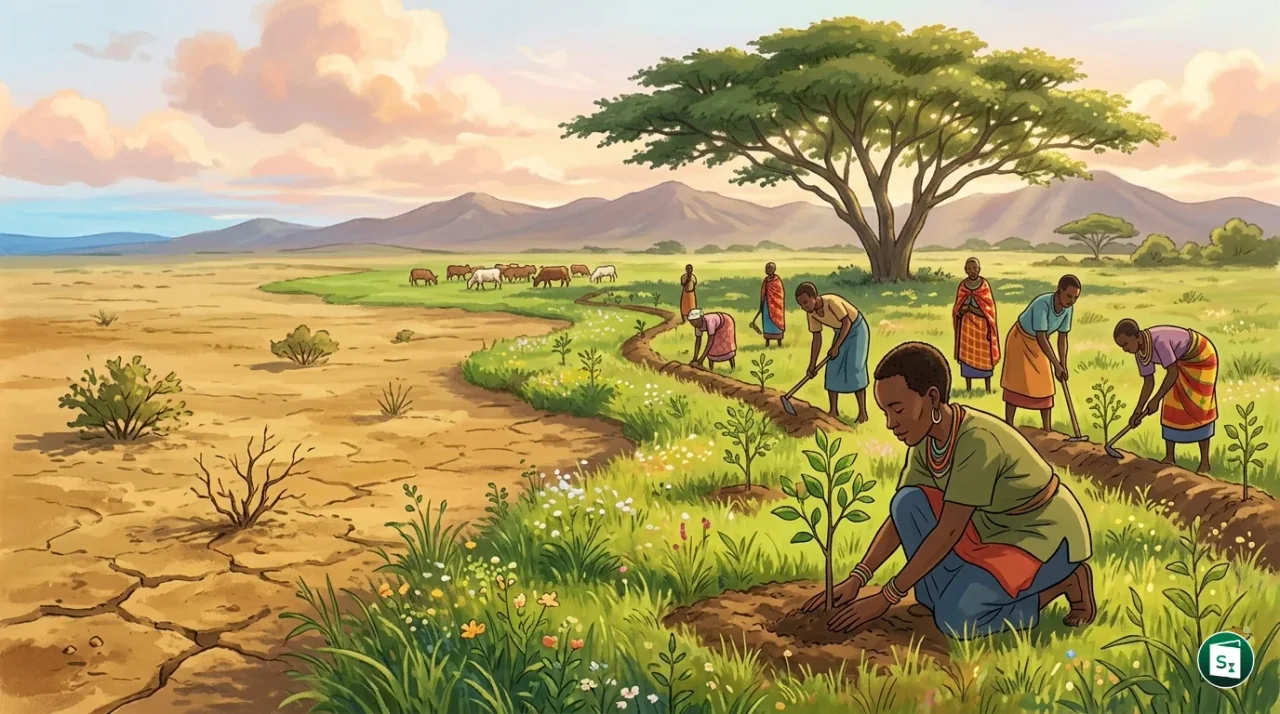
The World Day to Combat Desertification and Drought was observed globally on June 17, 2026, with Kenya hosting the official commemorations. The day carried the theme “Rangelands: Recognize. Respect. Restore.”, drawing urgent attention to the world’s most extensive yet most overlooked ecosystems. With up to half of all rangelands already degraded or at risk, the observance served as a call to action for governments, communities, and international bodies to protect and restore these vast landscapes that support two billion people and provide nearly 70 percent of global livestock feed.
What Is the World Day to Combat Desertification and Drought?
The United Nations General Assembly declared June 17 as the World Day to Combat Desertification and Drought through resolution A/RES/49/115 in December 1994. The day was established to promote public awareness of international efforts to combat desertification and the effects of drought, and it has been observed annually since 1995. The date itself carries deep significance, as it marks the anniversary of the adoption of the United Nations Convention to Combat Desertification (UNCCD), which was adopted in Paris on June 17, 1994, and entered into force on December 26, 1996.
Since 2019, the observance has also been referred to simply as Desertification and Drought Day. Each year, a different country hosts the global observance, working with the UNCCD secretariat to organize a programme of activities. In 2025, Colombia hosted the event, while previous hosts have included Germany (2024), the United States (2023), Spain (2022), and Costa Rica (2021).
What Are Desertification and Drought?
Desertification refers to the degradation of land in arid, semi-arid, and dry sub-humid areas (collectively known as drylands), resulting from factors such as climatic variations and human activities. It is not about the expansion of existing deserts but rather the loss of biological productivity of land. Key drivers include deforestation, overcultivation, overgrazing, poor irrigation practices, and climate change.
Drought, on the other hand, is a natural, temporary phenomenon characterized by below-normal precipitation over a prolonged period. While drought is a climatic event, desertification is a process of land degradation that can be exacerbated by drought. Together, they pose severe threats to food security, water availability, biodiversity, and human livelihoods, especially in vulnerable dryland regions.
Currently, up to 40 percent of the world’s land is degraded, affecting 3.2 billion people globally. The annual cost of drought is estimated at $307 billion, a figure that has risen by nearly 29 percent since 2000.
The 2026 Theme: Rangelands: Recognize. Respect. Restore.
The 2026 theme placed rangelands at the centre of global environmental discourse. The three-part call to action carried a specific meaning for each word.
Recognize the economic, ecological, and cultural value of rangelands. These landscapes contribute to national and regional economies, support biodiversity and wildlife, regulate water cycles, and store vast amounts of carbon. They account for one-sixth of global food production and represent nearly one-third of the planet’s carbon reservoir.
Respect the pastoralists, Indigenous Peoples, and local communities who have sustained these landscapes for generations. Their traditional knowledge, customary governance systems, and seasonal mobility are essential for maintaining the health and productivity of rangelands. An estimated 500 million pastoralists worldwide depend directly on these ecosystems.
Restore degraded rangelands through investment in sustainable land and water management, strengthened governance, improved drought preparedness, and community-led restoration efforts. The UNCCD has warned that the degradation of rangelands is proceeding at an alarming rate, in some places faster than the loss of rainforests.
What Are Rangelands?
Rangelands are natural ecosystems dominated by grasses, grass-like plants, forbs, or shrubs, suitable for grazing or browsing. The category includes grasslands, savannas, shrublands, tundra, deserts, wetlands, and mountain pastures. They cover 54 percent of the Earth’s land surface, making them the single largest land cover type on the planet.
| Type of Rangeland | Share of Global Rangelands |
|---|---|
| Deserts and xeric shrublands | 35% |
| Tropical and subtropical grasslands, savannas, and shrublands | 26% |
| Tundra | 15% |
| Temperate grasslands, savannas, and shrublands | 13% |
| Montane grasslands and shrublands | 6% |
| Mediterranean forests, woodlands, and scrub | 4% |
| Flooded grasslands and savannas | 1% |
Why Rangelands Matter
Rangelands are critical for climate resilience, food security, and biodiversity conservation. They support around two billion people, provide nearly 70 percent of global livestock feed, and hold about 30 percent of the world’s soil organic carbon. Despite this, they remain among the most undervalued and underprotected ecosystems. According to the UNCCD Global Land Outlook Thematic Report on Rangelands and Pastoralists (May 2024), up to 50 percent of rangelands are degraded, driven by land use change, overgrazing, population growth, and climate change.
Kenya Hosts the Global Observance
The global observance of Desertification and Drought Day 2026 was hosted by Kenya at Vipingo Central Primary School in Kilifi County. This marked the first time in nearly a decade that the African continent hosted the global event. Drylands and rangelands cover around 80 percent of Kenya’s land area and sustain millions of people, largely through pastoralism and livestock production.
The event brought together high-level national and local authorities, community representatives, youth groups, pastoralists, and development partners. Activities included ceremonial tree planting, tours of exhibitions showcasing land restoration initiatives, and cultural performances by local schools and community groups.
Kenya’s Cabinet Secretary for Environment, Climate Change and Forestry, Deborah M. Barasa, stated that hosting the event was an opportunity to bring global attention to the realities facing dryland communities and the solutions already taking shape on the ground. UNCCD Executive Secretary Yasmine Fouad noted that rangelands are often treated as marginal land, but they are central to how economies, food systems, and communities function under pressure.
In a video message, United Nations Secretary-General Antonio Guterres called for urgent action, stating that protecting rangelands means investing in restoration, empowering rural communities, and forging international cooperation.
2026: International Year of Rangelands and Pastoralists
The 2026 Desertification and Drought Day coincided with the International Year of Rangelands and Pastoralists (IYRP 2026), declared by the United Nations General Assembly in February 2022 on the initiative of Mongolia. The Food and Agriculture Organization (FAO) serves as the lead agency for implementing the IYRP.
The IYRP aims to raise awareness about the vital contributions of rangelands and pastoralists to sustainable agrifood systems, biodiversity preservation, and climate resilience. It calls for increased investment in sustainable pastoral livestock systems, improved land management practices, and stronger policy frameworks to protect pastoralist mobility and land rights.
The alignment of the Desertification and Drought Day with the IYRP amplified the message that rangelands and pastoralists must be at the centre of global efforts to combat desertification, mitigate climate change, and achieve the Sustainable Development Goals (SDGs) , particularly SDG 15 (Life on Land) and its target of achieving Land Degradation Neutrality (LDN) by 2030.
The UNCCD and India’s Role
The United Nations Convention to Combat Desertification (UNCCD) is one of the three Rio Conventions that emerged from the 1992 Earth Summit in Rio de Janeiro, alongside the UN Framework Convention on Climate Change (UNFCCC) and the Convention on Biological Diversity (CBD). The UNCCD is the only legally binding international agreement that links environment and development to sustainable land management. It has 197 Parties (196 countries plus the European Union) and its secretariat is headquartered in Bonn, Germany.
India signed the UNCCD in 1994 and ratified it in 1996. The country faces significant challenges from land degradation, with ISRO’s Desertification and Land Degradation Atlas (2019) estimating that 97.85 million hectares or 29.7 percent of India’s total geographical area is undergoing degradation. Water erosion is the leading cause, followed by vegetation degradation and wind erosion.
India has committed to restoring 26 million hectares of degraded land by 2030 as part of its Land Degradation Neutrality targets. At UNCCD COP14 held in New Delhi in 2019, the Prime Minister announced an additional target of restoring 5 million hectares beyond the existing commitment. India has also been actively participating in the Bonn Challenge and the UN Decade on Ecosystem Restoration (2021-2030).
The upcoming UNCCD COP17 is scheduled to be held in Ulaanbaatar, Mongolia, in August 2026 under the theme “Restoring Land, Restoring Hope”. This will coincide with the International Year of Rangelands and Pastoralists and is expected to launch the Rangelands Flagship Initiative, a multi-partner global effort led by Mongolia and the UNCCD to increase investments in rangeland conservation and restoration.
Key Takeaways
- The World Day to Combat Desertification and Drought is observed annually on June 17, with the 2026 theme being “Rangelands: Recognize. Respect. Restore.”
- Kenya hosted the global observance in Kilifi County, marking the first time in nearly a decade an African country hosted the event.
- Rangelands cover 54 percent of Earth’s land surface, support two billion people, provide 70 percent of global livestock feed, and hold 30 percent of the world’s soil organic carbon.
- Up to 50 percent of rangelands are degraded or at risk, threatening food systems, biodiversity, climate resilience, and livelihoods.
- The day commemorates the adoption of the UNCCD on June 17, 1994. The UNCCD is one of the three Rio Conventions (alongside UNFCCC and CBD) and has 197 Parties with its secretariat in Bonn, Germany.
- The International Year of Rangelands and Pastoralists 2026, led by FAO, was declared by the UN General Assembly in 2022 on the initiative of Mongolia.
- India faces severe land degradation with 97.85 million hectares or 29.7 percent of its land degraded. India has committed to restoring 26 million hectares by 2030.