Francois Englert, the Belgian theoretical physicist who co-discovered the mechanism that explains how fundamental particles acquire mass, died on 18 June 2026 at his home in Uccle, Brussels. He was 93. Englert shared the 2013 Nobel Prize in Physics with Peter Higgs for what is now known as the Brout-Englert-Higgs (BEH) mechanism, a cornerstone of the Standard Model of particle physics that was experimentally confirmed by the discovery of the Higgs boson at CERN in 2012.
Who Was Francois Englert?
Born on 6 November 1932 in Etterbeek, Brussels, Englert grew up in a Jewish family that faced persecution during the Nazi occupation of Belgium in World War II. He survived by concealing his identity and moving between orphanages.
After the war, Englert pursued engineering, earning a degree in electromechanical engineering in 1955 from the Universite Libre de Bruxelles (ULB). But his curiosity drew him toward fundamental questions. He switched to physics, completing his masters in 1958 and a PhD in 1959, both from ULB.
Englert then moved to Cornell University in the United States as a research associate. There he met Robert Brout, a fellow Belgian physicist, beginning a collaboration that would reshape modern physics. Brout and Englert would co-direct ULB’s theoretical physics group for nearly two decades from 1980. Englert remained at ULB for the rest of his career, becoming professor emeritus in 1998. He also held visiting professorships at Tel Aviv University and Chapman University in California.
Englert was married three times and had five children. In 2013, King Albert II of Belgium ennobled him with the title of baron.
The BEH Mechanism
In the early 1960s, particle physics faced a deep puzzle. Theories describing the fundamental forces required the particles that carry these forces, called gauge bosons, to be massless. Yet experiments showed that the W and Z bosons, which carry the weak nuclear force, were heavy. If these particles had mass, the mathematical framework of the theory broke down.
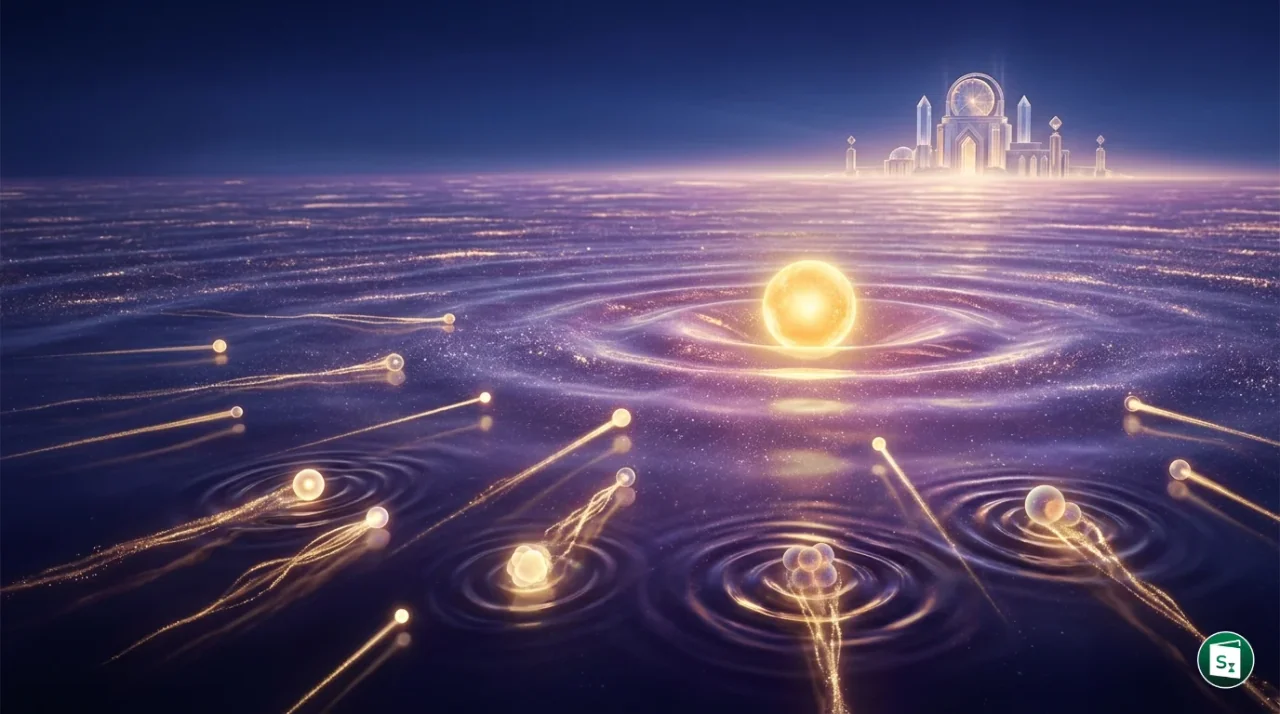
Englert and Brout, inspired by the work of Japanese physicist Yoichiro Nambu on spontaneous symmetry breaking in superconductivity, found the solution. In August 1964, they published a landmark paper titled “Broken Symmetry and the Mass of Gauge Vector Mesons” in Physical Review Letters. They proposed that empty space is not truly empty. It is filled with an invisible field, later called the Higgs field, that interacts with particles as they move through it. The more strongly a particle interacts with this field, the greater its mass.
Independently and within weeks, British physicist Peter Higgs published a similar paper that went a step further. Higgs explicitly predicted that this field should have an associated particle, which was later named the Higgs boson. A third group, consisting of Gerald Guralnik, Carl Hagen, and Tom Kibble, also independently arrived at the same mechanism later that year.
The combined insight is known as the Brout-Englert-Higgs (BEH) mechanism. It resolved the contradiction between gauge theory and particle mass, allowing the electroweak theory to unify the electromagnetic force and the weak nuclear force into a single framework. This unification was later validated through the work of Steven Weinberg, Abdus Salam, and Sheldon Glashow, who won the 1979 Nobel Prize for it. The mathematical consistency of the theory was proved by Gerardus ‘t Hooft and Martinus Veltman, earning them the 1999 Nobel Prize.
The 48-Year Hunt for the Higgs Boson
For nearly five decades, the Higgs boson remained a theoretical ghost. Physicists knew it had to exist for the Standard Model to hold, but detecting it required a machine powerful enough to create it.
The search began in earnest at CERN’s Large Electron-Positron (LEP) collider in the 1990s and continued at the Tevatron at Fermilab in the United States. Both set upper limits on where the Higgs could be but could not find it. In 2010, the Large Hadron Collider (LHC) at CERN, the most powerful particle accelerator ever built, began colliding protons at energies never achieved before.
On 4 July 2012, in a historic seminar at CERN, the spokespersons of the ATLAS and CMS experiments announced that they had independently observed a new particle with a mass of approximately 125 giga-electron volts (GeV), or about 130 times the mass of a proton. The statistical significance reached five sigma, the gold standard for a discovery in particle physics, meaning there was less than a one-in-3.5-million chance that the signal was a statistical fluke.
Both Englert and Higgs were present in the audience as the scientific world erupted in applause. Fabiola Gianotti, then ATLAS spokesperson, and Joe Incandela, then CMS spokesperson, delivered the results. CERN Director-General Rolf Heuer declared: “As a layman, I would say: now we have it.”
The discovery filled the last missing piece of the Standard Model, the theoretical framework that describes all known fundamental particles and three of the four fundamental forces. The Higgs boson remains the only known elementary particle with zero spin, a property that sets it apart from all other particles.
In March 2013, after further analysis, CERN confirmed that the new particle was indeed a Higgs boson, completing one of the greatest quests in the history of science.
Nobel Prize and Recognition
On 8 October 2013, the Royal Swedish Academy of Sciences announced that the Nobel Prize in Physics would be awarded jointly to Francois Englert and Peter Higgs. The official citation read: “for the theoretical discovery of a mechanism that contributes to our understanding of the origin of mass of subatomic particles, and which recently was confirmed through the discovery of the predicted fundamental particle, by the ATLAS and CMS experiments at CERN’s Large Hadron Collider.”
Robert Brout, who had died in 2011, could not share the prize as the Nobel is not awarded posthumously. Englert and Higgs each received half of the 8 million Swedish kronor prize amount.
Other Major Honours
| Award | Year | Details |
|---|---|---|
| Francqui Prize | 1982 | Belgium’s most prestigious academic award |
| Wolf Prize in Physics | 2004 | Shared with Brout and Higgs |
| High Energy and Particle Physics Prize | 1997 | European Physical Society, shared with Brout and Higgs |
| J. J. Sakurai Prize | 2010 | American Physical Society, shared with Brout, Higgs, Guralnik, Hagen, and Kibble |
| Prince of Asturias Award | 2013 | Technical and Scientific Research, shared with Higgs and CERN |
| Nobel Prize in Physics | 2013 | Shared with Peter Higgs |
Englert was also honoured by his country. On 8 July 2013, King Albert II of Belgium granted him the noble title of baron.
Key Takeaways
- Francois Englert, Belgian theoretical physicist, died on 18 June 2026 at the age of 93 in Uccle, Brussels.
- He co-discovered the Brout-Englert-Higgs (BEH) mechanism, which explains how fundamental particles acquire mass through interaction with the Higgs field.
- The mechanism was proposed in 1964 by Englert and Robert Brout and independently by Peter Higgs.
- The Higgs boson was discovered on 4 July 2012 by the ATLAS and CMS experiments at CERN’s Large Hadron Collider, with a mass of approximately 125 GeV.
- Englert shared the 2013 Nobel Prize in Physics with Peter Higgs for this work.
- He was born on 6 November 1932 in Etterbeek, Belgium, and was a professor emeritus at the Universite Libre de Bruxelles (ULB).