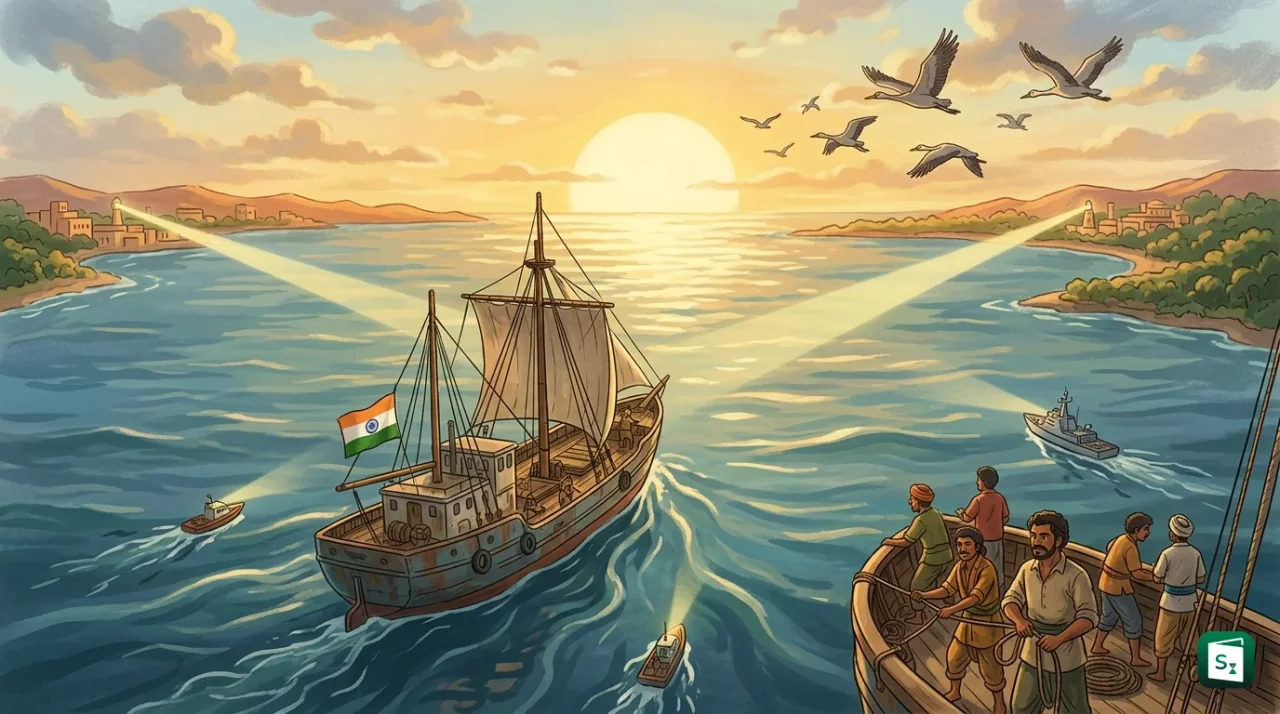
India launched the Seafarer-First initiative on 14 July 2026 to protect Indian seafarers operating in the conflict-affected waters of West Asia. The initiative came after Iranian missile strikes on two UAE-flagged merchant vessels, MT Al Bahiyah and MT Mombasa, in the Strait of Hormuz killed one Indian seafarer and injured several others. Union Minister for Ports, Shipping and Waterways Sarbananda Sonowal announced the whole-of-government response following a high-level inter-ministerial review meeting in New Delhi.
The Crisis in the Strait of Hormuz
The Strait of Hormuz has emerged as one of the world’s most dangerous shipping routes since the US-Iran conflict began on 28 February 2026. The two merchant vessels targeted in the latest attack carried a combined crew of 46, of which 30 were Indian nationals. One Indian seafarer was killed and another injured aboard MT Al Bahiyah, while nine Indian nationals on MT Mombasa sustained injuries, including two who remain critically injured.
These incidents were part of a broader pattern of escalating violence against commercial shipping in the region. Since the conflict began, at least seven Indian seafarers have been killed in multiple attacks involving commercial vessels transiting the Strait of Hormuz and adjoining waters. The attacks have involved missile strikes, drone attacks, and naval operations that have repeatedly put Indian crew members in harm’s way. Indian seafarers, who make up roughly 12% of the global maritime workforce at over 3.08 lakh, have been disproportionately exposed to these risks due to their large presence on international merchant vessels operating in the region.
What Is the Seafarer-First Initiative?
The Seafarer-First initiative is a comprehensive government response that adopts a whole-of-government approach to ensure the safety and welfare of Indian crew members in the conflict zone. It is led by the Ministry of Ports, Shipping and Waterways (MoPSW) in coordination with the Ministry of External Affairs (MEA), the Indian Navy, the Directorate General of Shipping (DGS), the Ministry of Petroleum and Natural Gas, the Ministry of Chemicals and Fertilisers, and Indian diplomatic missions in Iran, Oman, and the UAE.
The core principle of the initiative is that every Indian seafarer in the affected region must be individually accounted for, irrespective of the vessel’s flag. This marks a significant expansion of India’s maritime oversight, as the majority of Indian seafarers serve on foreign-flagged vessels over which India does not have direct regulatory jurisdiction. The initiative seeks to fill this gap through active diplomatic coordination and real-time information sharing.
Key Components of the Initiative
Real-Time Operational Dashboard
The Directorate General of Shipping (DGS) has been directed to establish a comprehensive vessel-by-vessel operational dashboard that will track every Indian seafarer aboard vessels operating in the Persian Gulf, Strait of Hormuz, and Gulf of Oman. The dashboard will provide real-time information on vessel position, ownership, cargo, crew strength, crew welfare, threat assessment, intended voyage, next port of call, and the availability of food, fuel, medicines, and communication facilities. This system enables authorities to respond swiftly to emergencies and maintain constant oversight of Indian crew members in high-risk maritime zones.
Dedicated Liaison Officers
A dedicated liaison officer has been appointed for every Indian seafarer impacted by the crisis. Each liaison officer serves as the single point of contact for families, coordinating medical updates, travel documentation, family assistance, repatriation, support from the Seafarers Welfare Fund, outstanding wages, contractual entitlements, and other compensations. This ensures that affected families have a direct government channel for all their concerns and do not have to navigate multiple authorities during a crisis.
Diplomatic and Naval Coordination
The initiative mandates round-the-clock coordination among all participating agencies. Officials have been directed to work closely with Indian missions in Iran, Oman, and the UAE to obtain verified, real-time information on navigational safety, coastal-state advisories, route status, port-of-refuge arrangements, hospitals, medical evacuation, repatriation procedures, management of mortal remains, and the status of ongoing investigations. The Indian Navy has been integrated into the coordination framework to provide maritime domain awareness and emergency response capability.
Fresh Threat Assessments and Compliance
Under the new directives, every vessel movement through the affected region must be undertaken only after a fresh threat assessment, the professional judgment of the ship’s master, and close coordination with competent maritime authorities. Shipowners, vessel managers, and Recruitment and Placement Service Licence (RPSL) agencies employing Indian seafarers in the region have been directed to immediately furnish compliance reports confirming that no Indian seafarer is being compelled to sail without adequate information, protection, and support.
24x7 Grievance Support System
A round-the-clock grievance support system has been activated for seafarers and their families. The helpline can be reached through a domestic toll-free number (1800-889-7768), an international toll-free number (+1-888-988-0256), WhatsApp (+91 8655856830), and email (enavik.24x7@gov.in).
Deployment Ban on Strait of Hormuz
Following the Seafarer-First initiative, the Directorate General of Maritime Administration (DGMA) issued Circular No. 36 of 2026 on 15 July 2026, directing shipowners, ship managers, and RPSL agencies to avoid deploying Indian seafarers on vessels undertaking voyages through the Strait of Hormuz until further orders. This precautionary measure was taken in view of the heightened security situation, which has seen attacks on at least five merchant vessels, including Mombasa B, Al Bahiyah, GFS Galaxy, MT Wedyan, and Al Rekayyat.
The Directorate General of Shipping
The Directorate General of Shipping (DGS), now transitioning to the Directorate General of Maritime Administration (DGMA), is the apex maritime authority of the Government of India. It was established in September 1949 and functions as an attached office of the Ministry of Ports, Shipping and Waterways. The DGS is headquartered in Mumbai and is headed by the Director General of Shipping, currently Shyam Jagannathan, an IAS officer.
The DGS is responsible for implementing shipping policy and legislation, ensuring safety of life and ships at sea, prevention of marine pollution, promotion of maritime education and training in coordination with the International Maritime Organization (IMO), regulation of employment and welfare of seafarers, development of coastal shipping, and certification of Merchant Navy Officers. It exercises statutory powers under Section 7 of the Merchant Shipping Act, 1958, which was superseded by the Merchant Shipping Act, 2025.
The DGS oversees the welfare of over five lakh Indian seafarers and regulates the training ecosystem of more than 165 pre-sea and post-sea maritime institutions across the country.
The Strategic Importance of the Strait of Hormuz
The Strait of Hormuz is located between Iran to the north and Oman to the south, connecting the Persian Gulf with the Gulf of Oman and the Arabian Sea. At its narrowest point, the strait is only 29 nautical miles (54 km) wide, with two-mile-wide navigable channels for inbound and outbound shipping.
The strait is one of the world’s most critical energy transit chokepoints. In 2025, an average of 20 million barrels per day of crude oil and oil products passed through the strait, representing roughly 25% of global seaborne oil trade and about 20% of global petroleum liquids consumption. Additionally, approximately 20% of global LNG trade transits the strait, primarily from Qatar and the UAE.
China and India together received 44% of the crude oil exports that passed through the Strait of Hormuz in 2025, making the waterway critical to India’s energy security. Beyond oil and gas, the strait also carries significant volumes of fertilisers, sulphur, and helium, all essential inputs for global agriculture and manufacturing.
Alternative pipeline routes exist but have limited capacity. Saudi Arabia’s East-West pipeline can carry up to 7 million barrels per day to the Red Sea, and the UAE’s Habshan-Fujairah pipeline can carry 1.8 million barrels per day to the Gulf of Oman. However, combined, these pipelines can bypass only a fraction of the strait’s total throughput. This dependency makes the security of the Strait of Hormuz a matter of direct strategic concern for India.
| Metric | Value |
|---|---|
| Oil flow through Hormuz (2025) | ~20 million barrels per day |
| Share of global seaborne oil trade | ~25% |
| Share of global LNG trade | ~20% |
| Combined share of China and India in Hormuz crude | 44% |
| Alternative pipeline capacity (Saudi + UAE) | ~3.5 to 5.5 mb/d |
| Narrowest width | 29 nautical miles (54 km) |
Key Takeaways
- The Seafarer-First initiative was launched by Union Minister Sarbananda Sonowal on 14 July 2026 in response to attacks on merchant vessels in the Strait of Hormuz.
- The initiative involves real-time tracking of Indian seafarers through a vessel-by-vessel operational dashboard managed by the Directorate General of Shipping (DGS).
- Dedicated liaison officers have been appointed for every affected Indian seafarer, serving as single-point contacts for families and coordinating repatriation, compensation, and welfare support.
- The DGMA issued Circular No. 36 of 2026 on 15 July 2026, banning the deployment of Indian seafarers on vessels transiting the Strait of Hormuz until further orders.
- The Directorate General of Shipping, established in September 1949, is headquartered in Mumbai and functions under the Ministry of Ports, Shipping and Waterways.
- The Strait of Hormuz carries approximately 20 million barrels of oil per day (25% of global seaborne oil trade) and is critical to India’s energy security, with India and China together receiving 44% of Hormuz crude exports.