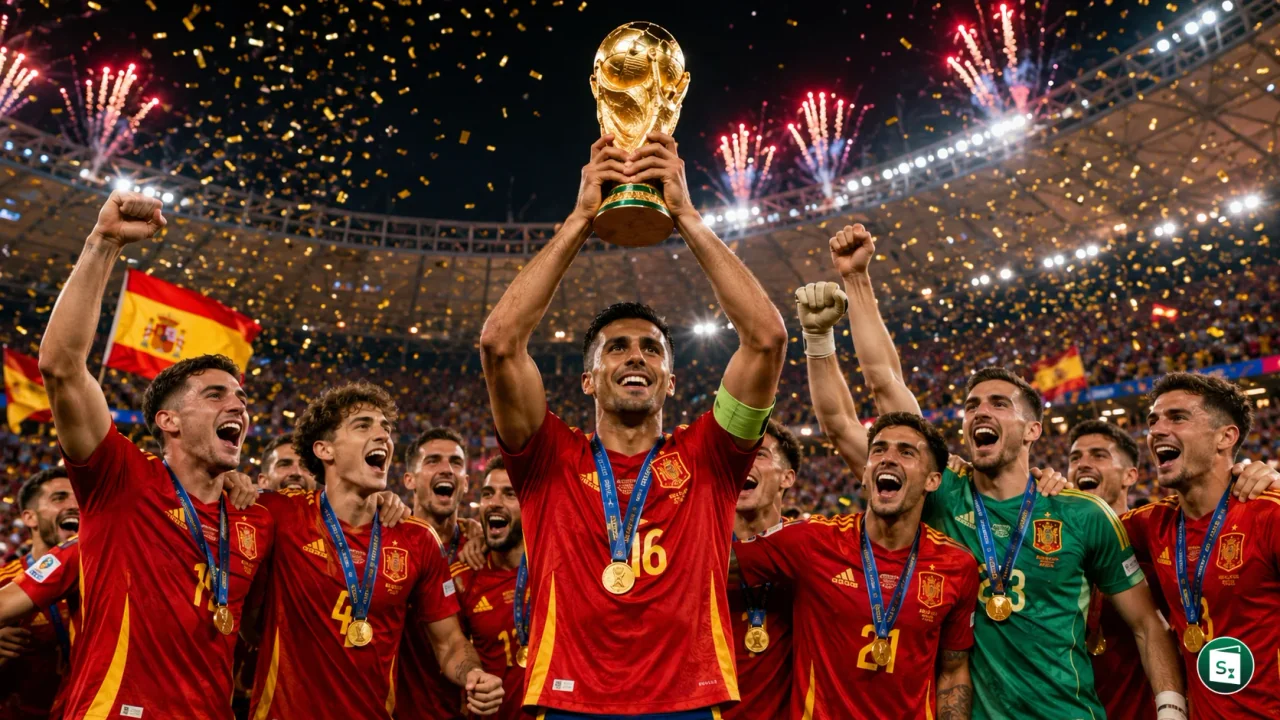
Spain ended a 16-year wait for a second FIFA World Cup title on 19 July 2026, beating defending champions Argentina 1-0 after extra time at the MetLife Stadium in East Rutherford, New Jersey. Substitute Ferran Torres scored the only goal in the 106th minute, silencing a capacity crowd that had come to witness what many expected to be Lionel Messi’s farewell coronation. The victory capped a dominant campaign in which Spain conceded just one goal across eight matches, the fewest ever by a World Cup-winning side.
A Final of Complete Spanish Dominance
From the opening whistle, Spain imposed their trademark possession game on a visibly uncomfortable Argentina side. La Roja monopolised the ball, dictated the tempo, and carved open the Argentine defence repeatedly, only to be denied by an inspired Emiliano Martinez. The Argentina goalkeeper made 12 saves over the course of the match, keeping his team in the contest despite being pinned back for long stretches.
Argentina failed to register a single shot on target during regulation time. Spain had already taken 13 shots on target by the time the final whistle blew, a statistic that underscored the one-sided nature of the contest. The defending champions were further weakened when midfielder Enzo Fernandez received a second yellow card deep into stoppage time at the end of regulation, reducing Argentina to ten men for the extra period.
Spain’s breakthrough finally came in the early moments of the second half of extra time. Lamine Yamal, the 19-year-old Barcelona winger, collected the ball on the right wing and played it to Pedro Porro. His right-footed cross appeared to be drifting out of play, but substitute Nico Williams, who had entered in the 75th minute, headed it back across goal. Ferran Torres, who had come on just past the hour mark, connected perfectly with his left foot to send the ball past Martinez and into the net. “It was a goal scored by 47 million people,” Torres said.
Key Match Statistics
| Statistic | Spain | Argentina |
|---|---|---|
| Shots on target | 13 | 0 |
| Possession | 67% | 33% |
| Passes completed | 729 | 312 |
| Pass accuracy | 92% | 78% |
| Corners | 9 | 2 |
| Yellow cards | 2 | 4 |
| Red cards | 0 | 1 |
Ferran Torres: The Unlikely Hero
Ferran Torres entered the final without having scored a single goal in the tournament. The 26-year-old Barcelona forward, born in Foios near Valencia, had gone six matches without finding the net before being introduced as a substitute in the 63rd minute. His strike in the 106th minute was his only goal of the entire World Cup, but it was the most important one any Spaniard scored.
Torres came through the youth academy of Valencia before moving to Manchester City in 2020 for an initial transfer fee of around €23 million. He joined Barcelona in 2022 and has since established himself as a versatile forward capable of playing across the front line. His composed left-footed finish under pressure from a tight angle showed the composure of a player who had also won the UEFA Euro 2024 with Spain and the UEFA Champions League with Manchester City in 2023. He was named Man of the Match for the final.
Luis de la Fuente: The Oldest Manager to Win the World Cup
Spain head coach Luis de la Fuente, aged 65, became the oldest manager ever to win the FIFA World Cup, a record confirmed by Guinness World Records. Born on 21 June 1961 in Haro, La Rioja, he took charge of the Spanish senior team in December 2022 after a highly successful career managing Spain’s youth teams, winning the UEFA European Under-19 Championship in 2015 and the UEFA European Under-21 Championship in 2019.
Under de la Fuente, Spain has been transformed into a near-unbeatable force. The team has won the UEFA Nations League in 2023, the UEFA Euro 2024, and now the FIFA World Cup 2026 without losing a single match in any of those campaigns. Spain’s current unbeaten run stands at 38 matches, an extraordinary sequence that began after a friendly defeat in March 2023. De la Fuente’s philosophy of technical dominance, positional play, and squad unity turned a talented generation into world champions.
Spain’s Record-Breaking Campaign
Spain’s path to the title was built on an iron-clad defensive foundation. The team kept seven clean sheets in eight matches and conceded just one goal across the entire tournament, in a 2-1 quarterfinal win over Belgium. This is the fewest goals ever conceded by a World Cup-winning side, surpassing the previous mark set by Italy in 2006 and France in 1998, who each conceded two goals during their victorious campaigns.
Spain became only the fourth European nation to win multiple men’s World Cups, joining Germany (4 titles), Italy (4), and France (2). Spain’s only previous title came in 2010 in South Africa, where Andres Iniesta scored the winner against the Netherlands in extra time. The 2010 triumph had also followed a UEFA European Championship victory in 2008, mirroring the current team’s achievement of winning Euro 2024 before adding the World Cup.
Spain’s Journey to the Title
| Stage | Opponent | Score | Goalscorers |
|---|---|---|---|
| Group H | Uruguay | 3-0 | Oyarzabal (2), Yamal |
| Group H | Saudi Arabia | 2-0 | Williams, Olmo |
| Group H | Cape Verde | 1-0 | Yamal |
| Round of 32 | Switzerland | 2-0 | Oyarzabal, Merino |
| Round of 16 | Senegal | 1-0 | Olmo |
| Quarterfinal | Belgium | 2-1 | Yamal, Cucurella |
| Semifinal | France | 2-0 | Yamal, Oyarzabal |
| Final | Argentina | 1-0 (a.e.t.) | Ferran Torres |
Notably, teenagers Lamine Yamal and Pau Cubarsi, both aged 19, became the fourth and fifth teenagers to feature in a FIFA World Cup final. They joined Brazil’s Pele (17 in 1958), Italy’s Giuseppe Bergomi (18 in 1982), and France’s Kylian Mbappe (19 in 2018), all of whom ended up on the winning side.
Individual Awards: Spain Sweeps the Honours
The Spanish team put together a near-complete clean sweep of the tournament’s individual awards.
Rodri won the Golden Ball as the tournament’s best player. The Manchester City midfielder and 2024 Ballon d’Or winner was the midfield engine behind Spain’s dominance, completing 753 passes with a 94% accuracy rate across the tournament. The 29-year-old, who captained Spain throughout the World Cup, also set a record for most passes completed in a single World Cup edition. He is the 11th player in football history to win the World Cup, UEFA Champions League, and Ballon d’Or in his career.
Unai Simon won the Golden Glove as the tournament’s best goalkeeper. The Athletic Club shot-stopper kept seven clean sheets, the most by any goalkeeper in a single FIFA World Cup, surpassing the previous benchmark of five held jointly by legends such as Gianluigi Buffon, Iker Casillas, and Oliver Kahn. Simon conceded just one goal, a record for a World Cup-winning goalkeeper.
Pau Cubarsi, the 19-year-old Barcelona centre-back, won the Best Young Player Award. He started all eight matches for Spain and was a rock in central defence, forming a formidable partnership with Aymeric Laporte. He became the first defender ever to receive the award.
| Award | Winner | Nation | Key Achievement |
|---|---|---|---|
| Golden Ball | Rodri | Spain | 753 passes, 94% accuracy |
| Silver Ball | Lionel Messi | Argentina | 8 goals, 4 assists |
| Bronze Ball | Kylian Mbappe | France | 10 goals, 4 assists |
| Golden Boot | Kylian Mbappe | France | 10 goals (first back-to-back winner) |
| Golden Glove | Unai Simon | Spain | 7 clean sheets, 1 goal conceded |
| Best Young Player | Pau Cubarsi | Spain | First defender to win the award |
| FIFA Fair Play Award | Netherlands | Netherlands | Best disciplinary record |
Kylian Mbappe Makes Golden Boot History
France captain Kylian Mbappe claimed the Golden Boot with 10 goals in eight matches, becoming the first player in World Cup history to win the award in consecutive tournaments. He had previously won it in Qatar 2022 with eight goals. Mbappe scored twice in France’s 6-4 third-place playoff defeat against England to seal his place at the top of the scoring charts, finishing ahead of Lionel Messi (8 goals) and Jude Bellingham (7 goals). Mbappe also became the fourth player ever to score 10 or more goals in a single World Cup edition, after Just Fontaine (13 in 1958), Sandor Kocsis (11 in 1954), and Gerd Muller (10 in 1970).
Lionel Messi ended the tournament with eight goals, having been pipped by Mbappe for the Golden Boot for the second consecutive World Cup. At 39 years and 25 days, Messi also became the oldest outfield player to appear in a World Cup final, surpassing Sweden’s Gunnar Gren (37 years, 241 days in 1958). Spain’s victory denied Argentina the chance to become the first team since Brazil in 1962 to win back-to-back World Cups.
The First 48-Team World Cup
The 2026 edition was the first FIFA World Cup to feature 48 teams, expanded from the 32-team format used since 1998. A total of 104 matches were played across 16 host cities in three countries, making it the largest sporting event ever staged.
Tournament Format
The 48 teams were divided into 12 groups of four teams each. The top two from each group, plus the eight best third-placed teams, advanced to a new Round of 32 knockout stage. From there, the tournament followed a straight single-elimination bracket through the Round of 16, quarterfinals, semifinals, and final. The expanded format added an extra knockout round and increased the total number of matches from 64 to 104.
Host Cities and Venues
The United States hosted 78 matches across 11 cities, while Canada and Mexico hosted 13 matches each across two and three cities respectively. The opening match was played on 11 June 2026 at the historic Estadio Azteca in Mexico City, which hosted its third World Cup after 1970 and 1986.
| Country | Host Cities | Stadiums |
|---|---|---|
| USA (11) | New York/New Jersey, Los Angeles, Dallas, San Francisco, Miami, Seattle, Houston, Philadelphia, Atlanta, Kansas City, Boston | MetLife Stadium, SoFi Stadium, AT&T Stadium, Levi’s Stadium, Hard Rock Stadium, Lumen Field, NRG Stadium, Lincoln Financial Field, Mercedes-Benz Stadium, Arrowhead Stadium, Gillette Stadium |
| Canada (2) | Toronto, Vancouver | BMO Field, BC Place |
| Mexico (3) | Mexico City, Guadalajara, Monterrey | Estadio Azteca, Estadio Akron, Estadio BBVA |
The final was held at MetLife Stadium, officially designated as the New York New Jersey Stadium for the tournament. The venue, with a capacity of 82,500, is the home of the NFL’s New York Giants and New York Jets. This was the first World Cup final hosted in North America since the 1994 final at the Rose Bowl in Pasadena, California.
Record Prize Money
FIFA distributed a record total of $871 million to the 48 participating teams, a 65% increase from the $528 million paid out at the 2022 World Cup in Qatar. Of this, $655 million was allocated as performance-based prize money, while each team received a guaranteed $12.5 million base payment covering a $10 million qualification fee and a $2.5 million preparation grant.
Prize Money by Finish
| Finishing Position | Performance Prize | Total Earnings |
|---|---|---|
| Champions (Spain) | $51 million | $63.5 million |
| Runner-up (Argentina) | $34 million | $46.5 million |
| Third place (England) | $30 million | $42.5 million |
| Fourth place (France) | $28 million | $40.5 million |
| Quarterfinalists | $20 million each | $32.5 million each |
| Round of 16 | $16 million each | $28.5 million each |
| Round of 32 | $12 million each | $24.5 million each |
| Group stage | $10 million each | $22.5 million each |
Spain’s $51 million champions’ prize was the largest winner’s payout in World Cup history, surpassing the $42 million received by Argentina in 2022. The runners-up received $34 million, also higher than the 2022 runners-up prize of $30 million.
Key Takeaways
- Spain won the 2026 FIFA World Cup on 19 July 2026, defeating defending champions Argentina 1-0 after extra time at MetLife Stadium (New York New Jersey Stadium) in East Rutherford, New Jersey.
- Ferran Torres scored the match-winning goal in the 106th minute and was named Man of the Match, while Rodri captained Spain to victory and won the Golden Ball as the tournament’s best player.
- Luis de la Fuente became the oldest manager to win a FIFA World Cup, and Spain conceded just one goal across eight matches, the fewest by any World Cup-winning side.
- Kylian Mbappe won the Golden Boot with 10 goals, becoming the first player in World Cup history to win the award in consecutive tournaments (2022 and 2026).
- The tournament was the first 48-team FIFA World Cup, co-hosted by USA, Canada, and Mexico, with 104 matches played across 16 host cities.
- FIFA distributed a record $871 million in prize money, with champions Spain receiving $51 million, the largest winner’s payout in World Cup history.
- Spain completed a historic double, adding the World Cup to their UEFA Euro 2024 title and extending their unbeaten run to 38 matches.