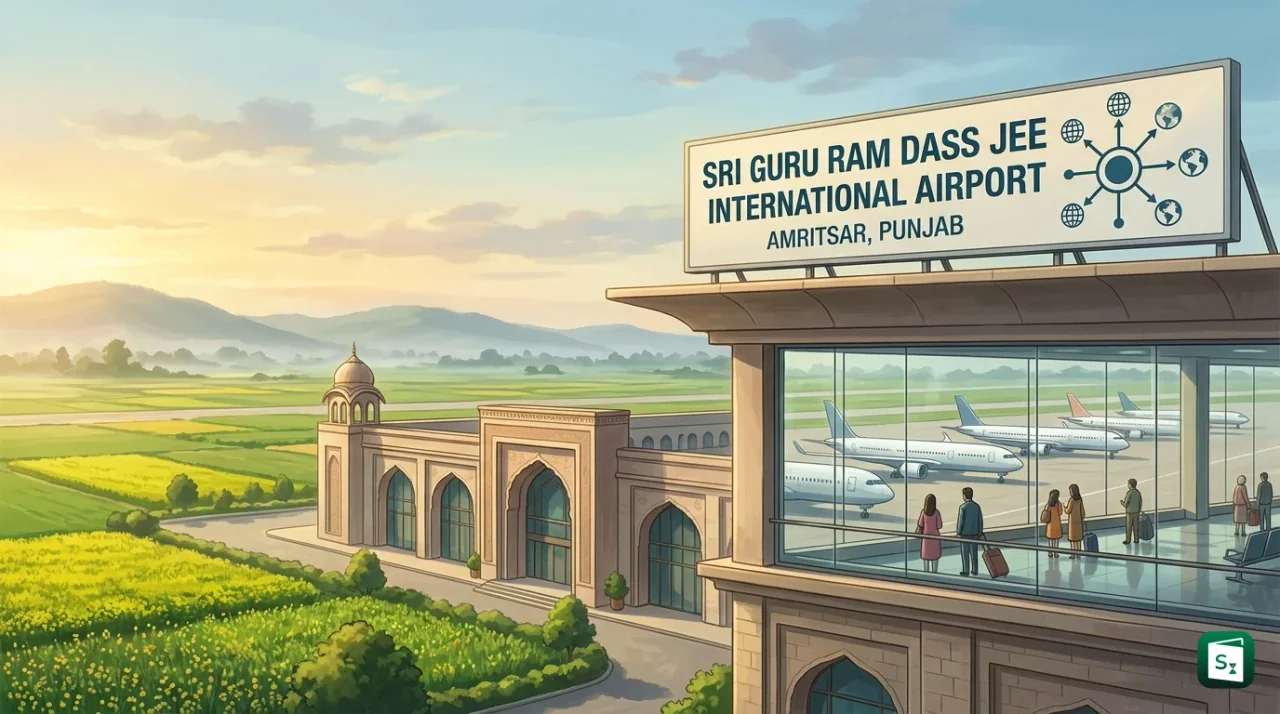
The Ministry of Civil Aviation has launched Hub & Spoke International Flight Operations at Sri Guru Ram Dass Jee International Airport in Amritsar, making it the second spoke airport in India after Varanasi. Passengers can now complete check-in, immigration, customs clearance and baggage drop at Amritsar itself before travelling to Delhi, where they will directly board their onward international flights without repeating any formalities. The initiative is part of India’s International Aviation Hub Strategy, which aims to develop four hubs and 40 spoke airports across the country to rival global transit centres such as Dubai, Doha and Singapore.
What Is the Hub-and-Spoke Aviation Model?
The hub-and-spoke model is an airline network design in which a central airport, the hub, serves as the main transit point for passengers arriving from smaller regional airports, known as spokes. Instead of operating direct international flights from every city, airlines concentrate long-haul services at a few hubs and use feeder flights to bring passengers from the surrounding spoke cities.
Under this system, a passenger flying from Amritsar to London first takes a domestic flight to Delhi, the hub, and then boards a long-haul international flight to the UK. The key difference from the earlier system is process integration. Passengers now complete check-in, immigration and customs formalities at the spoke airport itself. Their baggage is tagged all the way to the final destination, and at Delhi they proceed directly to the international departure gate without re-checking luggage or clearing immigration again.
This model is already widely used across the world. Airlines such as Emirates, Qatar Airways and Singapore Airlines have built their networks around hub airports in Dubai, Doha and Singapore. In the United States, carriers like Delta Air Lines and United Airlines also rely on hub-and-spoke operations to serve a large number of destinations efficiently.
Amritsar as North India’s International Gateway
Amritsar currently has direct international connectivity to only seven destinations. Under the hub-and-spoke arrangement, passengers can now access more than 20 international destinations through Delhi with a single check-in and a single baggage tag. Air India operates the service under its Easy Connect brand, with two daily flights from Amritsar to Delhi that connect onwards to destinations including London, Toronto, Frankfurt, Dubai, Singapore, Kuala Lumpur and Bangkok.
The geographical catchment of Amritsar makes it a strategic choice. The airport serves not just Punjab but also large parts of Jammu and Kashmir, Himachal Pradesh and Haryana. Nearly 1.5 lakh passengers travel from Amritsar to Delhi every year to board international flights, and a similar number arrive from overseas via Delhi and travel onward to Amritsar. Minister Ram Mohan Naidu noted that of the approximately 3 crore Indians living abroad, nearly 1 crore are Punjabis, underlining the region’s strong diaspora links.
Sri Guru Ram Dass Jee International Airport is the largest and busiest airport in Punjab and the second largest airport in northern India after Delhi’s Indira Gandhi International Airport. It handled over 2.5 million passengers annually and is equipped with a CAT III-B Instrument Landing System, enabling landings even in poor visibility. The airport is operated by the Airports Authority of India (AAI), which was constituted under the Airports Authority of India Act, 1994.
From Varanasi to Amritsar: The Expansion Plan
India’s first hub-and-spoke international operations began from Varanasi on June 25, 2026, with Air India’s inaugural Easy Connect flight (AI1111) carrying 180 passengers from Lal Bahadur Shastri International Airport through Delhi to 17 international destinations. Over the following month, the Varanasi service operated smoothly, connecting passengers to 18 destinations through Delhi.
Amritsar is the second spoke airport to join the network. Civil Aviation Secretary Samir Kumar Sinha said that the government plans to establish four hub airports and 40 spoke airports across India. The next cities expected to join the network include Ahmedabad, Guwahati, Visakhapatnam, Patna, Goa and Kochi. The ministry also indicated that IndiGo is expected to launch operations under the model through Mumbai Airport soon.
Once fully operational, the network is expected to serve around 1,200 passengers daily, equivalent to approximately 4.5 lakh passengers annually, providing seamless international connectivity from regional India.
Why India Needs the Hub-and-Spoke Model
A major motivation behind the strategy is India’s heavy reliance on foreign transit hubs. According to the government, nearly 35% of international passengers travelling from India currently transit through airports in Dubai, Doha, Singapore and other overseas hubs before reaching their final destinations. This means a large share of airline revenue, airport handling fees and economic benefits flow out of the country.
By building domestic hubs in Delhi, Mumbai, Bengaluru and Hyderabad, India hopes to retain that traffic within its own airports. The country’s geographical location between Europe and East Asia gives it a natural advantage as a transit destination, similar to how Dubai and Singapore have positioned themselves.
The Ministry of Civil Aviation, established in 1947 and headquartered at Rajiv Gandhi Bhawan in New Delhi, is responsible for formulating national policies and programmes for the aviation sector. It administers key legislation including the Aircraft Act, 1934 and the Aircraft Rules, 1937, and oversees airlines, airports and regulatory bodies in the sector.
Economic Impact and Job Creation
Beyond passenger convenience, the hub-and-spoke model is expected to generate significant economic benefits. Studies undertaken for the Ministry indicate that the development of aviation hub operations could create nearly 4 lakh direct and indirect jobs and contribute an additional $30 billion to India’s economy by 2030. By 2047, the cumulative impact is projected to support around 1.6 crore jobs and contribute nearly $1.4 trillion to the national economy.
The economic spillover effects for Amritsar and the wider Punjab region include growth in hotels, hospitality, handicrafts, textiles, cargo and logistics sectors. The influx of transit passengers and improved global connectivity is expected to boost tourism, trade and investment in the region.
Key Takeaways
- Amritsar became the second spoke airport under India’s hub-and-spoke aviation model, following Varanasi (June 25, 2026).
- Passengers can now complete check-in, immigration, customs and baggage drop at Sri Guru Ram Dass Jee International Airport and transit at Delhi without repeating formalities.
- The model provides access to more than 20 international destinations through Delhi, up from just seven direct destinations from Amritsar earlier.
- Nearly 1.5 lakh passengers travel annually between Amritsar and Delhi to catch international flights in each direction.
- The government plans to establish four hub airports and 40 spoke airports under the International Aviation Hub Strategy.
- The Ministry of Civil Aviation, established in 1947, is headquartered at Rajiv Gandhi Bhawan, New Delhi.