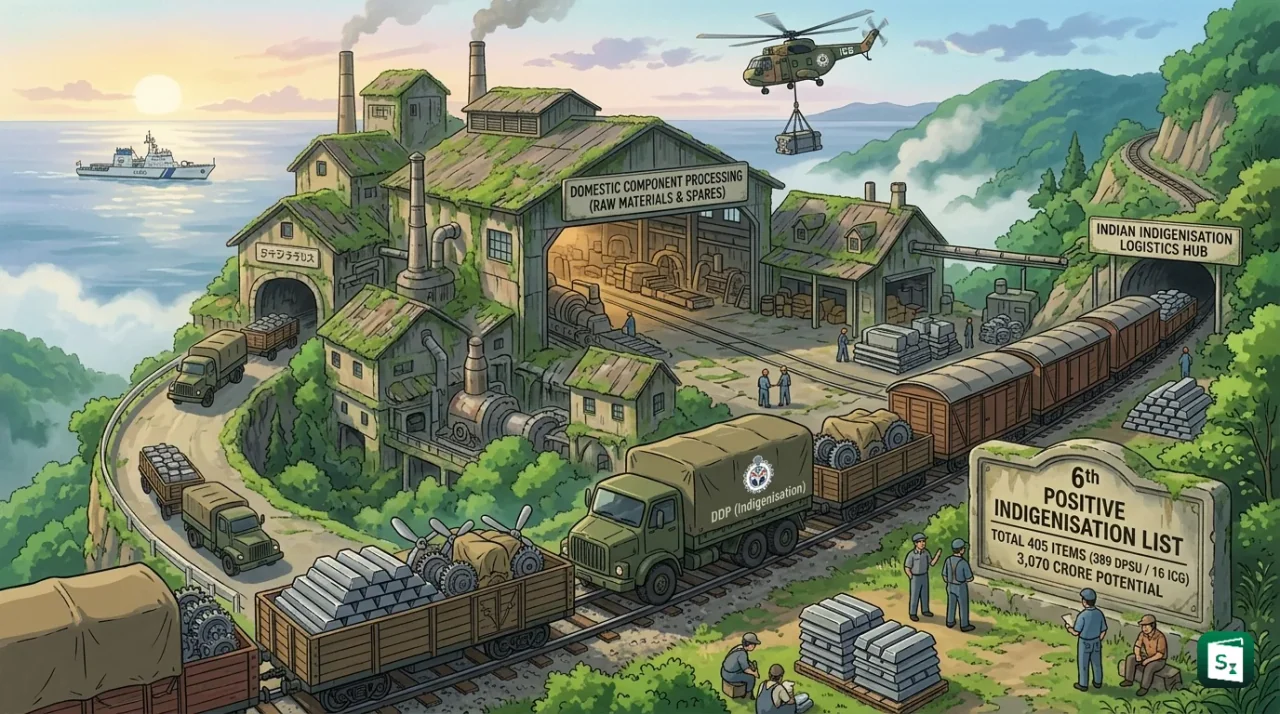
The Department of Defence Production (DDP) under the Ministry of Defence has notified the 6th Positive Indigenisation List (PIL) comprising 405 strategically important defence items with an estimated business potential of ₹3,070 crore. Of these, 389 items belong to Defence Public Sector Undertakings (DPSUs) and 16 items to the Indian Coast Guard (ICG). Once these items are successfully developed in India, they will be procured only from domestic industry, giving a fresh push to self-reliance in defence manufacturing.
What Is a Positive Indigenisation List?
A Positive Indigenisation List (PIL) is a government notified list of defence items that must be sourced only from Indian industry after a specified timeline. The term positive means the list identifies what will be positively procured from domestic makers, rather than merely banning imports. Once an item is on the list and the indigenisation timeline ends, the buyer is required to place orders only with Indian vendors.
The PIL is a central tool of the Aatmanirbhar Bharat (Self-reliant India) initiative in defence. The core idea is import substitution. By giving long term assurance that the government will buy a specific component or system only from Indian firms, the Ministry of Defence creates market certainty for domestic industry to invest, design, develop and produce.
There are two parallel streams of PILs. The Department of Military Affairs (DMA) notifies lists for major weapons, platforms and systems required by the Armed Forces, such as helicopters, corvettes and air defence systems. The Department of Defence Production (DDP) notifies lists for sub-systems, assemblies, sub-assemblies, components, spares and raw materials required by Defence Public Sector Undertakings (DPSUs) and Service Headquarters. The 6th list notified in August 2026 belongs to the DDP stream. It focuses on the smaller but critical building blocks that keep larger platforms operational.
Each item on the list carries an indicative indigenisation timeline. Until that date, imports may continue if domestic capability does not exist. After the timeline, procurement can only be from Indian industry, including through in house production by DPSUs. This timed embargo gives industry a clear window to develop technology, get qualified and scale production.
What the 6th List Covers
The 6th PIL includes 405 items described as Line Replaceable Units (LRUs), sub-systems, sub-assemblies, spares, components and raw materials. An LRU is a modular part of an aircraft, ship or vehicle that can be quickly removed and replaced in the field without detailed workshop repair. Sub-systems and sub-assemblies are functional groupings of components that together perform a specific task within a larger system.
The breakup is 389 items for DPSUs and 16 items for the Indian Coast Guard (ICG). The goods span multiple domains of defence technology.
| Platform Category | Examples Covered in the List |
|---|---|
| Air Platforms | Advanced Light Helicopter (ALH) Dhruv, Light Utility Helicopter (LUH), Su-30MKI fighter, Light Combat Aircraft (LCA) Tejas and AL-31FP engine components |
| Armoured Platforms | T-72 and T-90 tanks and BMP-II infantry combat vehicle related items |
| Naval Platforms | Components for warships and Coast Guard vessels |
| Missile Systems | Konkurs-M and Invar anti-tank guided missiles and Medium Range Surface to Air Missile (MRSAM) related items |
| Defence Electronics | Radars, sonars, fire control systems and satellite communication systems |
| Ammunition and Other Equipment | High Explosive Anti-Tank (HEAT) ammunition and other critical defence equipment |
The list is not about complete weapon systems. It targets the imported content hidden inside these systems, such as sensors, electronic modules, hydraulic parts, engine spares, special alloys and raw materials that DPSUs have historically sourced from abroad. By indigenising these inputs, the larger platforms become more Indian in content, easier to maintain during operations and less vulnerable to supply chain disruptions.
The detailed item wise list with indigenisation timelines has been uploaded on the SRIJAN Defence Portal (srijandefence.gov.in). Upon successful indigenous development and qualification, DPSUs and the ICG will procure the items from Indian industry.
How Indigenisation Will Be Done
DPSUs and the ICG will pursue indigenisation through multiple routes, with strong involvement of Indian industry, particularly Micro, Small and Medium Enterprises (MSMEs) and start ups.
The two main routes are the Make procedure and in-house development. The Make procedure is defined under the Defence Acquisition Procedure (DAP) 2020, which is the primary rulebook for capital procurement by the Armed Forces. Make has three sub-categories. Make-I is for equipment that needs indigenous design and development, with the government funding up to 70 per cent of prototype development cost. Make-II is for import substitution items where industry funds the prototype on its own, with no government funding but an assurance of orders if development succeeds. Make-III covers items manufactured in India as import substitution through transfer of technology from a foreign firm, also without government funding.
DAP 2020 also incentivises the smallest firms. Projects where procurement is expected to be not more than ₹100 crore per year are earmarked for MSMEs. Most items in the DDP PILs fall under what is effectively Make-II style industry funded development, where DPSUs float an Expression of Interest (EoI) or Request for Proposal on the SRIJAN portal and invite domestic firms to develop the item.
In-house development refers to development carried out directly by the DPSU itself, using its own design centres, factories and supply chains, sometimes with contracted support from Indian vendors.
For a company, the process starts on the SRIJAN portal, launched by DDP in August 2020 as a dedicated platform for indigenisation. DPSUs and Service Headquarters publish items they currently import, with details such as part number, quantity, value and technical specifications. Indian firms can show interest, seek clarifications and submit development proposals to the nodal officer listed for each item.
Background: Five Lists Before This and the SRIJAN Portal
The idea of a Positive Indigenisation List was first announced as part of the Aatmanirbhar Bharat Abhiyan reforms unveiled in May 2020. The government set a target to raise indigenous procurement for the Armed Forces and to eventually raise defence exports.
On the DMA side, three major lists of weapons and platforms have been notified so far, starting with 101 items in August 2020, 108 items in May 2021 and 101 items in April 2022, with items to be embargoed for import between December 2020 and December 2027.
On the DDP side for DPSU components and spares, the progress before the 6th list was:
| DDP PIL | Items Notified | Nature |
|---|---|---|
| 1st List, December 2021 | 2,851 items | Included 2,500 items already indigenised plus 351 to be indigenised within three years. Estimated to save foreign exchange of about ₹3,000 crore per year |
| 2nd List, March 2022 | 107 items | Sub-systems and components for DPSU platforms |
| 3rd List, August 2022 | 780 items | Additional Line Replaceable Units and spares |
| 4th List, May 2023 | 928 items | Included LRUs, spares and high end materials with import substitution value of about ₹715 crore |
| 5th List, June 2024 | 346 items | Strategically important components and raw materials |
| 6th List, August 2026 | 405 items | 389 DPSU plus 16 ICG items, with business potential of ₹3,070 crore |
The five DDP lists together account for 5,012 items. The SRIJAN portal has become the single window linking these lists to industry. By June 2026, more than 33,000 defence items had been offered for indigenisation by DPSUs and Service Headquarters through the portal. Of these, over 15,700 items have been successfully indigenised over the last five years, resulting in estimated import substitution of about ₹9,000 crore. In addition, DPSUs had placed procurement orders, including in house production, worth about ₹10,000 crore on domestic vendors up to March 2026, according to the Ministry of Defence. The 6th list now adds to that pipeline.
Why This List Matters
For DPSUs such as Hindustan Aeronautics Limited (HAL), Bharat Electronics Limited (BEL), Bharat Dynamics Limited (BDL), Mazagon Dock Shipbuilders Limited (MDL) and others operating under the Department of Defence Production, indigenisation of critical inputs directly reduces the share of imported content. The DDP was set up to build production infrastructure and achieve self reliance in design, development and production of defence equipment, and it oversees 16 DPSUs including seven new companies formed from the former Ordnance Factory Board (OFB) in October 2021.
For the Indian Coast Guard (ICG), which was established on 1 February 1977 and operates under the Ministry of Defence for maritime law enforcement, search and rescue and coastal security, the inclusion of 16 items marks a targeted effort to make its fleet more maintainable from domestic sources.
For industry, the estimated ₹3,070 crore business potential creates a defined domestic market. Because each item has a timeline, firms can plan investment and hiring with some certainty. The focus on LRUs and spares is especially attractive for MSMEs and start ups, as these items need precision engineering but not the massive capital of a complete platform. Successful development can also qualify firms for future orders beyond the immediate list, building a tiered supplier ecosystem similar to those in aerospace and automotive sectors.
For national security, dependence on imports for spares is a strategic risk. During conflicts or global supply disruptions, a missing spare can keep a fighter or tank grounded. A domestic supply chain for even small components improves operational readiness, saves foreign exchange and supports the longer term goal of turning India from a defence importer into a defence producer. The Ministry has stated that the 6th PIL is expected to expand opportunities for Indian industry, strengthen the domestic manufacturing ecosystem, encourage investment and innovation, and further reduce import dependence.
The Bigger Picture: Defence Self Reliance Framework
The PIL does not work alone. It is part of a wider set of reforms. The Defence Acquisition Procedure (DAP) 2020 increased the required Indigenous Content (IC) to 50 to 60 per cent for most Buy categories and created the Buy (Indian-Indigenously Designed, Developed and Manufactured) or Buy (Indian-IDDM) category that gives highest priority to fully indigenous design. The Make in India in Defence framework, the Defence Industrial Corridors in Uttar Pradesh and Tamil Nadu, and the Innovations for Defence Excellence (iDEX) scheme launched in 2018 for start ups all push in the same direction.
Even with progress, challenges remain. Industry must meet stringent quality and certification standards, especially for airborne items. Timelines can slip if development and field trials take longer than expected. DPSUs also need to hand hold vendors with technical data and testing facilities. The success of the 6th list will therefore depend on how quickly capable firms come forward on SRIJAN, how fast prototypes clear trials, and how transparently orders are placed once an item is qualified.
The inclusion of items for platforms such as ALH, LUH, Su-30MKI, LCA, T-72, T-90, BMP-II, Konkurs-M, Invar and MRSAM shows where the government sees the largest remaining import dependence. MRSAM, for example, is the Medium Range Surface to Air Missile system jointly developed by the Defence Research and Development Organisation (DRDO) and Israel Aerospace Industries (IAI) and produced in India, while many tank and aircraft spares are still sourced under legacy contracts. Indigenising their sub-units is a step toward deeper self reliance without waiting for entirely new platforms.
Key Takeaways
- The 6th Positive Indigenisation List notified by the Department of Defence Production in August 2026 comprises 405 items with business potential of ₹3,070 crore.
- The list includes 389 items for DPSUs and 16 items for the Indian Coast Guard, covering LRUs, sub-systems, spares, components and raw materials.
- Items span ALH, LUH, Su-30MKI, LCA Tejas, AL-31FP engine, T-72, T-90, BMP-II, Konkurs-M, Invar and MRSAM and defence electronics such as radars and sonars.
- The SRIJAN Defence Portal, launched in August 2020, hosts the item wise list and timelines and has offered over 33,000 items, with more than 15,700 items indigenised by June 2026.
- The first five DDP PILs together notified 5,012 items, and indigenisation has led to import substitution of about ₹9,000 crore and DPSU orders of about ₹10,000 crore on domestic vendors up to March 2026.
- Indigenisation will be pursued through Make procedure under DAP 2020 and in-house development, with priority for MSMEs and start ups.