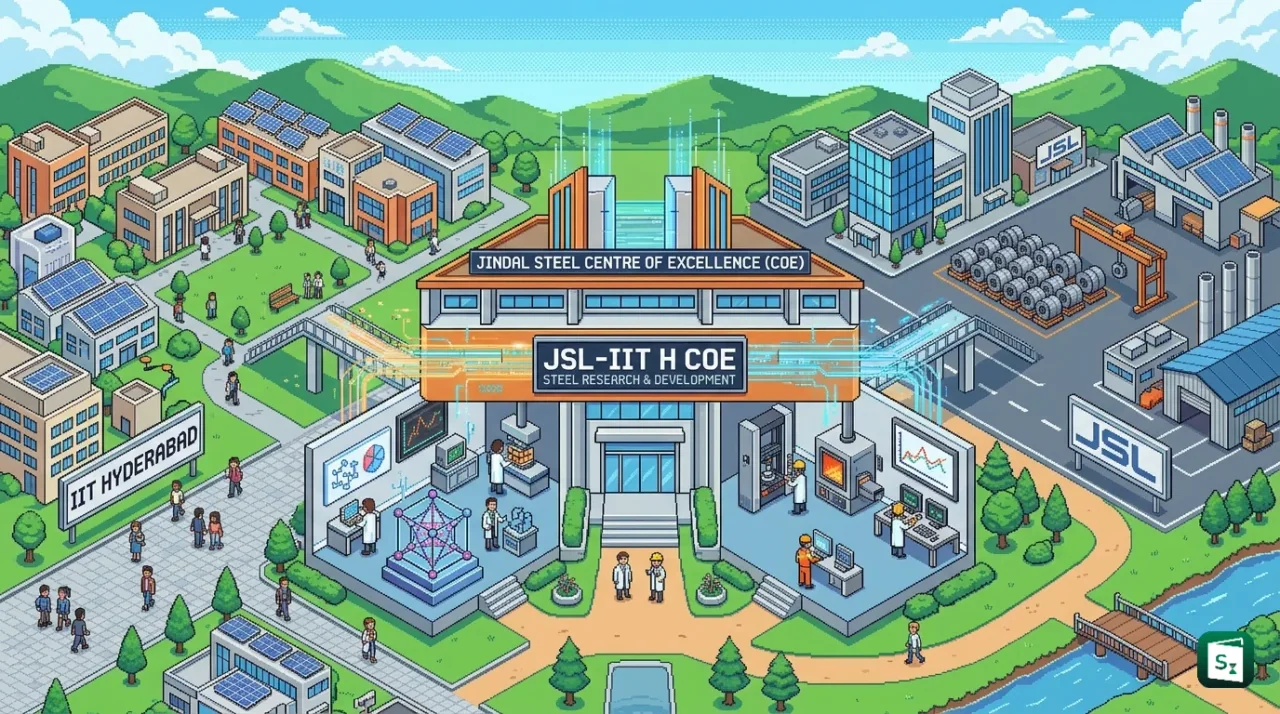
Jindal Steel Ltd has signed a Memorandum of Understanding with the Indian Institute of Technology Hyderabad to set up the first-of-its-kind Jindal Steel Centre of Excellence at the institute’s campus in Kandi, Sangareddy. The agreement was signed on 20 August 2026 and will create a dedicated hub for research and development of high-strength and value-engineered steel. By linking the institute’s research strength with industry expertise, the centre aims to speed up the use of advanced steel across India’s infrastructure and strategic sectors.
What Does the MoU Establish?
The Memorandum of Understanding (MoU), a formal agreement to work together, was signed between Jindal Steel Ltd (JSL) and the Indian Institute of Technology Hyderabad (IIT Hyderabad or IITH) on 20 August 2026 at the IITH campus in Kandi, Sangareddy district, Telangana. Under it, Jindal Steel will invest in and develop a physical Centre of Excellence inside the IITH campus that will function as the Jindal Steel Centre of Excellence for High-Strength, Value-Added and Value-Engineered Steel Products and Solutions.
The centre is described as first-of-its-kind for this combination of products and solutions. It will combine IITH’s technical and research capabilities with Jindal Steel’s manufacturing, metallurgical and engineering expertise. The stated goal is to accelerate both the development of applications for advanced steel grades and their adoption in real-world projects, offering higher performance, lower material consumption, reduced weight, faster execution, improved durability and better lifecycle economics.
The partnership was announced by Jindal Steel Managing Director V R Sharma and IITH Director Prof B S Murty. Both sides said the centre would demonstrate solutions that are stronger, lighter, faster and more efficient and help move them from lab and design stage to large-scale use.
Who Are the Partners?
Jindal Steel Ltd
Jindal Steel Ltd (JSL), formerly known as Jindal Steel and Power Ltd (JSPL), is one of India’s leading integrated steel producers. It is part of the O P Jindal Group and is headquartered in New Delhi. The company is chaired by Naveen Jindal. In terms of tonnage, it is the third largest private steel producer in India and the only private player in the country to produce rails, including the world’s longest 121-metre rails.
The company operates on a mine-to-metal model with captive resources and advanced manufacturing. It runs state-of-the-art integrated plants at Angul in Odisha, Raigarh in Chhattisgarh and Patratu in Jharkhand, along with a 9 MTPA pellet plant at Barbil in Odisha. Its investment footprint exceeds $12 billion, and it maintains operations across India and Africa. Its portfolio includes sponge iron, slabs, rails, structural steel, hot rolled plates, coils and iron ore pellets. The Angul plant, India’s only steel plant using a coal gasification based route to produce synthesis gas for Direct Reduced Iron (DRI), is being expanded from 6 MTPA to 12 MTPA. Jindal Steel also set up the world’s first MXCOL plant and operates the world’s largest coal-based sponge iron capacity.
The company was incorporated in 1979 as part of the Jindal Strips group set up by O P Jindal in 1969 at Hisar. Since 2025, the listed entity has used the name Jindal Steel Ltd after dropping “Power” following business restructuring.
IIT Hyderabad
The Indian Institute of Technology Hyderabad (IIT Hyderabad or IITH) is a public technical university located at Kandi near Sangareddy in Telangana. It was established in 2008 by the Ministry of Education, Government of India under the Institutes of Technology (Amendment) Act, 2011, and is an Institute of National Importance. The institute began functioning on 18 August 2008 from a temporary campus and moved to its permanent 576 acre campus at Kandi in July 2015 with technical and financial assistance from the Government of Japan.
The campus lies on National Highway 65 close to Hyderabad’s Outer Ring Road. The institute is currently headed by Director Prof B S Murty, a metallurgical engineer and Shanti Swarup Bhatnagar Prize (2007) awardee who took charge in August 2019. Prof Murty, earlier a professor at IIT Madras and IIT Kharagpur, is also President of the Indian Institute of Metals (IIM) from 1 August 2025. IITH is ranked 8th in NIRF 2024 Engineering category and operates 17 plus departments across engineering, science, design and liberal arts.
What Will the Centre of Excellence Do?
The centre will act as a hub for research and development, application engineering and adoption of advanced steel. It is not planned as a basic research lab alone but as a translational platform that connects research, design, testing and field use.
Understanding the Three Steel Categories
The MoU focuses on three overlapping product groups that are central to modern construction and manufacturing:
| Category | What It Means | Why It Matters |
|---|---|---|
| High-strength steel | Steel that can bear much higher load for the same thickness or weight compared to ordinary mild steel | Allows use of thinner, lighter sections, so structures need less steel and foundations become lighter |
| Value-added steel | Steel that has been processed further to add special properties, such as coated, plated, quenched or specially heat treated grades | Gives better corrosion resistance, wear resistance or surface quality for longer life |
| Value-engineered steel | Steel solutions where the grade, shape and fabrication method are chosen together to give the best performance at lowest overall cost | Reduces total project cost and time even if the per tonne steel cost is higher |
In simple terms, high-strength lets you use less steel, value-added makes the steel last longer or work better, and value-engineered makes the entire project more economical across its life.
Focus Areas and Applications
The centre will develop and demonstrate applications across a wide set of sectors. These include buildings and bridges, penstocks and large-diameter pipes, defence applications, yellow goods and heavy equipment, power plants, refineries, transportation systems and heavy engineering. Penstocks are large pipes or conduits that carry water under pressure to turbines in hydropower plants, while yellow goods refer to heavy construction and earthmoving equipment such as excavators and bulldozers.
The solutions are expected to help in faster execution, reduced weight, lower material consumption and better lifecycle economics. The centre will work directly with designers, consultants, structural engineers, fabricators, EPC (Engineering, Procurement and Construction) companies, equipment manufacturers and project developers to identify suitable applications and encourage the shift to higher grades.
Activities and Programmes
According to the partners, the physical centre at IITH will serve as a hub for several coordinated activities:
- Application development and technical demonstrations for new grades and structural systems
- Workshops, symposia and industry engagement programmes to share knowledge and test results
- Training and skill building for engineers, fabricators and students, including academic modules and specialised courses
- Student internships and placements and project-based learning with industry problems
- Demonstration projects that show performance, durability and cost benefits in actual structures
- Engagement with industry stakeholders, government agencies and end users to support technical evaluation and scale up adoption
The model complements another recent initiative by the same partners. In February 2026, IIT Delhi and Jindal Steel signed an MoU to set up a Nodal Centre of Excellence for Structural Steel Research and Innovation. That nodal centre at IIT Delhi, led by Director Prof Rangan Banerjee and Jindal Steel CEO Gautam Malhotra, acts as the hub in a hub-and-spoke framework coordinating with other IITs including IIT Hyderabad, IIT Bombay, IIT Madras and IIT Roorkee. The new IITH centre therefore functions as a spoke centre focused on advanced steel products and solutions while drawing on the national network for curriculum, design codes and outreach.
Why Advanced Steel Matters for India
India is the world’s second largest crude steel producer, producing about 151.14 million tonnes (MT) in FY25, up from 144.31 MT in FY24, with finished steel consumption at 150.23 MT. Steel contributes about 2 percent to GDP and supports more than 600,000 direct and 2 million indirect jobs. The government’s National Steel Policy (NSP) 2017, notified on 8 May 2017, sets a target of 300 MT per annum of crude steel capacity and 160 kg per capita consumption by 2030-31, up from about 220 MT capacity at the end of FY26.
A major gap the policy seeks to close is specialty and high-grade steel. While India is a net exporter of bulk finished steel, it still imports value-added grades such as high-strength and wear resistant steel, coated and plated products, specialty rails, alloy steels and electrical steels. To address this, the Production Linked Incentive (PLI) Scheme for Specialty Steel, launched on 29 July 2021 and expanded as PLI 1.1 on 6 January 2025, aims to create about 42 MT of specialty steel capacity. By March 2025, companies had committed ₹27,106 crore of investment with about ₹20,000 crore already invested.
Advanced steel directly supports national missions. Lighter, stronger grades mean less steel per bridge, building or pipe, faster construction and lower lifecycle cost, which is important as India builds highways, dedicated freight corridors, metro systems, housing, power plants and defence platforms under programmes such as Make in India and Viksit Bharat 2047. Reduced material use also helps cut the carbon footprint of construction, since steel production is energy intensive. Industry academia centres like the one at IITH help translate research on high-strength applications, performance based design and modern codes into standards that suit Indian conditions such as seismic zones, high temperatures and coastal corrosion.
For engineers and planners, the centre promises updated design methods, reference materials and direct design support, which can shorten project timelines and improve resilience against multiple hazards.
The Way Forward
The MoU sets the institutional base, but its impact will depend on rollout and coordination. The immediate next step is the creation of the physical centre at IITH, with Jindal Steel funding infrastructure, lab facilities and demonstration setups. Joint teams will then define priority projects for buildings, bridges and industrial applications, start pilot demonstrations and develop training modules and handbooks that can be used across engineering colleges and professional practice.
In the medium term, the centre is expected to work with government ministries, professional bodies and EPC players to push updated codes, standards and specifications that allow designers to confidently use higher grades, and to build a pipeline of trained engineers and fabricators through workshops and digital platforms. Its integration with the IIT Delhi nodal network will help avoid duplication, share resources and align research and skill programmes nationally. If demonstration projects can show clear savings in weight, time and lifecycle cost, adoption of high-strength and value-engineered steel could rise across both public procurement, supported by the Domestically Manufactured Iron and Steel Products (DMI&SP) Policy, and private construction, helping India meet its 2030 steel policy goals more sustainably.
Key Takeaways
- Jindal Steel Ltd and IIT Hyderabad signed an MoU on 20 August 2026 to establish the Jindal Steel Centre of Excellence at the IITH campus in Kandi, Sangareddy, Telangana.
- The centre is first-of-its-kind for high-strength, value-added and value-engineered steel products and solutions and will be funded and built by Jindal Steel at IITH.
- It will focus on applications across buildings, bridges, penstocks, large-diameter pipes, defence, yellow goods, power plants, refineries, transportation and heavy engineering.
- The hub will drive application development, technical demonstrations, training, workshops, student internships, academic modules and industry engagement with designers, fabricators and EPC firms.
- IIT Hyderabad, established in 2008 and an Institute of National Importance on a 576 acre Kandi campus, is headed by Director Prof B S Murty (Shanti Swarup Bhatnagar Prize 2007).
- Jindal Steel Ltd (formerly Jindal Steel and Power Ltd), part of the O P Jindal Group and led by Chairman Naveen Jindal, is India’s third largest private steel producer and the only private producer of rails.
- The initiative complements the IIT Delhi-Jindal Steel Nodal Centre of Excellence (February 2026) that coordinates a hub-and-spoke network with IIT Hyderabad, IIT Bombay, IIT Madras and IIT Roorkee in line with National Steel Policy 2017 (300 MT by 2030-31) and Viksit Bharat 2047.