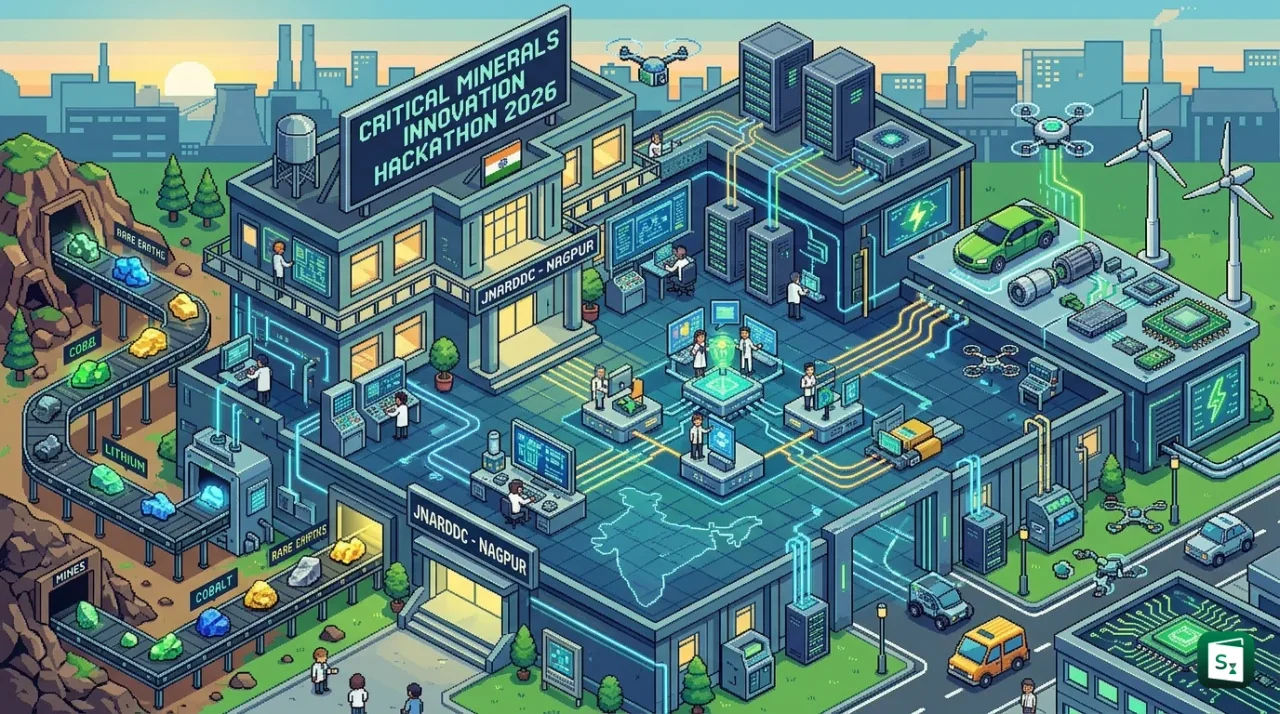
Union Minister for Coal and Mines G Kishan Reddy launched the Critical Minerals Innovation Hackathon 2026 (CMiH 2026) on 25 August 2026 in New Delhi to invite technology-driven solutions for India’s critical minerals sector. The hackathon is organised and hosted by the Jawaharlal Nehru Aluminium Research Development and Design Centre (JNARDDC), Nagpur, an autonomous body under the Ministry of Mines. It aims to strengthen the objectives of the National Critical Mineral Mission (NCMM) by engaging students, researchers, startups and innovators in solving real challenges in mineral exploration and technology tracking.
What Is the Critical Minerals Innovation Hackathon 2026?
The Critical Minerals Innovation Hackathon 2026, also called CMiH 2026, is a national level innovation challenge launched by the Ministry of Mines through JNARDDC. It invites participants to develop technically feasible and scalable solutions that can move towards proof of concept and prototype with expert mentoring. The focus is on creating a secure and self-reliant critical minerals ecosystem for India at a time when demand for clean energy and high technology applications is rising rapidly.
The hackathon was formally launched by the Union Minister for Coal and Mines in New Delhi on 25 August 2026. Detailed guidelines, problem statements and registration links have been made available on the JNARDDC website (jnarddc.gov.in). The process is fully online for idea submission in the first stage, followed by mentoring and prototype development support for shortlisted teams. Winners will be announced during India Mining Week 2026, scheduled from 15 to 17 November 2026 at Yashobhoomi Convention Centre, New Delhi.
Two Problem Statements Driving the Hackathon
CMiH 2026 is built around two specific problem statements that address major gaps in India’s critical minerals value chain. Each problem statement will have two winners, so four winning teams will be awarded in total. The first prize is ₹1.50 lakh and the second prize is ₹1 lakh for each problem area.
Mineral Prospectivity Mapping from Open Data
The first challenge asks participants to use publicly available open data to identify areas likely to host deposits of lithium and rare earth element (REE) pegmatites. A pegmatite is a very coarse grained igneous rock that often hosts lithium and rare earth minerals. Teams must develop a prospectivity heatmap, which is a colour coded map showing how likely each area is to contain the mineral, and then validate the map against known mineral occurrences. This approach aims to make exploration faster and cheaper by using data analytics and artificial intelligence rather than only traditional field surveys. It is especially relevant because India is 100 percent import dependent for lithium, cobalt and nickel and needs to accelerate domestic discovery.
Smart Technology and Patent Tracker for Critical Minerals
The second challenge is to build an intuitive, web based Smart R and D and Patent Tracking System for critical minerals. This system should automatically track new research papers, technologies and patents related to critical minerals across the value chain, from mining and beneficiation to processing and recycling. At present, information on global technological developments is scattered and difficult to monitor. A central tracker will help researchers, industry and policymakers see where technology is moving, avoid duplication and identify opportunities for collaboration or licensing. The solution should be user friendly, searchable and capable of continuous updating.
Who Can Participate and What Are the Key Dates?
The hackathon is open to a wide range of innovators. Eligible participants include students, research scholars, faculty and research teams, recognised startups, academic and R and D institutions, and individual innovators. Interdisciplinary teams are encouraged, with a maximum team size of five members including the team leader. Participants get a chance to showcase ideas before domain experts, receive expert mentorship and contribute directly to India’s mineral security.
Key timelines have been announced by JNARDDC:
| Event | Date / Detail |
|---|---|
| Hackathon launch | 25 August 2026 |
| Last date for registration and idea submission | 20 September 2026 |
| Mentoring, orientation and prototype development | September to November 2026 for shortlisted teams |
| Winner announcement | During India Mining Week 2026, 15 to 17 November 2026 |
| Prizes per problem statement | First prize ₹1.50 lakh, Second prize ₹1 lakh |
Shortlisted teams will go through orientation, expert mentoring, proof of concept development and final evaluation before the winners are declared at India Mining Week, which is being organised by the Ministry of Coal and Ministry of Mines as India’s largest mining summit.
About JNARDDC: The Organising Centre
The Jawaharlal Nehru Aluminium Research Development and Design Centre (JNARDDC) is a Centre of Excellence set up in 1989 in Nagpur, Maharashtra. It is an autonomous body under the Ministry of Mines, registered under the Societies Registration Act, 1860 and the Bombay Public Trust Act, 1950 as a Trust. It was established as a joint venture supported by the Ministry of Mines and the United Nations Development Programme (UNDP) at a cost of about ₹35 crore, and became fully functional in 1996. Its campus is located on Amravati Road, Wadi, Nagpur.
JNARDDC is recognised as a Scientific and Industrial Research Organisation (SIRO) by the Department of Scientific and Industrial Research (DSIR) under the Ministry of Science and Technology. It is an ISO/IEC 17025:2017 and ISO 17034:2016 NABL accredited laboratory. It is the only institute of its kind in India that carries out research and development from bauxite to finished aluminium product under one roof.
Originally created to support the emerging aluminium industry, its mandate has now been widened to include the promotion of recycling, critical minerals and transition to a circular economy in the non ferrous metals sector. Work areas include beneficiation and characterisation of bauxite, Bayer process modelling, reduction of energy consumption in smelters, alloy development and effective use of residues such as red mud, dross and spent pot lining. The Centre also provides analytical and testing services to non ferrous industries, steel plants and academic institutions and has been nominated as the implementing agency for the S and T PRISM funding programme of the Ministry of Mines. The present Director is Dr Anupam Agnihotri, an IIT Kanpur alumnus with a doctorate from VNIT Nagpur.
Why Critical Minerals Matter for India
Critical minerals are minerals that are essential for economic development and national security, but face high supply risk due to limited availability, geographic concentration or import dependence. The term is country specific, as each country defines criticality based on its resource endowment and industrial needs.
India’s List of 30 Critical Minerals
Based on a three stage assessment of economic importance and supply risk, a committee under the Ministry of Mines identified 30 critical minerals in June 2023 and released the report of the Committee on Identification of Critical Minerals. The list includes Antimony, Beryllium, Bismuth, Cobalt, Copper, Gallium, Germanium, Graphite, Hafnium, Indium, Lithium, Molybdenum, Niobium, Nickel, Platinum Group Elements (PGE), Phosphorous, Potash, Rare Earth Elements (REE), Rhenium, Silicon, Strontium, Tantalum, Tellurium, Tin, Titanium, Tungsten, Vanadium, Zirconium, Selenium and Cadmium. Of these, 24 minerals have been included in Part D of Schedule I of the Mines and Minerals (Development and Regulation) Act, 1957 (MMDR Act), giving the Central Government exclusive powers to auction mining leases and composite licences for them.
India is 100 percent import dependent for 10 of these minerals in 2020, including lithium, cobalt, nickel, vanadium, niobium, germanium, rhenium, beryllium, tantalum and strontium, with major sources being China, Chile, Australia, Brazil and Russia. Even promising finds such as the 5.9 million tonnes of inferred lithium resources identified by the Geological Survey of India (GSI) in the Salal Haimana area of Reasi district, Jammu and Kashmir, in February 2023, have not yet translated into commercial production due to processing and technology gaps.
These minerals are vital for sectors that will decide India’s future growth. Lithium, cobalt, nickel and graphite are needed for lithium ion batteries used in electric vehicles and energy storage. Rare earth elements like neodymium, praseodymium, dysprosium and terbium are used for permanent magnets in wind turbines and EV motors. Gallium, germanium, silicon and tellurium are critical for semiconductors and solar panels, while titanium, tungsten and beryllium are used in defence and aerospace.
The National Critical Mineral Mission and Its Targets
To address these vulnerabilities, the Government announced the National Critical Mineral Mission (NCMM) in the Union Budget 2024-25 on 23 July 2024 and the Union Cabinet approved it on 29 January 2025. The mission runs from 2024-25 to 2030-31 with an outlay of ₹16,300 crore and expected investment of ₹18,000 crore by Public Sector Undertakings, taking the total to ₹34,300 crore.
The NCMM has two broad objectives, to secure mineral availability from domestic and foreign sources, and to strengthen value chains through technology, regulation and finance. Key targets for the seven year period include 1,200 domestic exploration projects by GSI, 26 overseas assets by PSUs and 24 by private firms, 400 kilotonnes of material through recycling, 1,000 patents in the critical mineral value chain, training of 10,000 persons, setting up of 4 Mineral Processing Parks, creation of 3 Centres of Excellence and building 5 mineral stockpiles. The Geological Survey of India took up 195 exploration projects in 2024-25, including 35 in Rajasthan. The mission also provides for fast track regulatory approvals, a new Exploration Licence to encourage private participation and 100 percent foreign direct investment through the automatic route.
The NCMM is directly linked to India’s climate goals, which include reducing the emissions intensity of GDP by 45 percent by 2030 from 2005 levels, achieving 50 percent of power capacity from non fossil sources by 2030, and reaching net zero emissions by 2070. Without secure access to critical minerals, these targets cannot be met.
Significance and the Way Forward
The Critical Minerals Innovation Hackathon 2026 is significant because it links classroom innovation with a strategic national need. At a time when global supply chains for lithium and rare earths are highly concentrated, with China refining about 60 percent of the world’s lithium, India needs both new discoveries and faster tracking of global technology. By asking innovators to build a heatmap from open data, the hackathon could help prioritise where GSI and private explorers should focus limited field resources. By asking for a patent tracker, it addresses the gap between scattered global research and Indian decision making.
For participants, the hackathon offers mentorship, visibility before experts and a path from idea to prototype. For the country, it could add low cost exploration tools and a digital intelligence system that remains useful beyond the event. If successful, similar challenge based formats could be extended to other parts of the value chain, such as mineral processing, recycling from e waste and development of substitutes. The winners being showcased at India Mining Week 2026 also ensures that promising ideas get direct exposure to policymakers, mining companies and global investors who will gather in large numbers in New Delhi.
In the larger picture, the hackathon supports the approach of building a technologically capable and resilient mineral ecosystem rather than relying only on imports or overseas acquisitions through Khanij Bidesh India Ltd (KABIL), the joint venture of National Aluminium Company (NALCO), Hindustan Copper Ltd and Mineral Exploration Company Ltd set up to acquire assets abroad. Strengthening domestic innovation is the most durable way to reduce supply risk.
Key Takeaways
- The Critical Minerals Innovation Hackathon 2026 (CMiH 2026) was launched on 25 August 2026 by Union Minister for Coal and Mines G Kishan Reddy in New Delhi.
- It is organised and hosted by JNARDDC, Nagpur, an autonomous body under the Ministry of Mines established in 1989 and fully functional since 1996.
- The hackathon focuses on two problem statements, Mineral Prospectivity Mapping for lithium and REE pegmatites using open data and Smart R and D and Patent Tracking System for critical minerals.
- Last date for idea submission is 20 September 2026 and winners will be announced during India Mining Week 2026 from 15 to 17 November 2026 at Yashobhoomi, New Delhi, with first prize ₹1.50 lakh and second prize ₹1 lakh per problem statement.
- The initiative supports the National Critical Mineral Mission (NCMM), approved on 29 January 2025 for 2024-25 to 2030-31 with an outlay of ₹16,300 crore plus ₹18,000 crore expected PSU investment, targeting 1,200 exploration projects and 1,000 patents.