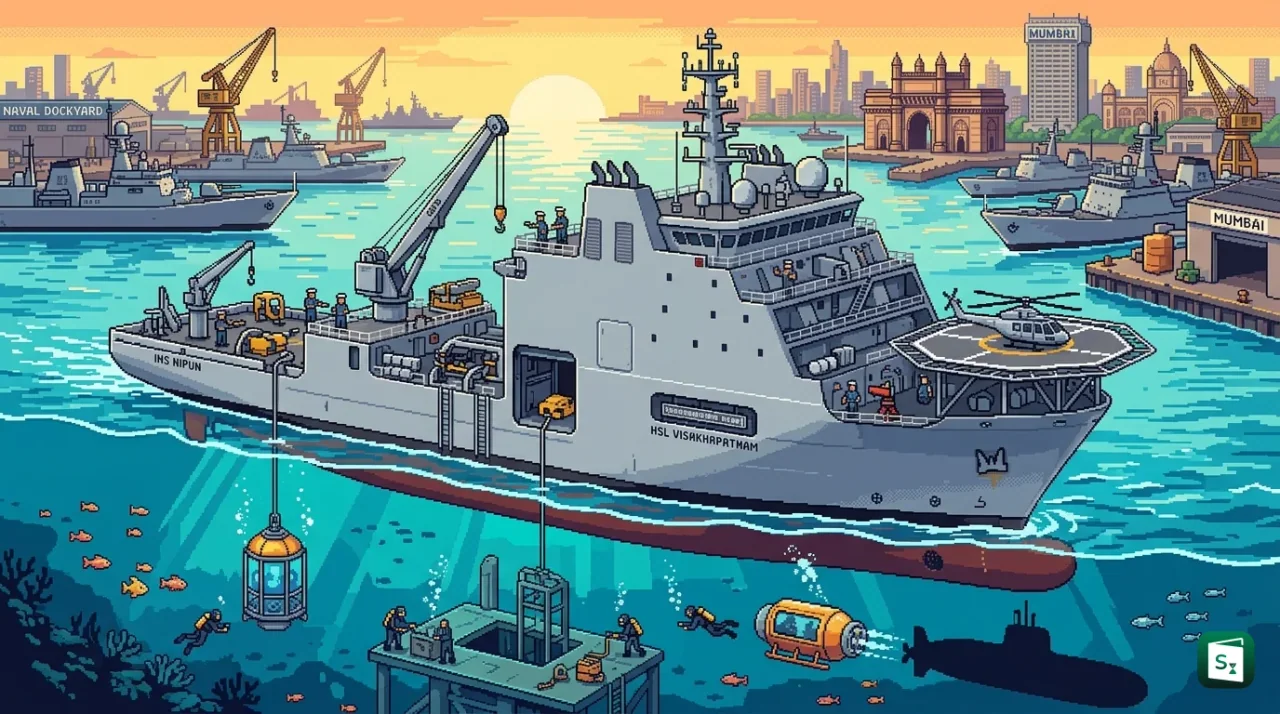
The Indian Navy commissioned INS Nipun, its second Nistar Class Diving Support Vessel (DSV), at the Naval Dockyard in Mumbai on 31 August 2026. The ceremony was presided over by Admiral Krishna Swaminathan, Chief of the Naval Staff. Built indigenously by Hindustan Shipyard Limited (HSL) in Visakhapatnam and delivered on 30 July 2026, the vessel will expand the Navy’s deep-sea diving, underwater intervention and submarine rescue capabilities on the western seaboard.
What Is INS Nipun and Why Does Its Name Matter?
INS Nipun is the second vessel of the Nistar Class, the Indian Navy’s first class of indigenously designed and built Diving Support Vessels (DSVs). The name Nipun comes from Sanskrit and means one who is adept, capable and well versed in a particular discipline. The name reflects the highly specialised nature of the ship, which is built to operate in one of the most demanding maritime domains, the deep sea.
The vessel is designated with pennant number A17 and yard number 11191 at HSL. It is the sister ship of INS Nistar (A16), the lead vessel of the class which was delivered on 8 July 2025 and commissioned on 18 July 2025 at Visakhapatnam under the Eastern Naval Command. While Nistar is based on the eastern seaboard, Nipun will be homeported at Mumbai under the Western Naval Command, giving the Navy a dedicated diving support presence on both coasts for the first time. The class revives a legacy name last used for a submarine rescue vessel acquired from the erstwhile Soviet Union that served from 1969 to 1989.
What Is a Diving Support Vessel and What Does It Do?
A Diving Support Vessel (DSV) is a specialised naval ship that acts as a floating base for underwater operations. Unlike a normal warship, a DSV carries complex diving systems, hyperbaric chambers, cranes and medical facilities to support divers working at significant depths. Its core roles include deep-sea diving, underwater inspection and repair, salvage of sunken objects, search and rescue, and submarine rescue support.
What a DSV does at sea includes deploying divers safely, monitoring them through video and sonar, holding precise position in rough seas, and recovering personnel from a distressed submarine. For a navy that operates submarines across the Indian Ocean Region, stretching from the Persian Gulf to the Malacca Strait, such a platform reduces dependence on leased commercial vessels and ensures rapid response when every hour matters. A DSV is different from a Diving Support Craft (DSC), which is much smaller at about 30 metres and about 390 tonnes and is meant for shallow harbour and coastal diving, while a DSV is an ocean-going ship of about 118 to 119.4 metres and over 9,300 to 10,500 tonnes that can stay at sea for more than 60 days and operate hundreds of metres below the surface.
Commissioning at Naval Dockyard Mumbai and Delivery Timeline
The commissioning took place on 31 August 2026 at Naval Dockyard, Mumbai, one of the Navy’s key operational hubs on the west coast. The Chief of the Naval Staff, Admiral Krishna Swaminathan, presided over the ceremony in the presence of senior officers including Vice Admiral Sanjay Vatsayan. With this induction, Mumbai becomes the home port for Nipun.
The journey from yard to fleet shows the long build cycle of such complex platforms. The contract for two Nistar Class DSVs was signed between the Indian Navy and Hindustan Shipyard Limited on 20 September 2018 at a cost of about ₹2,019 crore, later reported at about ₹2,392.94 crore for the class. The keel for Nipun was laid on 23 March 2020, three months after Nistar’s keel on 28 December 2019. Both ships were launched together on 22 September 2022 at Visakhapatnam. After extensive trials including manned and unmanned dives and tests of its observation class remotely operated vehicle, Nipun was formally delivered to the Navy on 30 July 2026 at Visakhapatnam. The ship has been built in accordance with the classification rules of the Indian Register of Shipping (IRS), which ensures compliance with international safety and quality standards. Its delivery followed Nistar’s delivery by about a year, completing the two-ship class as originally planned in 2018.
Inside INS Nipun: Key Features and Capabilities
INS Nipun is a purpose built platform for sustained underwater intervention. It measures about 118 to 119.4 metres in length with a beam of about 22.8 metres and displaces over 9,350 tonnes, with reports placing the Nistar Class at about 10,500 to 10,578 tonnes at full load. The ship can achieve speeds of 14 to 18 knots and has an endurance of more than 60 days at sea with a crew of about 215 to 250 personnel including about 25 officers. Modern navigation, platform management and Dynamic Positioning System (DP-II) allow the ship to hold exact position even in challenging sea states, a critical requirement when divers or submersibles are in the water. A 15-tonne subsea crane, side scan sonar, helipad and a set of medical facilities including an operating theatre, intensive care unit and an eight bed hospital with hyperbaric chambers are also fitted.
The Navy’s motto for the ship is “Far Beneath, Few Beyond”, which captures the endurance and precision needed for deep sea operations. The crest and motto underline the specialised role of the crew who support missions far below the surface.
Deep Sea Saturation Diving and Remotely Operated Vehicles
The core of Nipun’s diving capability is its Deep Sea Saturation Diving System. Saturation diving is a technique where divers live at the pressure of their working depth for days to weeks inside pressurised chambers. This avoids repeated decompression and allows efficient work at depths that would be impossible with normal surface supplied diving. Nipun can support saturation diving up to 300 metres depth, with a side diving stage for deployments up to about 75 metres for routine work. The system includes living chambers, transfer under pressure bells, gas blending units and a Self-Propelled Hyperbaric Lifeboat that can evacuate divers under pressure in an emergency.
To extend reach and safety, the ship carries Remotely Operated Vehicles (ROVs) of observation and work class. These tethered unmanned vehicles can operate up to about 1,000 metres depth for diver monitoring, underwater inspection, video survey and light salvage. A diving bell, moonpool, six person decompression chamber and side scan sonar further enhance intervention capability. Together, these tools allow the ship to inspect pipelines, search for wreckage, recover objects from the seabed and support prolonged underwater construction or repair.
Mother Ship for the Deep Submergence Rescue Vessel
The most strategically visible role of INS Nipun is as the Mother Ship for the Deep Submergence Rescue Vessel (DSRV). The DSRV is a compact rescue submersible that can mate with the escape hatch of a distressed submarine, create a watertight seal and evacuate crew members even from great depth. The Indian Navy inducted two such systems from James Fisher Defence, UK in 2018 and 2019, one each for the west and east coasts. Each DSRV is operated by a crew of three and can rescue 14 personnel in one sortie at depths up to 650 metres. In sea trials the DSRV dived to 666 metres, the remotely operated vehicle to 750 metres and side scan sonar to 650 metres.
Before Nistar and Nipun, the Navy had no purpose built mother ship and relied on a vessel borrowed from the Shipping Corporation of India, INS Sabarmati, causing delay in mobilisation. A dedicated mother ship closes a gap of nearly eight years and is crucial because response time decides survival in a submarine accident. Nipun can carry, maintain, launch and recover the DSRV and may need to repeat several trips to fully evacuate a large crew. The ship also demonstrated this integration during exercises such as Exercise Pacific Reach 2025 in Singapore, a biennial multinational submarine rescue drill first launched in 1996, where Nistar operated ROVs and DSRV mating drills with foreign submarines.
Nistar Class: How INS Nipun Compares with INS Nistar
Both ships belong to the Nistar Class, the Navy’s dedicated DSV class built by HSL. While they share the same design philosophy, there are minor reporting variations in displacement and indigenous content that reflect different commissioning stage data.
| Feature | INS Nistar (A16) | INS Nipun (A17) |
|---|---|---|
| Pennant and Yard No | A16, Yard 11190 | A17, Yard 11191 |
| Keel laid | 28 December 2019 | 23 March 2020 |
| Launched | 22 September 2022 | 22 September 2022 |
| Delivered | 8 July 2025 | 30 July 2026 |
| Commissioned | 18 July 2025 at Visakhapatnam | 31 August 2026 at Mumbai |
| Home port | Visakhapatnam, Eastern Naval Command | Mumbai, Western Naval Command |
| Length and displacement | About 118 to 119.7 metres, about 10,578 tonnes | About 118 to 119.4 metres, about 9,350 to 10,500 tonnes |
| Indigenous content | About 75 to 80 percent, over 120 MSMEs involved | About 75 percent, with reports citing over 80 percent |
| Core capability | Deep sea saturation diving to 300 metres, ROVs to 1,000 metres, DSRV mother ship | Same as Nistar, ensures dual coast coverage |
Together, the two vessels give the Navy redundancy and reach. One ship can undergo maintenance or operate elsewhere while the other remains available for emergencies, and each coast has immediate access to a full deep sea rescue capability.
Diving Support Vessel vs Diving Support Craft: Understanding the Difference
The Navy’s underwater fleet includes both large DSVs and small Diving Support Craft (DSC) and they serve different purposes.
A DSV like Nistar or Nipun is an ocean going ship designed for deep sea saturation diving, submarine rescue, salvage and sustained patrolling. It carries hyperbaric complexes, DSRV integration, DP-II station keeping and extensive medical support, and is built for operations far from shore for weeks at a time.
A DSC is a harbour and coastal craft built by Titagarh Rail Systems Limited (TRSL), Kolkata under a contract signed on 12 February 2021 for five vessels at a total cost of about ₹174.77 crore, about ₹30 crore per vessel. The DSC features a catamaran hull for stability, measures about 30 to 32.9 metres in length, displaces about 380 to 390 tonnes, achieves about 12 knots and carries a small diving team. It is equipped with modern diving gear to support the Command Clearance Diving Teams (CCDTs) for underwater repair, inspection, harbour clearance and salvage inside and close to harbour. The first craft, DSC A20 (Yard 325), was launched on 31 August 2023 and commissioned on 16 December 2025 at the Naval Base in Kochi under the Southern Naval Command, with hydrodynamic testing at the Naval Science and Technological Laboratory (NSTL), Visakhapatnam. While the DSC strengthens shallow water readiness, only a DSV can conduct deep sea saturation diving and operate a DSRV.
Hindustan Shipyard Limited and India’s Indigenous Shipbuilding Push
Hindustan Shipyard Limited (HSL) is a public sector undertaking headquartered at Gandhigram, Visakhapatnam, Andhra Pradesh. It was originally founded as the Scindia Shipyard on 21 June 1941 by industrialist Walchand Hirachand as part of the Scindia Steam Navigation Company, with the foundation stone laid by Dr Rajendra Prasad. The yard was nationalised in 1952 and renamed HSL, and in 2010 it was transferred from the Ministry of Shipping to the Ministry of Defence to focus on naval construction. The yard can build vessels up to 80,000 Deadweight Tonnage (DWT) and is India’s second largest shipyard after Cochin Shipyard.
HSL was awarded the Nistar Class project after signing the contract in September 2018 and used classification rules of the Indian Register of Shipping (IRS), an organisation established in 1975 and headquartered in Mumbai that classifies ships for safety and quality. The DSV project involved more than 120 Micro, Small and Medium Enterprises (MSMEs), illustrating the wider industrial ecosystem. With nearly 75 percent indigenous content, and some references citing over 80 percent for the lead ship, the class is presented as a milestone for Aatmanirbhar Bharat and Make in India in defence manufacturing. The success follows the yard’s earlier delivery of INS Dhruv in 2020 and aligns with the broader Positive Indigenisation Lists that restrict import of more than 509 items by 2024 to encourage domestic production. For HSL, which reported its highest production value of about ₹613 crore in 2022 and returned to positive net worth in 2025 after nearly four decades, the timely delivery of two highly complex diving platforms marks a transition from auxiliary builders to builders of specialised warships.
Strategic Significance for the Indian Navy and the Way Forward
INS Nipun adds a niche capability possessed by only a handful of navies worldwide. For a navy that operates an ageing conventional fleet of Sindhughosh or Kilo class submarines from the 1980s and 1990s alongside newer Scorpene or Kalvari class (Project 75) boats and is expanding its undersea footprint, a dedicated submarine rescue system is an operational necessity, not a luxury. The Navy’s DSRVs, procured in fly away configuration for rapid air, land or sea transport, now have dedicated mother ships on both coasts, reducing mobilisation time that previously depended on a borrowed hull.
The strategic value extends beyond national rescue. In April 2021, after the Indonesian submarine KRI Nanggala was lost with 53 personnel, India offered its DSRV system under the International Submarine Escape and Rescue Liaison Office (ISMERLO) framework. Few navies in the region can mount such a rescue. With Nistar and Nipun, India can position itself as a Preferred Submarine Rescue Partner in the Indian Ocean Region, a point emphasised by senior leadership at both commissionings. The ships also support salvage, underwater maintenance, disaster relief and humanitarian assistance, and can contribute to securing sea lanes and energy infrastructure in an increasingly contested Indo-Pacific where submarine activity has increased steadily.
Looking ahead, Admiral Swaminathan noted that commissioning is only the first step and that success will be measured by how quickly the platform becomes a fully deployable operational capability. This will require sustained training of saturation divers and DSRV crews, regular mating exercises with Indian and partner submarines, integration into tri service contingency plans, and continued indigenisation of high end diving and hyperbaric technologies that have historically relied on imported systems. As the Navy moves toward commissioning a large number of platforms in 2026, the dual coast DSV cover ensures that specialised diving and rescue readiness keeps pace with fleet expansion.
Key Takeaways
- INS Nipun (A17) is the second Nistar Class Diving Support Vessel, commissioned on 31 August 2026 at Naval Dockyard, Mumbai.
- The vessel was indigenously designed and built by Hindustan Shipyard Limited (HSL), Visakhapatnam, and delivered on 30 July 2026 with about 75 percent indigenous content.
- Nipun and its sister ship INS Nistar (A16), commissioned on 18 July 2025 at Visakhapatnam, give the Navy dedicated DSV cover on both coasts for the first time.
- Key capabilities include saturation diving up to 300 metres, ROVs up to 1,000 metres, DP-II station keeping and service as the Mother Ship for the DSRV which can rescue 14 personnel per sortie up to 650 metres.
- Hindustan Shipyard Limited, founded as Scindia Shipyard on 21 June 1941 by Walchand Hirachand and transferred to the Ministry of Defence in 2010, built the class under Indian Register of Shipping (IRS) rules signed on 20 September 2018.