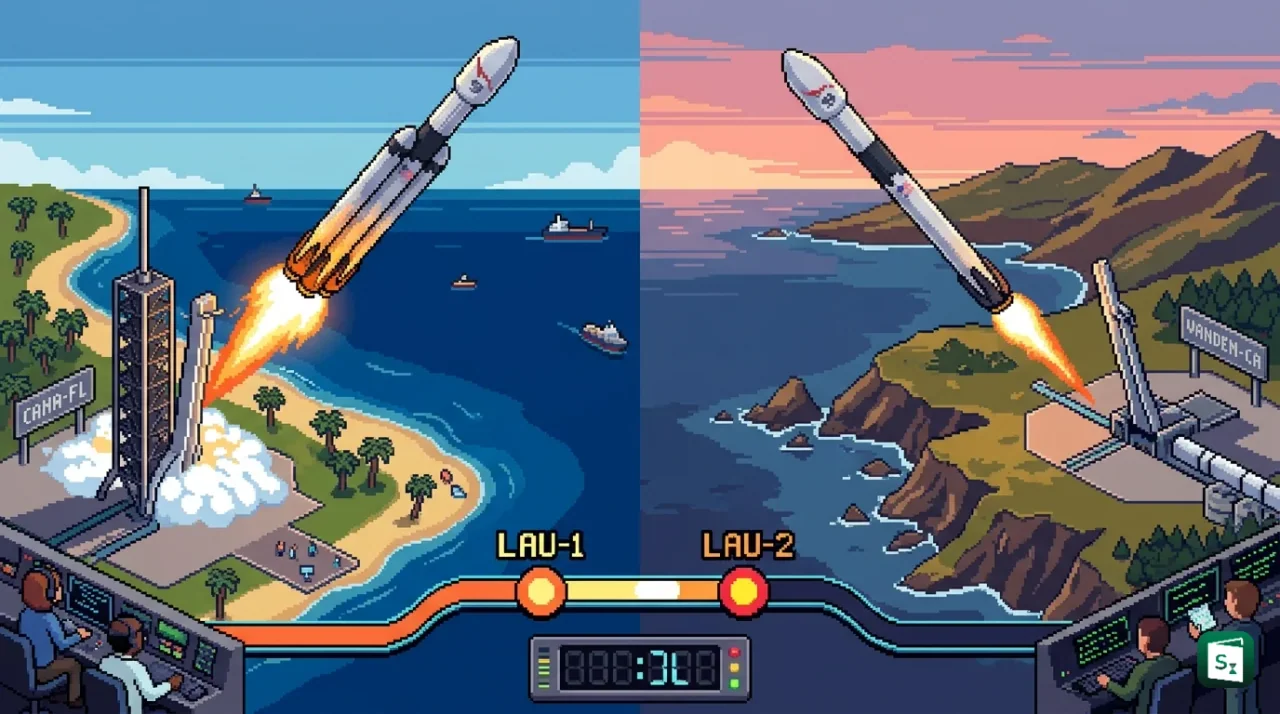
SpaceX launched two Falcon 9 rockets just 38.5 minutes apart on August 15, 2026, setting a new company record for the shortest interval between orbital flights. The first rocket carried eight Globalstar communication satellites from Cape Canaveral Space Force Station in Florida, while the second delivered a classified payload for the United States Space Force from Vandenberg Space Force Base in California. The dual launches, executed from opposite coasts of the United States on the same evening, demonstrated the company’s growing ability to treat rocket launches as routine, repeatable operations.
The Record-Breaking Dual Launch
The first Falcon 9 lifted off at 9:12 p.m. EDT from Space Launch Complex 40 at Cape Canaveral Space Force Station in Florida, carrying eight Globalstar satellites into low Earth orbit (LEO). Just 38.5 minutes later, at 9:50 p.m. EDT, a second Falcon 9 rocket launched from Space Launch Complex 4E at Vandenberg Space Force Base on California’s central coast, carrying a classified payload for the United States Space Force under the mission designation USSF-366.
The 38.5-minute gap shattered SpaceX’s previous record of 65 minutes, set on August 31, 2024, during two back-to-back Starlink missions. The new mark cut the old interval by 27 minutes, highlighting how rapidly SpaceX has refined its ability to prepare and launch separate Falcon 9 vehicles from two different launch sites simultaneously. This was the 52nd orbital launch from Florida’s Space Coast in 2026 alone.
| Detail | First Launch (Globalstar) | Second Launch (USSF-366) |
|---|---|---|
| Lift-off Time | 9:12 p.m. EDT | 9:50 p.m. EDT |
| Launch Site | Cape Canaveral SFS, Florida | Vandenberg SFB, California |
| Payload | 8 Globalstar satellites | Classified USSF payload |
| Booster | B1090 (14th flight) | B1088 (18th flight) |
| Landing Zone | Landing Zone 40, Cape Canaveral | Droneship “Of Course I Still Love You” (Pacific Ocean) |
| Landing Time | ~8 minutes after liftoff | ~8.5 minutes after liftoff |
Globalstar 2-R Mission: Restoring the iPhone’s Satellite Lifeline
The first Falcon 9 rocket on this mission used booster B1090 on its 14th flight. After stage separation, the first stage executed a precision landing at Landing Zone 40 at Cape Canaveral, approximately eight minutes after liftoff. The upper stage then continued to low Earth orbit, deploying all eight Globalstar satellites successfully over a six-minute window that began 56.5 minutes after launch.
The eight satellites are part of the Globalstar 2-R constellation replenishment, designed to replace aging spacecraft in the company’s low Earth orbit network. Globalstar, headquartered in Covington, Louisiana, operates a constellation of approximately 24 second-generation satellites at an altitude of 1,414 kilometres. These satellites provide mobile satellite services including voice, data, and direct-to-device emergency connectivity.
Globalstar and Apple’s Emergency SOS Partnership
Globalstar gained widespread public attention through its partnership with Apple. Starting with the iPhone 14 lineup in 2022, Apple’s Emergency SOS via Satellite feature uses Globalstar’s satellite network exclusively to allow iPhone users to send emergency messages when outside cellular and Wi-Fi coverage. Apple invested $450 million through its Advanced Manufacturing Fund to upgrade Globalstar’s satellite network and ground stations, and later committed approximately $1.5 billion more for a next-generation constellation.
The newly launched HIBLEO-4 replacement satellites are expected to undergo testing and calibration before entering commercial service, strengthening the infrastructure that supports direct-to-device communications for over two billion active Apple devices worldwide.
Amazon’s $11.57 Billion Acquisition
In April 2026, Amazon announced a definitive merger agreement to acquire Globalstar for $11.57 billion. The deal, expected to close in 2027, is driven by Amazon’s ambitions in the direct-to-device satellite connectivity market through its Amazon Leo constellation project. Under the agreement, Amazon has committed to maintaining Apple’s existing satellite services, ensuring continuity for Emergency SOS functionality on supported iPhone and Apple Watch models.
USSF-366: The Classified Military Payload
The second Falcon 9 rocket used booster B1088 on its 18th flight. After stage separation, the first stage landed on the autonomous droneship “Of Course I Still Love You” stationed in the Pacific Ocean, approximately 8.5 minutes after liftoff. That recovery marked the 650th successful Falcon booster landing in SpaceX’s history.
Details about the USSF-366 payload remain limited due to its classified nature. A spokesperson for the U.S. Space Force’s Space Systems Command confirmed only that the mission was assigned under a previously awarded National Security Space Launch (NSSL) Phase 3 Lane 1 task order. Rocket watchers have noted that the locations of rocket stage drop zones align precisely with those used for previous Starlink Group 15 launches, leading to speculation that the payload may consist of classified low Earth orbit satellites built on SpaceX’s Starshield satellite bus.
Starshield is a SpaceX project that uses modified versions of its Starlink satellite platform to fly national security missions for the U.S. government. The programme represents a growing segment of SpaceX’s business, providing secure communications and reconnaissance capabilities to military and intelligence agencies. SpaceX ended its livestream shortly after the first-stage landing, consistent with standard practice for national security flights.
Booster Recovery: The 650th Landing
Both first-stage boosters executed successful landings on August 15, adding to SpaceX’s rapidly growing recovery record. The Globalstar booster (B1090) completed its 14th flight before touching down at Landing Zone 40 at Cape Canaveral, approximately eight minutes after liftoff. The USSF-366 booster (B1088), on its 18th mission, landed on the droneship “Of Course I Still Love You” in the Pacific Ocean about 8.5 minutes after launch.
The recovery of B1088 marked the 650th successful Falcon booster landing in SpaceX’s history, a milestone that underscores the reliability and routine nature of the company’s rocket reuse programme. SpaceX has consistently demonstrated that its Falcon 9 first-stage boosters can be recovered, refurbished, and reflown multiple times, significantly reducing the cost of access to orbit.
The ability to land boosters on both land-based zones and autonomous droneships positioned downrange in the ocean gives SpaceX flexibility in mission planning. Land-based returns are used for missions launching from the East Coast where the trajectory permits, while droneship landings are employed for missions requiring higher velocity or those launching from Vandenberg on the West Coast.
SpaceX’s 2026 Launch Cadence: 96 Missions and Counting
The twin launches on August 15 brought SpaceX’s total Falcon 9 missions in 2026 to 96 orbital flights. Approximately 75 percent of those launches have been dedicated to expanding the company’s Starlink broadband satellite constellation, which now consists of nearly 11,000 satellites in low Earth orbit. The remaining missions have served commercial customers, government agencies, and national security clients.
SpaceX, founded in 2002 by Elon Musk and headquartered in Hawthorne, California, has become the world’s most prolific launch provider. The company’s Falcon 9 rocket, a two-stage vehicle powered by nine Merlin engines on its first stage, has been the workhorse of the commercial launch industry since its debut in 2010. The Block 5 variant, the current operational version, was designed specifically for rapid reusability and has flown more than 600 times with a success rate exceeding 99 percent.
The Significance of Rapid Turnaround
The 38.5-minute interval between launches represents more than just a statistical record. It demonstrates SpaceX’s ability to coordinate launch operations across two separate facilities on opposite sides of the country, manage independent countdown sequences, and execute precision booster recoveries almost simultaneously. This operational tempo is critical for the company’s long-term goals, including maintaining the Starlink constellation, fulfilling national security launch contracts, and supporting future deep space missions under NASA’s Artemis programme.
As SpaceX continues to increase its launch frequency, the company is effectively transforming orbital access from a rare, high-stakes event into a routine transportation service, a shift with significant implications for the global commercial space industry.
Key Takeaways
- SpaceX set a new company record on August 15, 2026, launching two Falcon 9 rockets just 38.5 minutes apart from opposite coasts of the United States.
- The first rocket carried eight Globalstar satellites from Cape Canaveral Space Force Station in Florida, while the second delivered the classified USSF-366 payload for the U.S. Space Force from Vandenberg Space Force Base in California.
- The 38.5-minute gap beat SpaceX’s previous record of 65 minutes, set on August 31, 2024, during two Starlink missions, by 27 minutes.
- Both first-stage boosters landed successfully, with the USSF-366 recovery marking the 650th successful Falcon booster landing in SpaceX history.
- Globalstar, which powers Apple’s Emergency SOS via Satellite on iPhone 14 and later models, is being acquired by Amazon for $11.57 billion in a deal expected to close in 2027.
- The twin launches brought SpaceX’s 2026 Falcon 9 mission total to 96, with approximately 75 percent flown in support of the Starlink constellation.