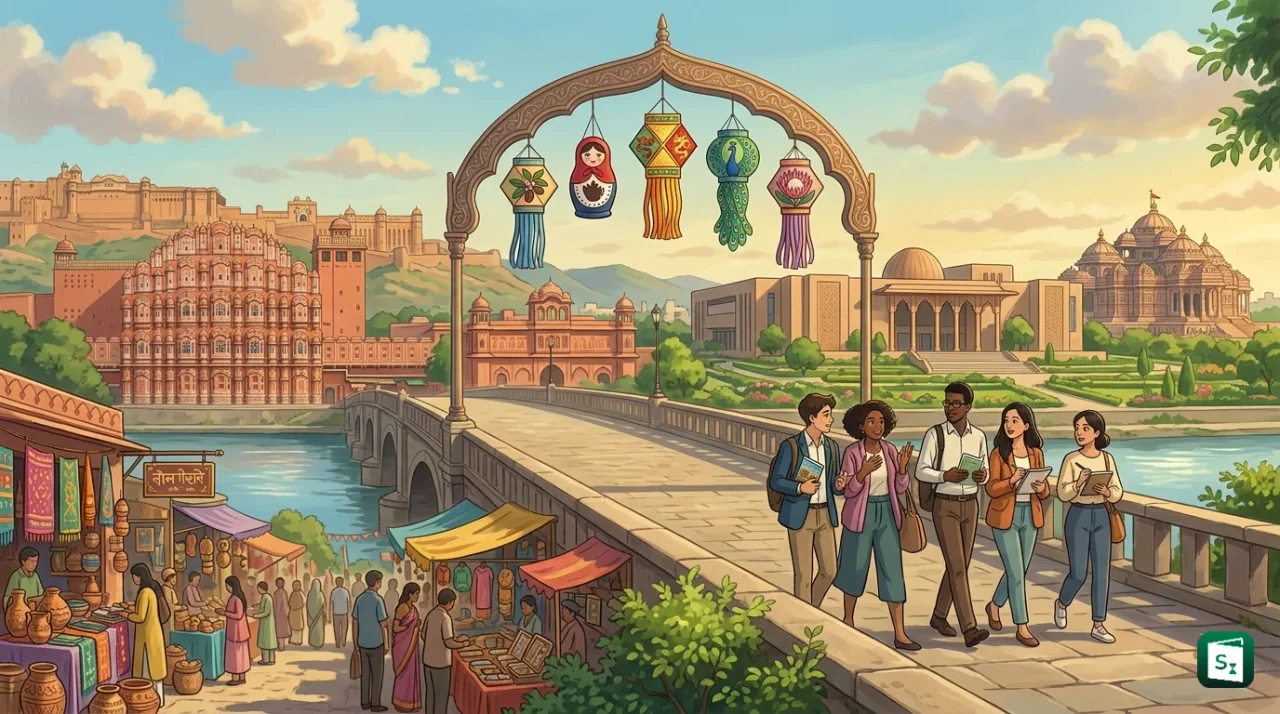
India hosted two key events under its BRICS Chairship 2026 on August 19, with the BRICS Youth Council Meeting and Youth Summit taking place in Gandhinagar, Gujarat, and the 2nd BRICS Tourism Working Group (TWG) meeting convening in Jaipur, Rajasthan. The Gandhinagar events, organised by the Department of Youth Affairs, brought together young leaders and delegates from BRICS member and partner countries to discuss youth-centric cooperation, while the Jaipur meeting, chaired by Tourism Secretary Bhuvnesh Kumar, advanced discussions on tourism sustainability, artificial intelligence integration, and seamless travel facilitation among member nations.
What Is BRICS?
BRICS is an intergovernmental grouping of major emerging economies, originally comprising Brazil, Russia, India, and China. The term “BRIC” was coined in 2001 by Goldman Sachs economist Jim O’Neill to describe the rapid economic growth potential of these four countries. South Africa joined the bloc in 2010, transforming the acronym into BRICS.
The grouping was formalised in 2006, and the first BRICS Summit was held in 2009 in Yekaterinburg, Russia. Since then, BRICS has grown into a significant platform for cooperation across economic, political, and cultural dimensions. The bloc now represents approximately 42% of the world’s population, 30% of the global land area, 23% of global GDP, and 18% of international trade.
In recent years, BRICS has expanded significantly. In January 2024, Egypt, Ethiopia, Iran, and the United Arab Emirates became full members. Indonesia joined the grouping in 2025, further expanding its footprint. The New Development Bank (NDB), established by BRICS members to finance infrastructure and sustainable development projects in emerging economies, is headquartered in Shanghai, China, with an initial authorised capital of $100 billion.
BRICS cooperation is structured around three core pillars: political and security cooperation, economic and financial cooperation, and people-to-people exchanges. The grouping addresses a wide range of global issues, including terrorism, climate change, food and energy security, trade, and international financial architecture reform.
India’s BRICS Chairship 2026
India assumed the BRICS Chairmanship on January 1, 2026, succeeding Brazil, which hosted the 17th BRICS Summit in 2025. India’s Chairship is guided by the theme “Building for Resilience, Innovation, Cooperation and Sustainability”, reflecting a people-centric and humanity-first approach articulated by Prime Minister Narendra Modi at the 2025 Rio Summit.
The theme is built around four core pillars:
- Resilience: Strengthening economic, social, and institutional capacities to withstand global uncertainties, supply chain disruptions, health challenges, and climate risks.
- Innovation: Promoting collaboration in technology, startups, MSMEs, and emerging technologies such as digital public infrastructure, fintech, and artificial intelligence to enable effective service delivery and future-ready growth.
- Cooperation: Deepening multilateral engagement among BRICS members through enhanced policy coordination, development finance, trade facilitation, and reforms in global institutional governance.
- Sustainability: Advancing sustainable development pathways, green growth, and climate resilience across member nations.
The 18th BRICS Summit is scheduled to be hosted in New Delhi on September 12 and 13, 2026. India’s Sherpa for BRICS is Sudhakar Dalela, Secretary (Economic Relations) in the Ministry of External Affairs, who has been coordinating the preparatory consultations and shaping the draft agenda for the Leaders’ Summit.
During its Chairship, India has organised a series of meetings across multiple tracks, including Sherpas’ meetings, working group discussions, and ministerial engagements. The first BRICS Sherpas’ Meeting was held in New Delhi on February 9 to 10, 2026, where representatives from all BRICS members and partner countries participated and endorsed India’s thematic priorities.
BRICS Youth Summit and Council Meeting in Gandhinagar
The BRICS Youth Council Meeting and BRICS Youth Summit 2026 were held on August 19 and 20 in Gandhinagar, Gujarat, as part of India’s BRICS Chairship. The two-day event was organised by the Department of Youth Affairs under the Ministry of Youth Affairs and Sports, with the goal of highlighting “Yuva Shakti” (youth energy) as a central force for innovation and sustainable development.
The inaugural session was attended by Gujarat Deputy Chief Minister Harsh Sanghavi, Union Minister of State for Youth Affairs and Sports Raksha Nikhil Khadse, Gujarat Acting Chief Secretary Anju Sharma, and Additional Secretary in the Department of Youth Affairs Nitesh Kumar Mishra, along with heads of delegation and representatives from BRICS member and partner countries.
The Youth Summit provided a platform for young leaders, officials, and ministers to exchange ideas and discuss issues of importance to young people. The deliberations focused on four key areas of youth cooperation:
- Education, entrepreneurship, and future readiness
- Inclusive development and youth wellbeing
- Sustainability and environmental responsibility
- People-to-people cooperation and youth engagement
Participants shared their experiences and innovative approaches while exploring opportunities for greater cooperation among young people across BRICS countries. The summit served as a precursor to the BRICS Youth Ministers’ Meeting, scheduled for August 22 in Visakhapatnam, Andhra Pradesh, where leaders will adopt the Joint Ministerial Statement on Youth Cooperation.
BRICS Youth Council Deliberations
The BRICS Youth Council Meeting was held alongside the summit and brought together representatives of BRICS member countries to deliberate on key areas of youth cooperation. The Council discussed the Draft Joint Declaration and the BRICS Youth Cooperation Framework, taking into account observations, national experiences, and best practices shared by participating countries.
The deliberations are expected to contribute to consensus-based outcomes ahead of the Youth Ministers’ Meeting. The participating delegates also experienced Gujarat’s cultural heritage through traditional cuisine and cultural interactions, providing opportunities for exchanges on the diverse traditions and practices of the participating countries.
India’s Youth Track Under BRICS 2026
The Gandhinagar events were part of a broader youth engagement calendar that India has planned under its BRICS Chairship. Earlier in the year, the BRICS Youth Coordination Meeting was held on March 25, 2026, where India presented an overview of the BRICS Youth Track for 2026, outlining key initiatives including working group meetings, thematic engagements, and the “Serve BRICS” volunteering initiative.
Under the “Serve BRICS” programme, India committed 1 million volunteer hours through the MY Bharat (Mera Yuva Bharat) platform, running from April 29 to July 31, 2026. MY Bharat is a national youth engagement platform launched by Prime Minister Narendra Modi on October 31, 2023, on Rashtriya Ekta Diwas. It operates as an autonomous body under the Department of Youth Affairs and serves as a technology-driven facilitator for youth development and youth-led development.
A Youth Entrepreneurship Working Group meeting was also held in Indore on May 20 and 21, 2026, followed by a virtual Youth Thematic Session on June 24, 2026. These events built momentum towards the Gandhinagar summit and the upcoming Youth Ministers’ Meeting.
BRICS Tourism Working Group Meeting in Jaipur
On the same day, the Ministry of Tourism hosted the 2nd BRICS 2026 Tourism Working Group (TWG) Meeting in Jaipur, Rajasthan, under India’s BRICS Chairship. The meeting was chaired by Bhuvnesh Kumar, Secretary, Ministry of Tourism, Government of India.
The Jaipur meeting built upon the 1st BRICS 2026 Tourism Working Group Meeting, which was held virtually on May 25, 2026, and brought together delegates from BRICS Member States to advance cooperation across India’s four thematic priorities in tourism:
- Artificial Intelligence and Tourism: Exploring the responsible use of AI in tourism management, marketing, and service delivery, including personalised travel experiences, tourism forecasting, and smart destination management.
- Sustainability and Responsible Tourism: Promoting eco-friendly tourism practices, conservation-based destination management, community participation, and reducing the environmental footprint of tourism activities.
- Tourism Skilling and Capacity Building: Strengthening workforce training, hospitality skills development, tourism entrepreneurship, and knowledge-sharing initiatives across BRICS nations.
- Tourism Exchanges and Seamless Travel Facilitation: Enhancing connectivity, simplifying visa processes, and facilitating seamless travel among member states to encourage greater visitor movement and people-to-people connections.
The Working Group recognised tourism as an important driver of economic growth, employment, sustainable development, and people-to-people exchanges, while responding to an evolving global tourism landscape shaped by technological change, changing traveller expectations, and sustainability imperatives.
In his remarks, Bhuvnesh Kumar highlighted that India’s Chairship has sought to advance cooperation around sustainability, skilling, seamless travel, and smart tourism. He noted that the outcome of the Working Group’s deliberations would provide an important basis for the BRICS Tourism Ministers’ Meeting on August 21.
As part of the programme, the BRICS delegates undertook a technical visit to key tourism and heritage sites in Jaipur, including Hawa Mahal, City Palace, and Amer Palace, offering them an opportunity to experience Rajasthan’s rich cultural and architectural heritage.
Significance of Youth and Tourism Cooperation
The simultaneous hosting of youth and tourism events underscores India’s strategy of using its BRICS Chairship to strengthen people-to-people exchanges, one of the three core pillars of BRICS cooperation. Both youth engagement and tourism are critical levers for building grassroots connections among member nations.
Youth as Agents of Change
With over 420 million young people, India possesses one of the largest youth populations in the world. The demographic dividend that India currently enjoys represents a fleeting window where a large working-age population can drive exceptional economic growth. By placing “Yuva Shakti” at the centre of its BRICS youth agenda, India is recognising young people not merely as beneficiaries of development, but as active architects of change who can shape public discourse, build enterprises, and drive social impact across communities and nations.
The BRICS Youth Summit and Council Meeting provide a structured mechanism for young leaders from member countries to collaborate on shared priorities such as education, entrepreneurship, sustainability, and inclusive development. The outcomes of these deliberations, including the BRICS Youth Joint Statement and the BRICS Youth Cooperation Framework, will feed into the Youth Ministers’ Meeting and ultimately influence policy directions across the bloc.
Tourism as an Economic Driver
Tourism is one of the most employment-intensive sectors globally, and BRICS nations collectively attract a significant share of international arrivals. The focus on artificial intelligence in tourism reflects the growing importance of technology in transforming how destinations are managed, marketed, and experienced. AI-powered tools can enhance personalised travel experiences, improve demand forecasting, and enable smarter resource allocation at tourist destinations.
The emphasis on sustainability and responsible tourism addresses a critical challenge facing the global travel industry. As tourism volumes grow, BRICS nations must balance economic benefits with the need to protect natural resources, preserve cultural heritage, and support local communities. The discussions on seamless travel facilitation, including simplified visa processes and improved connectivity, aim to make it easier for people to move across BRICS countries, thereby strengthening cultural understanding and economic ties.
People-to-People Exchanges Under India’s Chairship
India has framed its BRICS Chairship as a “people-centric Chairship”, highlighting engagement beyond government channels. This approach includes participation from the BRICS Academic Forum, Think Tank Council, Civil Forum, Business Council, Women’s Business Alliance, and youth and sports cooperation mechanisms. The simultaneous organisation of youth and tourism events in Gujarat and Rajasthan exemplifies this philosophy, bringing together government officials, young leaders, entrepreneurs, and cultural delegates in a multi-dimensional engagement.
Looking Ahead
The events in Gandhinagar and Jaipur are part of a packed calendar of BRICS engagements leading up to the 18th BRICS Summit in New Delhi on September 12 and 13, 2026. Several key meetings are scheduled in the coming days:
| Event | Date | Venue |
|---|---|---|
| BRICS Youth Ministers’ Meeting | August 22, 2026 | Visakhapatnam, Andhra Pradesh |
| BRICS Tourism Ministers’ Meeting | August 21, 2026 | Jaipur, Rajasthan |
| 18th BRICS Summit | September 12-13, 2026 | New Delhi |
The BRICS Tourism Ministers’ Meeting will provide political direction to BRICS tourism cooperation and is expected to review the outcomes of the two Tourism Working Group meetings held in May and August. The BRICS Youth Ministers’ Meeting will adopt the Joint Ministerial Statement on Youth Cooperation, consolidating the consensus built through the Youth Council and Youth Summit.
The outcomes of these ministerial meetings will feed into the broader BRICS Summit agenda in New Delhi, where leaders from all member and partner countries will discuss the future direction of the grouping under India’s Chairship. India’s ability to build consensus across diverse member states, including the newer entrants from the Middle East and Africa, will be a key test of its diplomatic leadership within the bloc.
Key Takeaways
- The BRICS Youth Council Meeting and BRICS Youth Summit 2026 were held on August 19-20 in Gandhinagar, Gujarat, organised by the Department of Youth Affairs under the Ministry of Youth Affairs and Sports.
- The 2nd BRICS Tourism Working Group (TWG) Meeting was held on August 19-20 in Jaipur, Rajasthan, chaired by Tourism Secretary Bhuvnesh Kumar.
- India’s BRICS Chairship 2026 is guided by the theme “Building for Resilience, Innovation, Cooperation and Sustainability”.
- The Youth Summit deliberated on four key areas: education and entrepreneurship, inclusive development, sustainability, and people-to-people cooperation.
- The Tourism Working Group focused on four thematic priorities: AI in tourism, sustainability and responsible tourism, tourism skilling, and seamless travel facilitation.
- The BRICS Youth Ministers’ Meeting is scheduled for August 22, 2026 in Visakhapatnam, and the BRICS Tourism Ministers’ Meeting will be held on August 21, 2026 in Jaipur.
- The 18th BRICS Summit will be hosted in New Delhi on September 12-13, 2026.
- MY Bharat (Mera Yuva Bharat), launched on October 31, 2023, is the national youth engagement platform through which India committed 1 million volunteer hours under the “Serve BRICS” initiative.