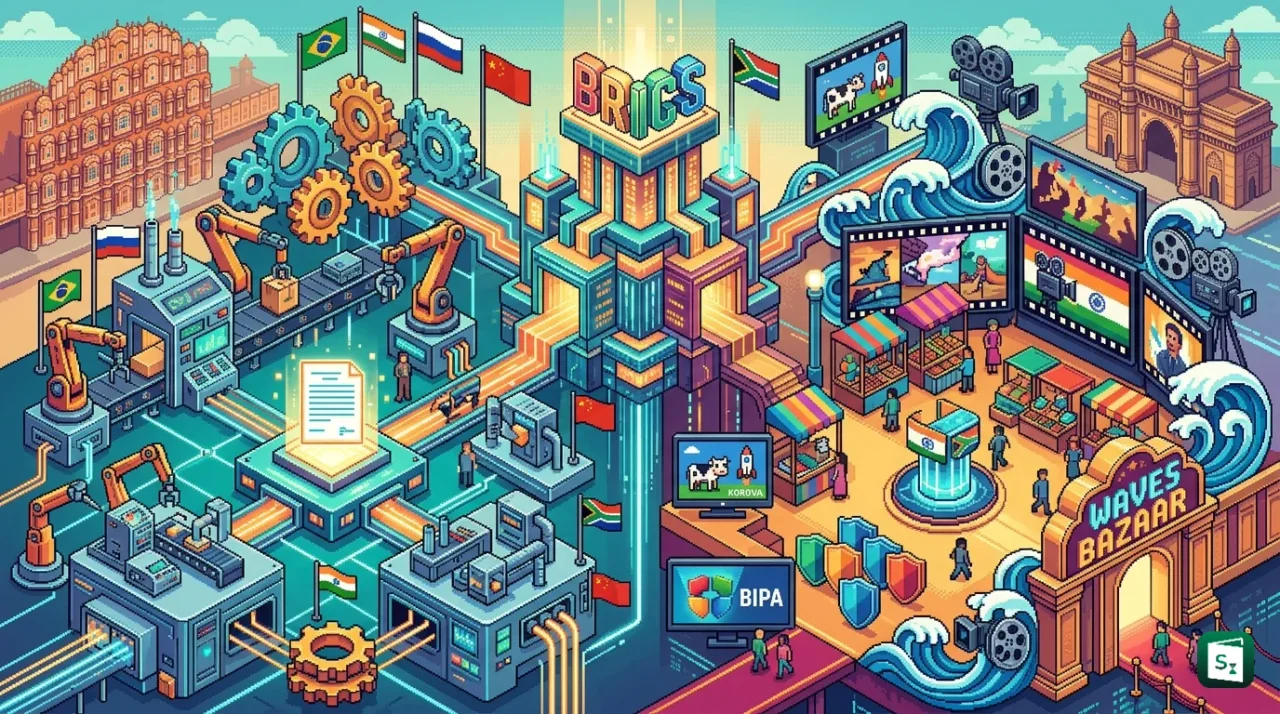
India successfully hosted the 10th BRICS Industry Ministers Meeting in Jaipur on 6 August 2026, under its BRICS Chairship. The meeting, held under the theme “Building for Resilience, Innovation, Cooperation and Sustainability,” brought together industry ministers and senior representatives from all BRICS member nations to advance cooperation on industrial growth and technological transformation. On the same day, the Ministry of Information and Broadcasting kicked off the BRICS WAVES Bazaar 2026 in Mumbai, marking a dual push by India to strengthen both industrial and creative economy ties within the bloc.
What Happened at the 10th BRICS Industry Ministers Meeting
Union Minister of Commerce and Industry Piyush Goyal welcomed delegates at the Jaipur meeting and described the city as one that connects centuries of traditional craftsmanship with a modern industrial economy. He emphasised that BRICS countries must translate shared aspirations into practical innovation and cooperation by leveraging their complementary strengths to build resilient industries.
Minister of State for Commerce and Industry Jitin Prasada reiterated India’s commitment to strengthening industrial cooperation among BRICS nations and highlighted the role of collaboration, innovation and mutual trust in building a resilient and inclusive industrial future.
The meeting was held under the BRICS Partnership on New Industrial Revolution (PartNIR), which serves as the principal mechanism for industrial collaboration among BRICS nations. Goyal recalled that the BRICS journey began with the inaugural summit in Yekaterinburg, Russia, in 2009, and acknowledged Brazil’s leadership during its 2025 Chairship. He said India’s Chairship aims to ensure continuity while promoting practical cooperation among businesses, investors and innovators across BRICS countries.
Key Outcomes of the Jaipur Meeting
The meeting produced several concrete outcomes across four priority areas identified by India. A Joint Declaration was adopted, reflecting the collective commitment of member countries to move beyond dialogue towards implementing practical measures for industrial cooperation.
The key outcomes included:
-
SME Working Group Framework: Finalisation of the Framework for Cooperation in the SME Working Group, aimed at strengthening micro, small and medium enterprise (MSME) ecosystems across BRICS countries. India’s Ministry of MSME leads this initiative.
-
Photovoltaic Industry Working Group: Adoption of the Terms of Reference and Action Plan for the BRICS Working Group on the Photovoltaic Industry, establishing a structured framework for cooperation in the clean energy sector.
-
Startup Innovation: Finalisation of an Action Plan for innovation-driven development through startups. India also proposed the creation of a BRICS Incubator Network and a BRICS Startup Innovation Fund to strengthen collaboration among emerging enterprises.
-
Transport and Logistics: Emphasis on resilient transport and logistics systems for industrial growth, highlighting initiatives such as GIS-based infrastructure planning and city logistics planning to improve industrial connectivity and supply chain resilience.
During the deliberations, Industry Ministers and heads of delegation shared their national experiences and policy initiatives aimed at accelerating industrial development, digital transformation, technological innovation and resilient manufacturing ecosystems.
BRICS WAVES Bazaar 2026: Creative Economy Collaboration
On the same day the Jaipur meeting concluded, the Ministry of Information and Broadcasting, through the National Film Development Corporation (NFDC), hosted the BRICS WAVES Bazaar 2026 in Mumbai. The two-day event, held on 6 and 7 August, brought together over 900 industry delegates from 20 BRICS member and partner countries and facilitated more than 275 curated B2B meetings between producers, studios, broadcasters, film commissions, AVGC-XR companies, investors, technology firms and government representatives.
The Bazaar served as a launchpad for several significant international collaborations. Among the major announcements were:
-
India-Russia Co-Production KOROVA: The India-Russia co-production KOROVA, produced by Kartina Entertainment and VEGA Films, was officially announced, further strengthening bilateral creative collaboration.
-
BRICS Independent Producers Alliance (BIPA): Industry leaders unveiled BIPA, envisioned as a permanent international platform connecting producers across BRICS nations through collaboration, investment, education and innovation.
-
NFDC-RioFilme Partnership: NFDC exchanged a Letter of Intent with Brazil’s RioFilme to strengthen audiovisual cooperation and facilitate Brazilian participation at WAVES 2027.
-
Archival Collaboration with Russia: NFDC and the National Film Archive of India (NFAI) announced ongoing archival collaboration with Russia’s Gosfilmofond, with both FIAF member archives exploring opportunities to formalise cooperation.
-
Global South Film Festival 2027: Industry representatives from South Africa, Russia, Thailand and Kazakhstan announced the proposed festival aimed at strengthening cultural and cinematic collaboration across emerging creative economies.
-
India-Vietnam Film Cooperation: The Media and Entertainment Association of India (MEAI) and Vietnam’s Ministry of Culture, Sports and Tourism signed a Record of Meeting to deepen film cooperation and work towards a formal bilateral agreement.
-
Calivision AI Studio: South Korea’s nCORE Inc. and UAE-based VisionX announced the launch of Calivision AI Studio in India, introducing an AI-first content production studio for cinematic and immersive storytelling.
-
India-Portugal Film Portuguese Man ‘O War: An India-Portugal feature film bringing together partners and co-producers from India, Brazil, Portugal and France was also announced.
What Is PartNIR?
The BRICS Partnership on the New Industrial Revolution (PartNIR) is a structured cooperation framework designed to guide BRICS member nations through the economic and technological shifts of the Fourth Industrial Revolution (Industry 4.0). It was formally established in 2021 after being proposed by Chinese President Xi Jinping at the 10th BRICS Summit in Johannesburg in 2018.
PartNIR focuses on unifying industrial capabilities, digital systems, and sustainable practices across the expanded bloc. It operates across five key areas: digitization, industrialization, innovation, inclusiveness, and investment. The partnership aims to accelerate digital transformation, maximize industrial productivity, ensure technological independence and integrate MSMEs into regional and global value chains while driving a transition toward a green, circular economy.
The PartNIR Innovation Center is based in Xiamen, China. Over the past five years, it has hosted more than 50 exchange events and finalized 138 cooperation projects, with total investments exceeding 62 billion yuan (approximately $9.1 billion).
Under India’s 2026 Chairship, the Ministry of MSME has been mandated to convene three SME Working Group Meetings and the inaugural BRICS MSME Forum, making MSME cooperation a central pillar of India’s PartNIR agenda.
India’s BRICS Chairship 2026: The Bigger Picture
India assumed the BRICS Chairship on 1 January 2026, marking its fourth time at the helm after 2012, 2016 and 2021. The Chairship theme, “Building for Resilience, Innovation, Cooperation and Sustainability”, reflects a people-centric and humanity-first approach articulated by Prime Minister Narendra Modi at the 2025 Rio Summit.
The expanded BRICS now includes 11 member countries: Brazil, Russia, India, China, South Africa, Egypt, Ethiopia, Iran, Saudi Arabia, the United Arab Emirates, and Indonesia (which joined in 2025). The bloc also has 10 partner countries: Belarus, Bolivia, Cuba, Kazakhstan, Malaysia, Nigeria, Thailand, Uganda, Uzbekistan, and Vietnam. Together, BRICS nations represent nearly half the world’s population and contribute more than 36% of global GDP in purchasing power parity terms.
India’s Chairship has been structured around four key pillars: Innovation (promoting digital public infrastructure, emerging technologies, fintech, AI, and knowledge sharing), Cooperation (deepening multilateral engagement through enhanced policy coordination and trade facilitation), Resilience (strengthening economic, social and institutional resilience), and Sustainability (embedding climate action in tangible, development-oriented initiatives).
On the sidelines of the Jaipur ministerial meeting, Goyal held bilateral discussions with Brazil’s Minister of Development, Industry, Trade and Services Marcio Fernando Elias Rosa, Egypt’s Minister of Industry Khaled Hashem Ali Maher, and South Africa’s Minister of Trade, Industry and Competition Parks Tau. The discussions focused on expanding trade and investment ties, enhancing cooperation in agriculture, energy, pharmaceuticals, manufacturing and critical minerals, and advancing negotiations on the proposed India-SACU Preferential Trade Agreement.
India will also host the 16th BRICS Trade Ministers’ Meeting in Jaipur on 7 August, following the Third Meeting of the BRICS Contact Group on Economic and Trade Issues held in New Delhi on 3 and 4 August. The meeting is expected to reaffirm India’s commitment to promoting an open, inclusive, transparent, equitable and rules-based multilateral trading system with the World Trade Organization at its core.
Key Takeaways
- The 10th BRICS Industry Ministers Meeting concluded in Jaipur on 6 August 2026 under India’s BRICS Chairship, adopting a Joint Declaration on industrial cooperation.
- The meeting focused on the BRICS Partnership on New Industrial Revolution (PartNIR), which was formally established in 2021 to guide member nations through the Fourth Industrial Revolution.
- Key outcomes included the finalisation of the SME Working Group Framework, the adoption of Terms of Reference for the Photovoltaic Industry Working Group, and India’s proposal for a BRICS Incubator Network and BRICS Startup Innovation Fund.
- The BRICS WAVES Bazaar 2026 concluded in Mumbai with over 900 delegates from 20 countries, featuring the India-Russia co-production KOROVA and the launch of the BRICS Independent Producers Alliance (BIPA).
- India holds the BRICS Chairship for the fourth time in 2026, with the bloc now comprising 11 member countries and 10 partner countries, representing nearly half the world’s population.
- The Chairship theme, “Building for Resilience, Innovation, Cooperation and Sustainability”, reflects India’s focus on MSME cooperation, digital transformation and sustainable development.