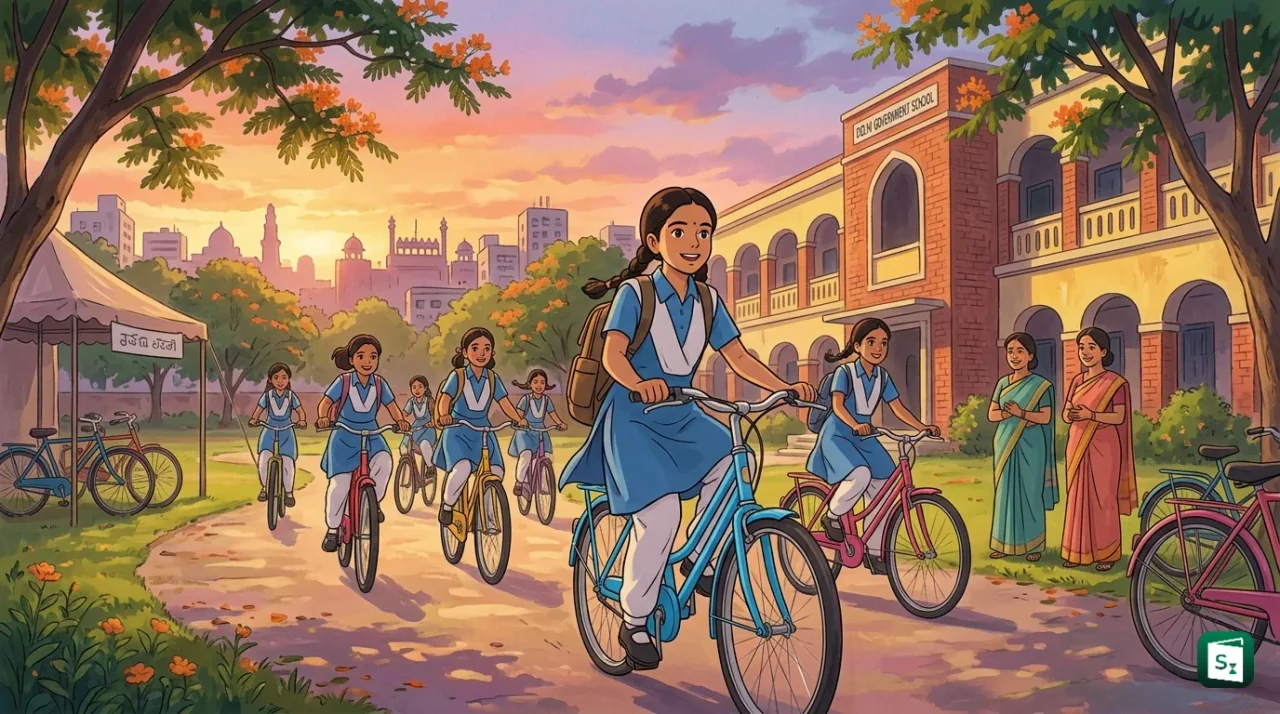
Chief Minister Rekha Gupta launched the Vidya Vahini scheme on 31 July 2026 at the East Vinod Nagar Sports Complex in New Delhi, handing over bicycles to more than 3,000 Class 9 girl students of Delhi government schools in the first phase. Under the programme, nearly 1.40 lakh eligible girl students across the national capital will receive free bicycles in a phased manner. The scheme aims to make the daily school commute safer and easier, boost attendance, and bring down dropout rates among girls.
What Is the Vidya Vahini Scheme?
Vidya Vahini is a welfare initiative of the Government of the National Capital Territory (NCT) of Delhi that provides free bicycles to girl students entering Class 9 in Delhi government schools. The name combines two words: Vidya, meaning education, and Vahini, meaning a carrier or convoy, so the scheme is literally a vehicle for education.
The programme was first announced by the Chief Minister while presenting the Delhi Budget for 2026-27 in March 2026, with an allocation of ₹90 crore. The idea took shape over the months that followed, and the procurement of bicycles began around the start of the new academic session.
Delhi is a Union Territory that functions with its own legislative assembly under Article 239AA of the Constitution, inserted by the 69th Constitutional Amendment Act, 1991. Education, along with health and transport, falls under the subjects on which the Delhi Assembly can legislate. The scheme is being implemented by the Directorate of Education, which runs more than a thousand government schools across the city.
How the Scheme Works
The Delhi Directorate of Education handles the purchase and supply of the bicycles and coordinates with individual schools for distribution. School principals prepare a verified list of all enrolled Class 9 girl students, and eligible students along with their parents are informed about the distribution dates and venues in their locality.
The core eligibility criteria are straightforward.
| Criterion | Requirement |
|---|---|
| Gender | Girl student |
| Class | Enrolled in Class 9 |
| School | Delhi government or government-aided school |
| Residence | Resident of Delhi |
The first launch event at the East Vinod Nagar Sports Complex covered more than 3,000 students, and distribution began from the Shalimar Bagh constituency, which the Chief Minister represents. The scheme is designed to become a recurring yearly benefit, so every incoming batch of Class 9 girl students can avail it each academic year.
Why Bicycles Matter for Girls’ Education
The reasoning behind the scheme rests on a well-documented problem: transport is one of the biggest reasons girls drop out of school. In many parts of Delhi, government schools are not within walking distance, and girls often depend on parents, siblings, or public transport to get there. When the daily commute becomes too hard or too unsafe, families pull daughters out of school, and the dropout problem is most acute at the secondary stage.
A free bicycle removes this barrier in a practical way. It lets a girl travel independently, on her own schedule, without waiting for someone to drop her off or pick her up. The Chief Minister described the bicycle as “a medium of dignity” for young girls, since it gives them a sense of self-reliance and eases parents’ worries about their daughters travelling alone. Education Minister Ashish Sood, who was present at the launch, said the programme directly targets the transport difficulties girls face after entering Class 9.
Beyond access to school, the bicycles link to cleaner mobility. Delhi is among the most polluted cities in the world, and the government has framed the scheme as part of its push for clean transport. Officials said the programme would also create awareness among students about the health and environmental benefits of cycling.
Analogy · The Last-Mile School Ride Expand analogy
A free bicycle works like a free first-class railway ticket for a student living far from school. The ticket does not change what is taught inside the classroom, but it removes the very reason many students never reach the classroom in the first place. Removing the commute barrier is often the single most effective way to keep girls enrolled.
A Proven Idea Across States
Delhi is not the first state to hand out bicycles to schoolgirls, and the track record of such schemes is strong. Bihar’s Mukhyamantri Balika Cycle Yojana, launched in 2007, gave a bicycle to every girl enrolling in Class 9 and is widely credited with changing the face of girls’ education in the state. It reduced the school dropout rate among girls and put lakhs of confident young women on bicycles across the state’s villages and towns.
Tamil Nadu has provided bicycles to school and college students for years and, in its 2026-27 budget, announced the distribution of bicycles to 5.3 lakh Class 11 students in government and government-aided schools under its Puthiya Payanam scheme. West Bengal runs a similar programme for girl students. The NITI Aayog has acknowledged that bicycle distribution to schoolgirls in Bihar and West Bengal has significantly reduced dropout rates, improved attendance, and helped learning outcomes.
| State | Scheme | Beneficiaries |
|---|---|---|
| Delhi | Vidya Vahini | Class 9 girls, 1.40 lakh in phases |
| Bihar | Mukhyamantri Balika Cycle Yojana (2007) | Girls enrolling in Class 9 |
| Tamil Nadu | Puthiya Payanam | 5.3 lakh Class 11 students (2026-27) |
| West Bengal | Bicycle scheme for girl students | Secondary school girls |
This history is what makes Delhi’s move more than a symbolic gesture. When a state puts bicycles in the hands of adolescent girls, it is investing in their continued education through the years when female dropout rates spike, which is typically after primary school and around the transition to secondary school.
Broader Policy Context: Girls’ Education and Clean Mobility
The scheme sits within a wider set of measures that the Rekha Gupta government has announced for women and students since it took office in February 2025. Rekha Gupta, the 9th Chief Minister of Delhi and its 4th woman Chief Minister, has made education and women’s welfare central themes of her administration. Earlier in 2026, she also launched the Lakshmi Yojana portal, a monthly aid scheme for women, alongside Vidya Vahini.
The programme also connects to national and international policy frameworks. India’s National Education Policy 2020 stresses universal access to school education and measures to reduce dropout rates. On the global stage, Sustainable Development Goal 4 commits to inclusive, equitable and quality education for all by 2030. Bicycle schemes address the access part of these goals in the most direct manner possible, by solving the practical problem of getting girls to school.
Key Takeaways
- The Vidya Vahini scheme was launched by Chief Minister Rekha Gupta on 31 July 2026 at the East Vinod Nagar Sports Complex, New Delhi.
- Under the scheme, free bicycles are provided to Class 9 girl students of Delhi government schools.
- More than 3,000 students received bicycles in the first phase, and nearly 1.40 lakh will benefit in a phased manner.
- The Delhi Budget for 2026-27 allocated ₹90 crore for the programme.
- Rekha Gupta is the 9th Chief Minister of Delhi and its 4th woman Chief Minister, who assumed office in February 2025.
- Delhi functions under Article 239AA of the Constitution (69th Amendment Act, 1991) and the scheme is implemented by the Directorate of Education.