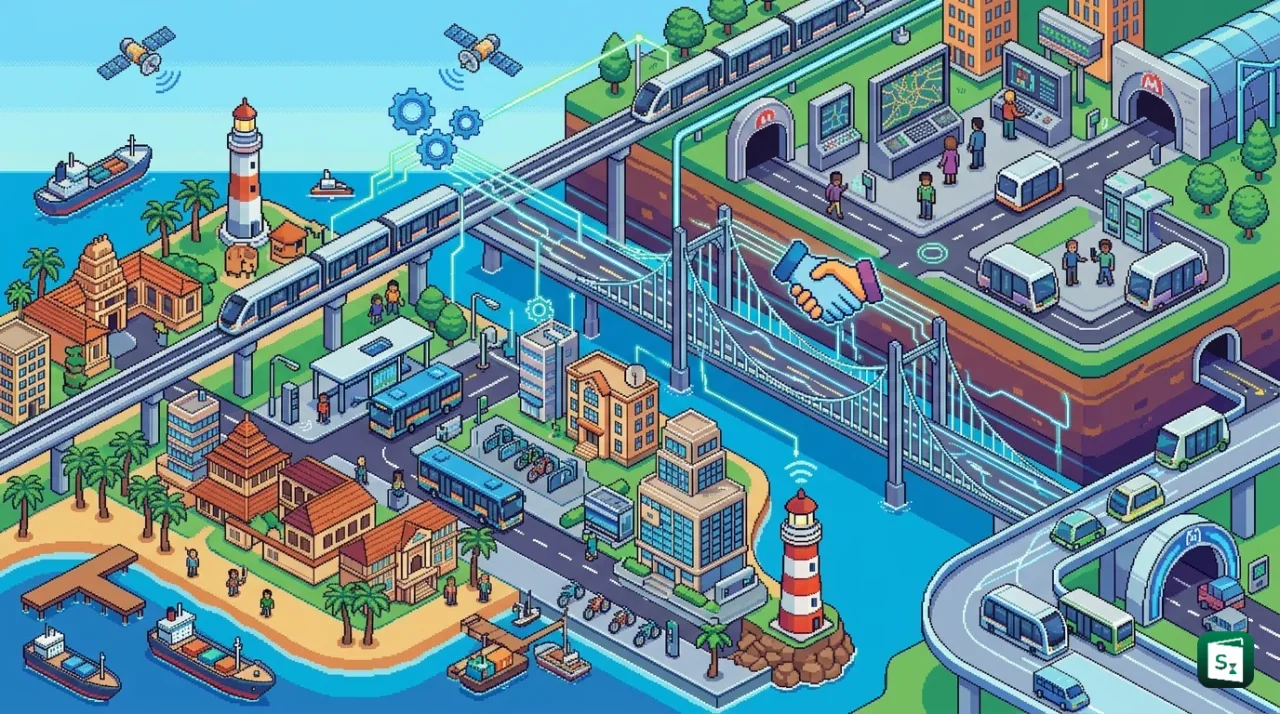
The Greater Visakhapatnam Municipal Corporation (GVMC) has signed a Memorandum of Cooperation (MoC) with the Moscow government in Russia to jointly develop a modern, technology-driven urban transport system for Visakhapatnam. The agreement covers smart mobility, sustainable urban transport, digital innovation, and technology transfer. It was signed during the 5th International Transport Summit held in Moscow.
The Pact at a Glance
The MoC was signed by GVMC Commissioner Ketan Garg and Maksim Liksutov, Deputy Mayor of Moscow and head of the city’s Department of Transport and Road Infrastructure Development. Visakhapatnam Member of Parliament M. Sribharat was present at the signing ceremony.
The partnership is a direct outcome of the visit of Andhra Pradesh’s Minister for Education, IT and Electronics, Nara Lokesh, to Russia in June 2026. During that visit, he held discussions with Moscow’s transport leadership on strengthening cooperation in urban mobility, connectivity, transport infrastructure and technology. Recognising Visakhapatnam’s rapid growth and its emergence as a major economic, industrial and technology hub, the two sides agreed to work together on advanced transport solutions for the city.
Why Moscow’s Transport Model Matters
Moscow operates one of the world’s most extensive and technologically integrated urban transport networks. Its public transport carries roughly 70 per cent of all trips made in the city, among the highest shares globally.
The network brings together the Moscow Metro, buses, trams, electric buses, the Moscow Central Circle (MCC) and the Moscow Central Diameters (MCD). The Moscow Metro alone has more than 250 stations and close to a dozen-and-a-half lines, while the entire expanded rail network spans 444 stations across Moscow. Since 2019, the city has added over 450,000 new regular public transport users, and it continues to invest in driverless metro trains and artificial-intelligence driven services.
The Troika Card and Intelligent Systems
A defining feature of Moscow’s system is the Troika smart card, a single contactless card that works across the metro, buses, trams, electric buses, the Central Circle and the Central Diameters. Instead of worrying about separate tickets, a commuter taps the same card on any mode, a model that has been cited as a reference point for Visakhapatnam.
The city also deploys intelligent transport systems for real-time traffic monitoring, regulation of traffic flows and public transport optimisation. Digital platforms, artificial intelligence, computer vision and data analytics are increasingly used to improve passenger convenience, road safety and the reliability of public services. Andhra Pradesh hopes to draw on these experiences while building a mobility model suited to Visakhapatnam’s geography, population and future infrastructure needs.
Scope of Cooperation
Under the MoC, the two sides will explore collaboration across a broad set of areas rather than a single project. The key areas of cooperation are summarised below.
| Area of Cooperation | What It Involves |
|---|---|
| Urban transport systems | Modern and sustainable urban transport, integrated mobility concepts |
| Intelligent transport solutions | Real-time traffic and public transport management |
| Digital ticketing | Integrated fare infrastructure on the lines of the Troika system |
| Artificial intelligence | Data-driven transport planning and autonomous transport technologies |
| Transport data | Participation in urban transport data initiatives |
| Sustainable mobility | Low-emission solutions, including energy-storage systems |
| Industrial collaboration | Automotive and electronics manufacturing, vertical transport solutions |
| Knowledge exchange | Technology transfer, training and exchange of officials and specialists |
The MoC creates an institutional framework for continued technical engagement, knowledge exchange and project-level cooperation. Both sides intend to adapt international best practices to local conditions rather than copy Moscow’s system wholesale.
Visakhapatnam’s Transport Ambitions
Visakhapatnam, known as the City of Destiny, is the largest city in Andhra Pradesh and a growing economic and industrial hub on the eastern coast. Its municipal body, the GVMC, is the first Greater Municipal Corporation in Andhra Pradesh, established in 2005 by merging the older Visakhapatnam Municipal Corporation with the Gajuwaka Municipality and surrounding panchayats. The city has also been part of the Centre’s Smart Cities Mission, launched in 2015, which supports technology-driven urban infrastructure across 100 cities.
Visakhapatnam Economic Region
The MoC is expected to support the development of the Visakhapatnam Economic Region (VER), a development framework that treats Visakhapatnam and its surrounding districts as a single growth engine. The VER framework, launched in November 2025, aims to attract investment, improve infrastructure and promote manufacturing and services across the region. Reliable and modern transport is central to this vision, since connectivity determines how easily people and goods can move across the region’s industrial corridors.
Vizag Metro Project
The city is also preparing for its own metro rail system. The Visakhapatnam Metro Rail Project, planned with three corridors spanning roughly 76 km and more than 50 stations, is being developed to provide a modern mass transit backbone. A robust metro network combined with intelligent traffic management and integrated ticketing would give the city the kind of multimodal public transport system that Moscow already runs. The MoC is therefore seen as a timely knowledge partnership as the city invests in big-ticket transport infrastructure.
India-Russia Urban Cooperation Context
This city-level agreement fits into a broader and long-standing India-Russia relationship. The two countries established a Strategic Partnership in 2000, which was upgraded to a Special and Privileged Strategic Partnership. They hold an Annual Summit as their highest institutionalised dialogue, with the most recent summit held in New Delhi in December 2025.
Within this framework, urban cooperation has grown as a distinct pillar. In March 2026, the third India-Russia Smart Cities Forum was held in New Delhi, bringing together policymakers and industry experts to discuss sustainable, technology-driven urban development. The forum highlighted the success of India’s Smart Cities Mission, which has seen over 7,500 projects completed across 100 cities, and pointed to deeper collaboration in digital systems and sustainable infrastructure.
At the national level, India and Russia have also set an ambitious target of raising bilateral trade to $100 billion by 2030. Agreements at the city level, such as the GVMC-Moscow MoC, complement these broader economic and strategic ties by channeling cooperation into concrete urban infrastructure projects. For Visakhapatnam, the partnership offers access to proven global technology at a time when Indian cities are rapidly trying to modernise their public transport.
Key Takeaways
- The GVMC signed a Memorandum of Cooperation with the Moscow government to build a modern urban transport system for Visakhapatnam, covering smart mobility, digital innovation and technology transfer.
- The agreement was signed during the 5th International Transport Summit in Moscow by GVMC Commissioner Ketan Garg and Moscow’s Deputy Mayor Maksim Liksutov.
- The partnership follows the June 2026 visit of Andhra Pradesh Minister Nara Lokesh to Russia and supports the Visakhapatnam Economic Region (VER).
- Cooperation areas include intelligent transport systems, digital ticketing modelled on Moscow’s Troika smart card, AI-driven transport planning and autonomous transport technologies.
- Moscow’s public transport, which handles about 70 per cent of all city trips, integrates the metro, buses, trams, electric buses, the Moscow Central Circle (MCC) and the Moscow Central Diameters (MCD).
- The pact adds an urban pillar to the India-Russia Special and Privileged Strategic Partnership, alongside the third India-Russia Smart Cities Forum held in New Delhi in March 2026.