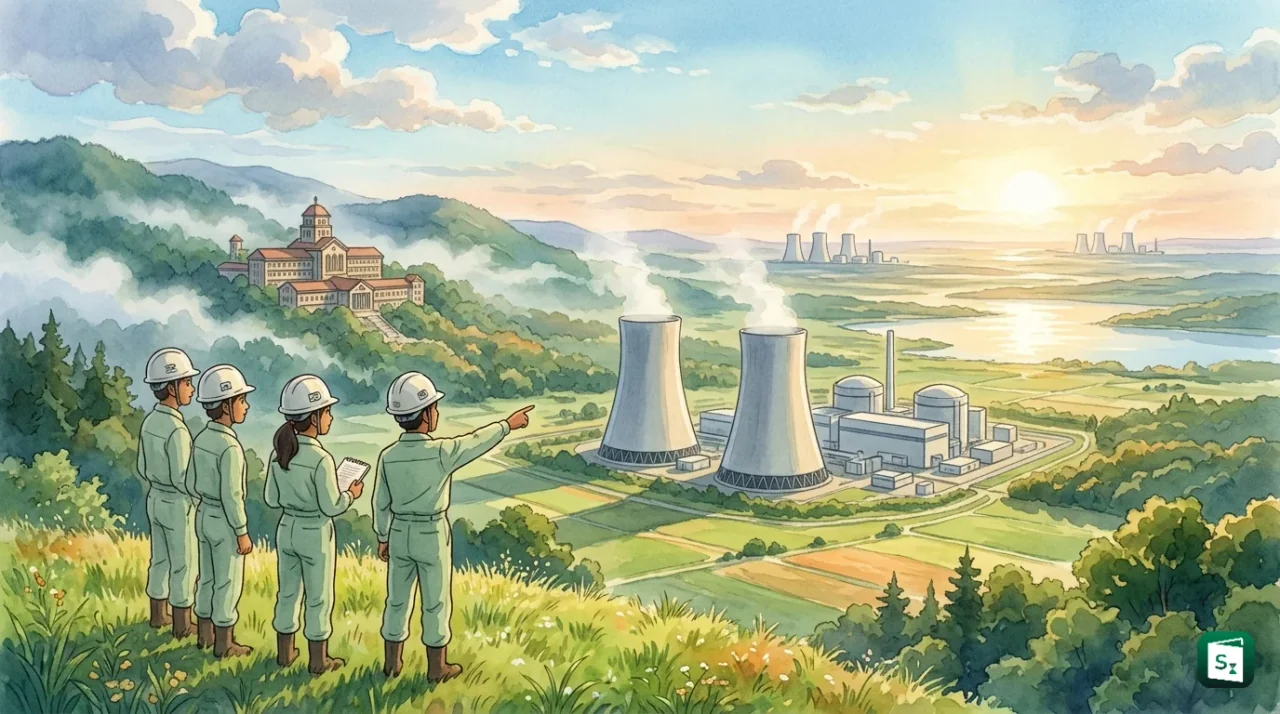
The Indian Institute of Technology Hyderabad (IITH), in partnership with the Pune-based technology firm Crimson Energy Experts Pvt Ltd (CEEPL), launched ANUGYAN, the Nuclear Technology Orientation Programme (NTOP), India’s first industry–academia course dedicated to the civil nuclear sector, on 3 August 2026. The three-month, fully residential programme is designed to turn engineers and industry professionals into deployment-ready specialists at a time when India plans to scale its nuclear power capacity from about 8.8 GWe to 100 GWe by 2047. The inaugural batch of 25 participants began on the day of the launch at the IITH campus in Kandi, Telangana.
What Is ANUGYAN?
ANUGYAN, whose full name is the Nuclear Technology Orientation Programme (NTOP), blends IITH’s academic strengths with the hands-on experience of senior nuclear professionals from Crimson Energy Experts Pvt Ltd (CEEPL), a consulting firm that works in energy and engineering. The aim is simple: to close the gap that often exists between what students learn in classrooms and what the nuclear industry actually needs on the ground.
Participants who finish the course receive a joint certification from IIT Hyderabad and CEEPL. The course is open to engineering graduates, working professionals, public sector undertaking (PSU) executives, engineering, procurement and construction (EPC) contractors, and equipment manufacturers. According to the official brochure, the programme fee is ₹3.5 lakh, excluding accommodation, and the instruction is delivered by veterans who have spent decades working at leading institutions of the Department of Atomic Energy (DAE), including the Bhabha Atomic Research Centre (BARC) and the Nuclear Power Corporation of India Limited (NPCIL).
Why India Needs a Nuclear Workforce Now
India currently operates 24 commercial nuclear reactors with an installed capacity of about 8,780 MW, which works out to roughly 3 per cent of the country’s total electricity generation. The government’s ambition is to raise this to 100 GW by 2047, a more than ten-fold jump in just over two decades, and to use nuclear power as steady, round-the-clock baseload supply that does not depend on the sun or the wind.
That scale-up cannot happen without people. A government-appointed committee that prepared the roadmap to 100 GW has estimated the expansion could need investments on the order of ₹19 lakh crore, and every new reactor brings with it a demand for physicists, safety engineers, quality-assurance specialists and design teams. The Central Electricity Authority (CEA) has noted that while only one company builds nuclear plants today, a dozen or more players, including private firms, are likely to enter the field soon, which sharply increases the need for trained professionals across the supply chain.
Curriculum and Who Can Join
The programme is structured around 24 modules that cover the full span of modern nuclear engineering. Participants study reactor physics, thermal hydraulics, radiation shielding, nuclear safety, quality assurance and engineering design, alongside Atomic Energy Regulatory Board (AERB) compliance requirements and simulator-based training.
Emerging Technologies
A distinctive part of the syllabus is its focus on next-generation reactor concepts, including Small Modular Reactors (SMRs) and floating nuclear power plants. SMRs are compact reactors, typically with a capacity of under 300 MW, that are largely factory-built and assembled on site, making them quicker to deploy and easier to finance than giant conventional plants. India has placed SMRs at the centre of its nuclear future, with a national mission to have at least five indigenously developed units operational by 2033.
Who It Serves
The course targets four broad groups. Fresh engineering graduates get a direct entry route into the nuclear industry, while working professionals use it to switch into, or move up within, the sector. PSU executives gain the technical exposure needed to oversee large power projects, and EPC contractors and equipment manufacturers learn the specific requirements of supplying nuclear plants. This spread reflects the programme’s goal of feeding skilled people into every link of the emerging nuclear supply chain, from design and construction to operation and regulation.
The Policy Backdrop: SHANTI Act and Nuclear Energy Mission
ANUGYAN has been launched against the backdrop of the most sweeping change to India’s nuclear legal framework in decades. The Sustainable Harnessing and Advancement of Nuclear Energy for Transforming India Act, 2025 (SHANTI Act), which received Presidential assent in December 2025, repealed the Atomic Energy Act, 1962 and the Civil Liability for Nuclear Damage Act, 2010. It permits, for the first time, limited private participation in building and operating nuclear plants and in fabricating nuclear fuel, while keeping sensitive strategic activities under government control. The law also gave statutory status to the AERB, the nuclear safety regulator.
The SHANTI Act supports the Nuclear Energy Mission for Viksit Bharat, announced in the Union Budget 2025-26 with an outlay of ₹20,000 crore for research and development of SMRs. Under the mission, the Bhabha Atomic Research Centre is developing the 220 MWe Bharat Small Modular Reactor (BSMR-200) and a 55 MWe reactor, with an estimated construction time of 60 to 72 months. The mission is a pillar of India’s goal of reaching net zero carbon emissions by 2070, since nuclear energy provides clean, dependable power that can replace coal-fired plants.
Beyond ANUGYAN: CODENE and India’s Nuclear Future
ANUGYAN is not an isolated initiative. It builds directly on a tripartite memorandum of understanding signed by IIT Hyderabad, Dassault Systèmes and Crimson Energy Experts during the Bharat Innovate 2026 event in Nice, France, earlier this year. Under that agreement, the three partners are establishing the Centre of Design Excellence in Nuclear Engineering (CODENE) at IITH, India’s first academic hub for advanced nuclear design, digital simulation and collaborative research.
Together, ANUGYAN and CODENE are meant to build a talent pipeline from inside India rather than depending on overseas expertise. IITH and CEEPL have also said they are exploring, along with IIT Jammu, the possibility of setting up India’s first micro reactor within an academic institution, which would allow hands-on research in reactor physics and advanced nuclear systems on campus.
Significance
For India, the significance of ANUGYAN lies in timing. The country is opening its nuclear sector to private investment, planning a national fleet of SMRs, and negotiating new international collaborations, all at once. A skilled domestic workforce is the common thread that makes every one of these ambitions feasible. Programmes such as ANUGYAN also serve the broader objective of Atmanirbhar Bharat, ensuring that India can design, build, operate and regulate its reactors largely on its own rather than importing capability along with technology.
Key Takeaways
- ANUGYAN, the Nuclear Technology Orientation Programme (NTOP), is India’s first industry–academia course in nuclear technology, launched jointly by IIT Hyderabad and Crimson Energy Experts Pvt Ltd (CEEPL).
- The three-month, fully residential programme began on 3 August 2026 with a first batch of 25 participants at the IITH campus in Kandi, Telangana.
- The course, built around 24 modules, teaches reactor physics, thermal hydraulics, radiation shielding, nuclear safety, and AERB compliance, along with Small Modular Reactors (SMRs) and simulator-based training.
- India aims to expand nuclear power capacity from about 8.8 GWe to 100 GWe by 2047, over a ten-fold increase, and nuclear power currently supplies roughly 3 per cent of the country’s electricity.
- The programme supports the SHANTI Act, 2025, which repealed the Atomic Energy Act, 1962 and the Civil Liability for Nuclear Damage Act, 2010 and opened the sector to private participation, and the ₹20,000 crore Nuclear Energy Mission for Viksit Bharat.
- IIT Hyderabad, established in 2008 under the Institutes of Technology Act, houses the planned Centre of Design Excellence in Nuclear Engineering (CODENE).