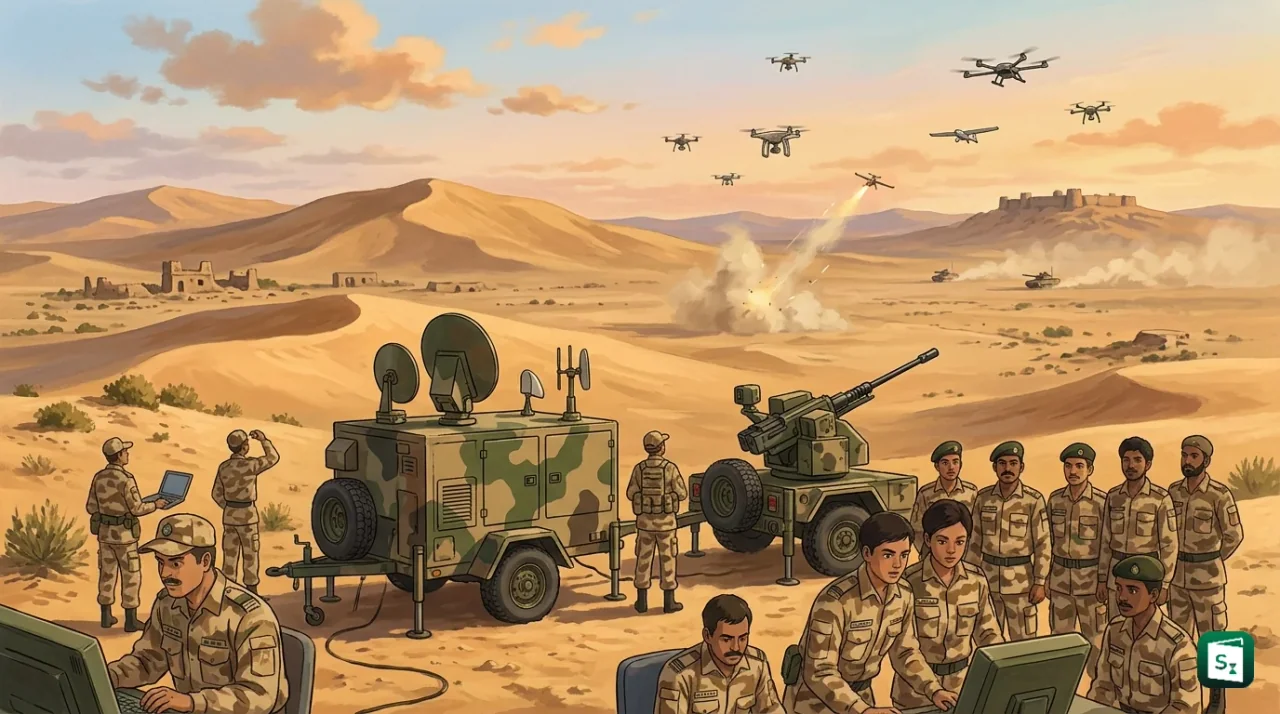
The Indian Air Force (IAF) conducted the third edition of its counter-drone helicopter exercise, ROTOR CLAP-III, at the Pokhran Field Firing Range in the Jaisalmer district of Rajasthan. The week-long drill was themed around Counter-Unmanned Aerial Systems, commonly known as Counter-UAS, and brought together nearly all major rotary-wing platforms of the force. This was the latest in a series of steps aimed at preparing the helicopter fleet for a front where hostile drones and cheap, disruptive small aerial systems have become a defining challenge of modern warfare.
What Is Exercise ROTOR CLAP-III?
ROTOR CLAP-III is a specialised helicopter exercise built around the theme of countering unmanned aerial systems. An unmanned aerial system (UAS) is any aircraft that operates without a pilot on board, and a counter-UAS capability refers to the full set of skills and technologies used to detect, track and destroy hostile drones before they reach their targets.
The exercise is the third edition of a series the IAF has developed around rotary-wing counter-drone work. Its primary purpose is to validate operational concepts and refine tactics, techniques and procedures for tackling emerging aerial threats in realistic conditions. The setting was deliberately chosen: the Pokhran Field Firing Range lies in the Thar Desert, close to the India-Pakistan border, and offers vast, sparsely populated terrain where live weapons can be fired safely. The desert also mirrors the operational environment of India’s western sector, where drone activity has risen sharply in recent years.
During the drill, helicopter units flew live-firing missions, launching missiles and rockets against simulated low-flying aerial targets. The IAF described the exercise as bringing together its helicopter units to validate operational concepts against emerging threats, with missions ranging from precision strikes and battlefield support to reconnaissance, troop insertion and casualty evacuation. Special emphasis was placed on seamless coordination between different helicopter types in the demanding desert terrain.
Why Helicopters for Counter-Drone Warfare?
The rationale behind using helicopters to hunt drones is tied to the limitations of conventional air defences. Ground-based air defence systems are typically tied to fixed locations and are designed to engage larger, faster targets like fighter aircraft or cruise missiles. Small drones that fly low and slow, sometimes behind hills or buildings, can slip through these gaps. A helicopter, by contrast, offers mobility that static defences cannot, and it can reposition within minutes to intercept a threat.
A counter-UAS helicopter can be deployed quickly from remote or confined sites, without needing the long runways and airfield infrastructure that fixed-wing fighters require. Against a slow-moving drone skimming over the ground, a rocket-armed or gun-armed helicopter that can change position rapidly becomes a reliable link in what is called the kill chain, the process from detecting a target to destroying it. There are reports the IAF plans to further adapt some of its helicopters into mobile airborne drone hunters, fitting them with AI-enabled radars, jammers and micro-missiles to engage small, low-flying targets that are hard for traditional systems to catch.
[!NOTE] Kill chain refers to the sequence of steps involved in engaging a target: sensing it, tracking it, deciding to engage, and finally destroying it.
It is also worth clarifying a distinction that appears often in this discussion. Soft-kill methods, such as jamming or spoofing a drone’s communication and navigation signals, disable the drone without destroying it. Hard-kill methods, such as guns, missiles, lasers and interceptor drones, physically bring it down. A robust counter-UAS strategy blends both approaches, and exercises like ROTOR CLAP-III are designed to test such integrated responses.
The Fleet That Took Part
ROTOR CLAP-III drew on almost the entire helicopter inventory of the Indian Air Force, combining attack gunships with transport and utility helicopters to practise coordinated operations.
- Attack helicopters: the American-made AH-64 Apache, the Russian-origin Mi-25/35 gunships, and the indigenous Prachand light combat helicopter.
- Transport and utility helicopters: the heavy-lift Chinook, the medium Mi-17, and the indigenously built ALH Dhruv.
The presence of the Prachand carries particular significance. It is India’s first indigenously designed and built combat helicopter, developed by Hindustan Aeronautics Limited (HAL) and designed to operate at high altitudes and in desert conditions where performance of imported platforms degrades. Its presence in a counter-drone role reflects the growing emphasis on using home-grown platforms in new missions, a theme that runs through India’s broader defence modernisation efforts.
The Growing Drone Threat on India’s Borders
The attention the IAF is giving to drones reflects a threat that has grown steadily for several years. Cheap, commercially available drones are now used by both state armies and non-state actors for surveillance, dropping explosives and smuggling. Small drones are difficult to detect with conventional radar because of their small radar cross-section and their tendency to fly low and slow, which makes them a persistent security challenge.
The western border, which includes Punjab, Jammu and Kashmir and Rajasthan, has emerged as the focal point of this concern. The Border Security Force (BSF), which guards this frontier, has recorded a sharp rise in drones used for trafficking narcotics, arms and ammunition from across the border. In 2025 alone, Indian agencies reported a large number of attempted drone deliveries of drugs, with the vast majority occurring along the Punjab border, alongside seizures of substantial volumes of heroin and other substances.
Beyond smuggling, drones have also been used in direct attacks. A notable early example was the drone attack on the Jammu airbase in 2021, in which small quadcopters dropped improvised explosives. More recently, the experience of Operation Sindoor, the cross-border military operation of May 2025, underlined how a battlefield can now be flooded with cheap unmanned systems and loitering munitions. This combined picture, of smuggling by criminal groups and drones used in actual operations, has made counter-UAS capability a top priority for the security establishment.
India’s Expanding Counter-Drone Ecosystem
Countering drones is not a task for a single weapon or a single service. It requires a multi-layered approach that combines sensors to detect threats with different means of neutralising them. Detection typically depends on a mix of radars, radio-frequency detectors, which pick up the signals a drone uses to communicate with its operator, and electro-optical and infrared sensors, which track the aircraft visually or by its heat signature. Neutralisation then ranges from jamming and spoofing of drone signals to physical interception by guns, missiles, lasers and interceptor drones.
India has been building this ecosystem across agencies. Border forces have deployed counter-drone systems and specialised firearms units along the western frontier, while training institutions have been set up to build skills in detecting and defeating drones. The military has moved in a parallel direction, with plans to embed unmanned and counter-unmanned capabilities more deeply into infantry and other formations.
On the industry side, indigenous development is picking up pace. One flagship effort is the ‘Bhargavastra’ counter-drone system, designed primarily to tackle drone swarms, which are large formations of drones attacking together. Instead of using expensive surface-to-air missiles, Bhargavastra fires a large salvo of inexpensive micro-missiles and rockets, a far more economical way to defend against mass drone attacks. Similar efforts are under way across the private sector, with firms developing jamming systems, detection radars and drone-based countermeasures. This push is consistent with the broader goal of reducing dependence on imported defence technology and building critical systems at home.
The Way Forward
Exercises such as ROTOR CLAP-III point to a clear direction: the IAF is treating drones as a permanent feature of the battlefield rather than a passing threat. For helicopter units, this means a gradual shift in role, from traditional ground attack and transport missions to a greater share of air defence duties against low-flying aerial threats. The reported plan to equip some helicopters with AI-enabled radars, jammers and micro-missiles, effectively turning them into airborne drone hunters, is a logical next step that builds on the lessons of this exercise.
There are, however, limits to what a single platform can achieve. Drones can now be produced so cheaply and in such numbers that no single interceptor can cope with a mass attack. The answer lies in a layered defence, where ground-based jammers, guns, lasers and interceptors work alongside helicopters and other airborne platforms under a single coordinated network. Continued investment in indigenous systems, from micro-missile based defences to drone-mounted countermeasures, will be essential, as will the integration of such systems across the army, navy and air force. For now, ROTOR CLAP-III is best understood as one more step in building this network, bringing the helicopter fleet into a fight that shows no signs of fading.
Key Takeaways
- Exercise ROTOR CLAP-III is the third edition of the Indian Air Force’s specialised counter-drone helicopter exercise, conducted at the Pokhran Field Firing Range in Jaisalmer, Rajasthan.
- The drill was themed around Counter-Unmanned Aerial Systems (Counter-UAS) and included live firing of missiles and rockets at simulated aerial targets.
- Helicopter platforms that took part included the AH-64 Apache, Mi-25/35, indigenous Prachand gunships, along with Chinook, Mi-17 and ALH Dhruv transport and utility helicopters.
- Prachand, India’s first indigenous combat helicopter built by Hindustan Aeronautics Limited (HAL), is designed for high-altitude and desert operations.
- Counter-UAS approaches combine soft-kill methods like jamming and spoofing with hard-kill methods like guns, missiles, lasers and interceptor drones.
- India faces a growing drone threat along its western border, including cross-border smuggling of narcotics, arms and ammunition, highlighted by incidents such as the 2021 Jammu airbase drone attack.