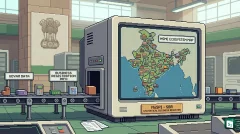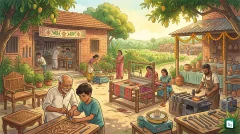
The Ministry of Micro, Small and Medium Enterprises (MSME) and the Department for Promotion of Industry and Internal Trade (DPIIT) signed a Memorandum of Understanding (MoU) on August 5, 2026, at Vanijya Bhawan in New Delhi to accelerate the commercialisation, quality standardisation, and market penetration of India’s Geographical Indication (GI) products. As part of the partnership, the two bodies launched the ‘Bharat GI’ banner to onboard GI collectives and authorised users onto the Open Network for Digital Commerce (ONDC) and the Government e-Marketplace (GeM). The agreement links DPIIT’s mandate of protecting intellectual property with the MSME Ministry’s role in enterprise development, aiming to turn regional crafts into scalable, export-ready businesses.
What Does the MoU Cover?
The MoU was signed by Md. Salik Parwaiz, Director in the Ministry of MSME, and Karan Thapar, Director of the IPR Division in DPIIT, in the presence of senior officials from both organisations. The agreement rests on the understanding that legal registration alone does not create economic value; a GI product earns money only when it reaches buyers. Coordinated effort is needed to move these products from protection to profit.
Under the framework, both ministries will integrate the One District One Product (ODOP) initiative into their programme design and interventions. ODOP is a central scheme that identifies a signature product for every district of India and helps brand and market it. By linking GI products with the ODOP ecosystem, the government wants district-level specialities to ride on an existing support network of branding, training, and market linkages.
The partnership also plans to co-sponsor dedicated GI Pavilions at national and international trade expos, buyer-seller meets, and exhibitions. These pavilions give artisans a direct stage to display their goods to domestic and foreign buyers. Together, the digital and physical efforts aim to enhance the livelihoods of indigenous artisans, weavers, and producers while strengthening India’s overall GI ecosystem.
What Are Geographical Indications (GIs)?
A Geographical Indication (GI) is a name or sign used on products that come from a specific place and whose quality, reputation, or characteristics are linked to that origin. The tag tells the buyer that a product is genuine and truly comes from its claimed region. Darjeeling tea grown anywhere else in the world cannot legally be sold as “Darjeeling tea”. A GI is a form of intellectual property right (IPR), like a patent, trademark, or copyright, but with a key difference. A trademark protects one company’s brand, while a GI is collectively owned by all the producers in a particular region.
In India, GI registration is governed by the Geographical Indications of Goods (Registration and Protection) Act, 1999, which came into force on September 15, 2003. The law was enacted to comply with the WTO’s Agreement on Trade-Related Aspects of Intellectual Property Rights (TRIPS Agreement), which sets global standards for GI protection. Darjeeling tea was the first product to receive a GI tag in India, in the year 2004-05. A registered GI is valid for 10 years and can be renewed indefinitely.
How a Product Gets a GI Tag
The Geographical Indications Registry, located in Chennai, processes all GI applications in India. It works under the Controller General of Patents, Designs and Trade Marks (CGPDTM), which functions under DPIIT in the Ministry of Commerce and Industry. Any association of persons, producers, organisation, or authority that represents the interests of producers can file an application.
The registration process has clear stages. An application is filed, examined for defects, and published in the Geographical Indications Journal to invite objections. If no opposition succeeds, the GI is registered. Once registered, the producer group owns the tag collectively, and only authorised users from the defined geographical area may use the product name commercially.
India’s GI Landscape in Numbers
India had 658 registered Indian Geographical Indications as of July 22, 2025, according to government data. These products span several categories, with handicrafts forming the largest share.
| Category | Number of GIs |
|---|---|
| Handicrafts | 365 |
| Agricultural products | 218 |
| Foodstuff | 50 |
| Manufactured products | 22 |
| Natural products | 3 |
| Total | 658 |
Some of the best-known GI products include Basmati rice, Kanchipuram silk, Banarasi sarees, Kashmir saffron, Darjeeling tea, Chanderi fabric, and Mysore sandal soap. Most of these goods are made by artisans, weavers, and small producers who fall under the umbrella of the MSME sector.
The sheer scale of India’s cultural diversity suggests far more products deserve protection. At the GI Samagam event held in January 2025, the Commerce and Industry Minister set a target of reaching 10,000 GI registrations by 2030, up from around 605 at the time. The gap between this ambition and the current figure shows why simply registering a GI is not enough. Each new tag needs marketing support, digital reach, and export channels to actually benefit the communities behind it.
The Key Players: MSME Ministry and DPIIT
The MoU brings together two wings of the government that had previously worked in separate lanes.
The Department for Promotion of Industry and Internal Trade (DPIIT) is the nodal department for the registration and legal protection of Geographical Indications in India, operating under the Geographical Indications of Goods (Registration and Protection) Act, 1999. It sits within the Ministry of Commerce and Industry. Beyond GIs, DPIIT handles industrial policy, foreign direct investment, intellectual property rights, and flagship programmes such as Startup India and the ODOP initiative.
The Ministry of Micro, Small and Medium Enterprises (MSME) is the nodal ministry for the growth, financial health, and overall development of micro, small, and medium enterprises, traditional industries, and artisans across the country. Most GI producers, whether weavers, potters, or food processors, are tiny enterprises that fall squarely within this ministry’s domain.
The two roles are complementary. DPIIT protects the legal identity of a GI product, while the MSME Ministry nurtures the businesses that make it. This MoU formally fuses these two functions so that legal protection and commercial growth happen together.
How ‘Bharat GI’ Connects Artisans to Digital Markets
The centrepiece of the MoU is the ‘Bharat GI’ banner. Under this umbrella, the two departments will facilitate the onboarding of GI collectives and authorised users onto two digital platforms, ONDC and GeM. A collective is a group of registered producers of a GI product, such as a cooperative or a registered association of weavers. Bringing these groups online gives small artisan enterprises a storefront they could never build on their own.
The partnership will also support capacity building and digital enablement for artisans, weavers, and producer collectives. Many traditional craftspeople have no experience with cataloguing products, managing online orders, or arranging logistics. Training and hand-holding under this framework aim to close that digital skills gap.
ONDC: An Open Marketplace for Everyone
The Open Network for Digital Commerce (ONDC) is an initiative of DPIIT, launched in April 2022, to democratise e-commerce in India. It is a non-profit Section 8 company incubated at the Quality Council of India. Unlike giant private marketplaces, ONDC uses open-sourced protocols so that any buyer or seller platform can connect to the network and transact with each other. It is often compared to UPI, which made digital payments interoperable across banks.
For a GI producer, ONDC matters because it removes the barriers of high commission and platform lock-in. A small artisan cooperative can list its products once and reach buyers across the country through any participating app. This directly benefits the MSME-TEAM initiative, through which the MSME Ministry is already helping lakhs of small enterprises, including women-owned ones, join the network.
GeM: A Direct Channel to Government Buyers
The Government e-Marketplace (GeM) is an online platform for public procurement, launched on August 9, 2016, by the Ministry of Commerce and Industry. It allows central and state governments, public sector undertakings, and autonomous bodies to buy goods and services directly from registered sellers. GeM replaced the earlier Directorate General of Supplies and Disposals (DGS&D) and runs as a 100 percent government-owned non-profit company.
For GI products, GeM offers a vast and predictable market. Government departments, offices, and institutions across the country buy handicrafts, textiles, and food items in bulk for gifting, events, and daily use. A Banarasi saree or a Mysore sandal soap registered under ‘Bharat GI’ can now be sold directly to government buyers, giving artisans a steady revenue stream that individual retail sales rarely provide.
Why Commercialisation Matters
Holding a GI tag and earning money from it are two very different things. Many Indian GI products have been registered for years but never reached buyers outside their home region. The tag protects a name from misuse, but it does not by itself create demand, build a brand, or open export channels.
The MoU addresses this gap directly. By putting GI products on ONDC and GeM, the government is giving them three things at once: visibility to millions of online consumers, access to government procurement, and a route to international buyers through trade pavilions. For a weaver in Banaras or a farmer in Darjeeling, this can mean moving from selling to local middlemen at low margins to selling a premium, authenticated product directly to end customers.
There is also a protection angle. When genuine GI goods become widely available through official platforms, it becomes harder for counterfeit products to pass themselves off as the real thing. Every verified sale on an official channel strengthens the value of the GI brand and discourages fakes in the market. In short, commercialisation and protection reinforce each other.
The Way Forward
The success of the ‘Bharat GI’ initiative will depend on execution. Onboarding producer collectives is only the first step; sustaining them requires ongoing training in digital commerce, quality control, packaging, and logistics. The two departments will need to ensure that small artisans are not left behind in the rush to go digital.
Several existing policy threads point in the same direction. The 10,000 GIs by 2030 target set at the GI Samagam in January 2025 signals a national push to expand GI registrations rapidly. The ODOP programme, which now covers more than 770 districts, provides the physical ecosystem of support. A revised FDI policy now allows inventory-based e-commerce for exports, which can help GI and ODOP goods reach foreign buyers. The ‘Bharat GI’ banner ties these threads together by giving every newly registered product a ready-made digital marketplace the day it is registered.
If implemented well, the initiative could turn India’s handicraft and agro-based MSMEs into premium brands competing globally, in line with the vision of self-reliance and ‘Vocal for Local’. The real test will be whether the digital storefronts translate into higher incomes for the artisans who actually create these products.
Key Takeaways
- The MSME Ministry and DPIIT signed an MoU on August 5, 2026, at Vanijya Bhawan in New Delhi to commercialise India’s Geographical Indication (GI) products.
- The ‘Bharat GI’ banner will onboard GI collectives and authorised users onto ONDC and GeM for domestic and global market access.
- A Geographical Indication (GI) is a form of intellectual property right that identifies products whose quality and reputation are linked to their place of origin.
- GIs are governed by the Geographical Indications of Goods (Registration and Protection) Act, 1999, which came into force on September 15, 2003, in line with the WTO’s TRIPS Agreement.
- Darjeeling tea was India’s first GI-tagged product, registered in 2004-05, and the Geographical Indications Registry is located in Chennai.
- India had 658 registered GIs as of July 2025, with a target of 10,000 GI registrations by 2030, announced at the GI Samagam in January 2025.