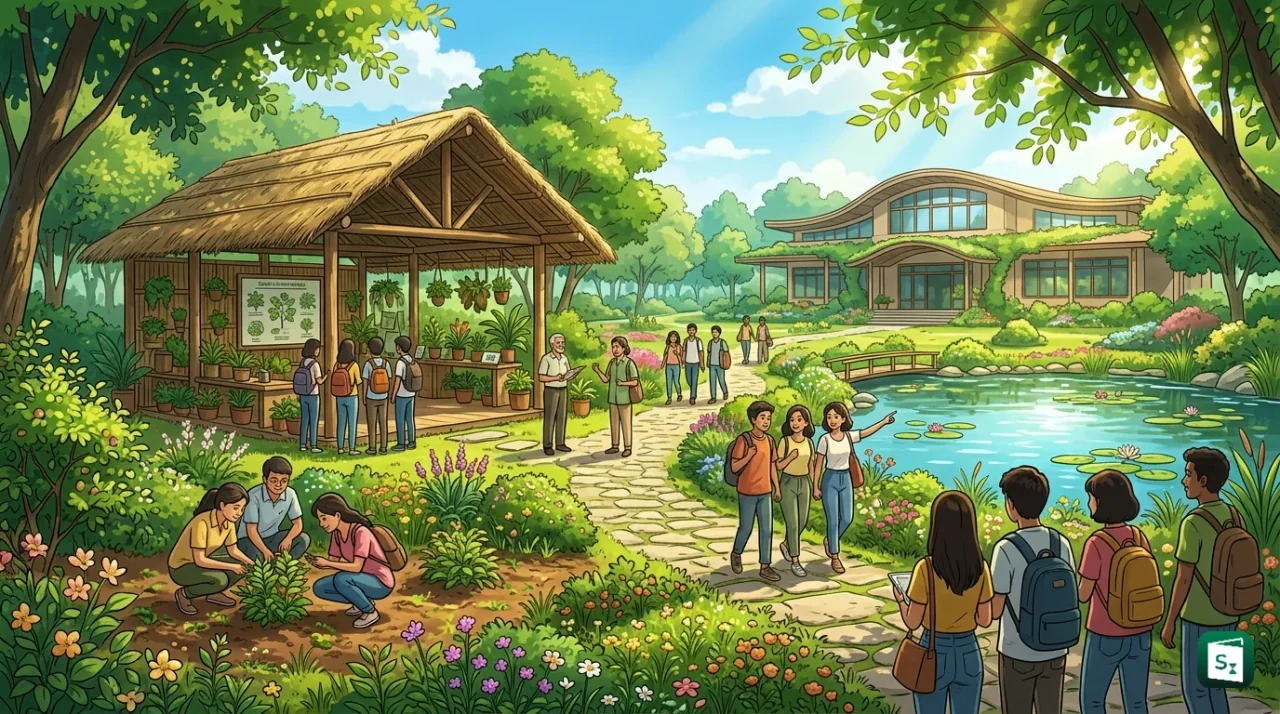
Union Minister of State for Science and Technology, Dr Jitendra Singh, dedicated India’s first Eco-Educational Hub, ‘Prakriti Gyan Dham’, to the nation on 8 August 2026. The facility has been developed by the CSIR-National Botanical Research Institute (CSIR-NBRI) at the Maharishi Parashar Bioresource Centre (MPBC), Banthra Campus, Lucknow. It is a living repository of India’s botanical diversity, designed to promote hands-on experiential learning, biodiversity conservation, and public outreach.
What Is Prakriti Gyan Dham?
Prakriti Gyan Dham literally translates to a ‘sanctuary of knowledge about nature’. It is an Eco-Educational Hub, a concept that blends an open-air botanical campus with the functions of a science museum and an outdoor classroom. Unlike a conventional botanic garden, every section here is designed to teach, explain, and connect the visitor to the ecological and cultural history of India’s plant life.
The hub represents a convergence of scientific research, environmental education, biodiversity conservation, botanical heritage, and cultural interpretation. It offers an immersive environment for students, researchers, educators, nature enthusiasts, and the general public, acting as a direct bridge between scientific knowledge and public engagement. Different facilities within the campus make India’s plant diversity, conservation efforts, and botanical heritage accessible through experiential and interactive learning, rather than through textbooks alone.
Key Attractions Inside the Hub
PAaVan Path
The PAaVan Path, short for Plants and Associated Vegetations for Appreciating Nature, is the central experiential feature of the campus. This interpretive heritage trail takes visitors through curated plant collections that represent diverse ecological regions of India and their associated vegetation. It is designed as the core route along which a visitor moves through the different themed sections of the hub.
Indian Heritage Garden
At the heart of the hub is the Indian Heritage Garden, which brings together heritage trees propagated from historically significant locations across the country. Among the notable trees on display are the Bawan Imli Tamarind Tree from Fatehpur, associated with the sacrifice of 52 freedom fighters; the Mother Dussehri Mango Tree from Lucknow; the Patalpuri Banyan of Prayagraj; and the mango tree planted by Mahatma Gandhi at Bhitiharwa, Champaran. Descendants of trees associated with the historic Dandi March route in Gujarat are also part of the collection.
The garden uses QR-enabled audio systems to give visitors historical, cultural, and botanical information about the heritage trees through their smartphones. This turns the landscape into an interactive learning space where a tree’s story can be heard while walking beneath its branches.
Vibhav and Bhairav Enclaves
The Vibhav Enclave, also called the Threatened Plants of India Garden, provides a dedicated space for rare, endangered, and threatened plant species. It promotes awareness about biodiversity loss, habitat degradation, climate change, and the need to conserve plant genetic resources.
The Bhairav Enclave, or the State Plants of India Garden, brings together the officially designated State Plants of the States and Union Territories, presenting their ecological, cultural, and symbolic significance in one place.
Bamboosteum
Another major attraction is the Bamboosteum, which houses 43 indigenous and exotic bamboo species. The facility demonstrates the importance of bamboo as a renewable bioresource with applications in ecological restoration, carbon sequestration, soil conservation, sustainable livelihoods, traditional craftsmanship, and green infrastructure. In simple terms, it shows how one versatile grass family can support everything from soil protection to rural enterprise.
Analogy · A Library of Living Plants Expand analogy
Think of Prakriti Gyan Dham as a library, but one where the books are alive. The heritage garden holds the biography of the nation’s history, the threatened plants section is the rare books room, and the Bamboosteum is a reference section on a single useful plant family. Visitors do not just read; they walk through the shelves, touch the pages, and listen to the stories.
A Science-to-Society Push
During the dedication ceremony, Dr Jitendra Singh called for taking the work of scientific institutions closer to society by systematically showcasing their technologies, success stories, and societal applications. He said the outreach of scientific institutions should go beyond laboratories and institutional campuses, with greater use of digital and social media platforms, so that farmers, entrepreneurs, students, industry, and other stakeholders can access scientific solutions and livelihood opportunities.
The science-to-society orientation of the programme was visible in the technologies launched and transferred alongside the hub. An herbal formulation for male reproductive health, developed in collaboration with Himalaya, was formally launched. Four plant-based technologies, Herbal Anti-Dandruff Hair Care Oil, Frotus: Lotus-inspired Perfume, Frotus: Rudra Perfume, and Herbal Nano Serum, were transferred to the Kudumbashree State Poverty Eradication Mission, Kerala, to promote women-led entrepreneurship and livelihood generation through science-based value-added products.
CSIR-NBRI also transferred the Design and Development of a Low-Cost Photobioreactor technology to Witwake Solutions Pvt. Ltd., Lucknow, strengthening industry-academia collaboration. A photobioreactor is a closed system used to grow microalgae, or microscopic photosynthetic organisms, under controlled light, temperature, and nutrient conditions. It enables year-round cultivation of algae for applications ranging from biofuels and food supplements to wastewater treatment and carbon dioxide capture.
The Minister also released a documentary on India’s Heritage Gardens, and underlined the need to combine traditional knowledge with modern technologies to address emerging environmental and climate challenges. He emphasised that scientific institutions should use their success stories not merely as a communication exercise, but as a way of making potential users aware of solutions that can contribute to livelihoods and economic opportunities.
About CSIR-NBRI and the Maharishi Parashar Bioresource Centre
The Council of Scientific and Industrial Research (CSIR) is an autonomous research and development organisation established on 26 September 1942, headquartered in New Delhi. It operates under the Department of Scientific and Industrial Research (DSIR) of the Ministry of Science and Technology, and is among the world’s largest publicly funded research and development networks, running about 37 national laboratories across India.
The National Botanical Research Institute (NBRI) in Lucknow is one of these constituent laboratories. Its origins trace back to a royal garden established around 1800 by Nawab Saadat Ali Khan of Awadh, which later came to be known as the Sikandar Bagh after one of the queens of Nawab Wajid Ali Shah. The garden was converted into the National Botanic Gardens in the 1930s, was taken over by CSIR in 1953, and was renamed the National Botanical Research Institute in 1978. The institute’s botanic garden, spread over about 65 acres, holds more than 5,000 plant species and varieties, and has been designated a Living National Repository by the National Biodiversity Authority, Chennai. The garden is also a Lead Botanic Garden under the Ministry of Environment, Forest and Climate Change for strengthening ex-situ conservation, or the conservation of plant species outside their natural habitats, such as in botanical gardens and seed banks.
The Maharishi Parashar Bioresource Centre (MPBC) at Banthra, near Lucknow, is a field research station of CSIR-NBRI. The centre is named after Maharishi Parashar, the Vedic sage credited as the author of the Vishnu Purana and regarded as the father of Jyotish Shastra, or Vedic astrology. He is also known as the father of Veda Vyasa, the sage who compiled the Vedas and composed the Mahabharata. The Banthra campus functions as a bioresource hub, where plants of economic and ecological value are studied and conserved, and it now hosts the Eco-Educational Hub as its flagship public-facing facility.
Dr Zabeer Ahmed, Director of CSIR-NBRI and CSIR-IIIM Jammu, said the hub has been conceived as a living repository of India’s botanical diversity, enabling visitors to engage with the country’s plant heritage through interactive and immersive learning. The event was also attended by Dr G.N. Singh, Advisor (Health) to the Chief Minister of Uttar Pradesh, and Dr Ajit Kumar Shasany, Vice-Chancellor of the Central University of Odisha.
Why the Hub Matters
Prakriti Gyan Dham addresses a gap that has long existed in India’s science outreach. Scientific research in botany has traditionally been confined to laboratories and institutional campuses, and its results rarely reached the public. The hub changes this by converting scientific knowledge into an interactive experience that anyone can walk into, making plant science accessible in the same way a museum makes history accessible.
For students and educators, the hub works as a living laboratory where classroom concepts in biology, ecology, and environmental science can be seen and felt. The Vibhav Enclave teaches the reality of threatened plant species, while the Bamboosteum shows a renewable natural resource with direct applications in climate mitigation, livelihood generation, and green construction.
For farmers and rural entrepreneurs, the technology transfers announced at the inauguration, such as the four plant-based products handed over to Kerala’s Kudumbashree Mission, demonstrate how institutional research can be turned into income-generating products. The hub reinforces India’s broader push, visible in initiatives like the CSIR Floriculture Mission, to take laboratory innovations to fields and to generate rural employment through science.
The initiative also aligns with India’s international commitments to biodiversity. As a party to the Convention on Biological Diversity (CBD), signed at the Rio Earth Summit in 1992, India has committed to conserving its biological wealth. Facilities that combine ex-situ conservation with public awareness help India meet these obligations while building a culture of environmental stewardship among citizens.
Key Takeaways
- ‘Prakriti Gyan Dham’ is India’s first Eco-Educational Hub, dedicated to the nation by Union Minister Dr Jitendra Singh on 8 August 2026.
- The hub is located at the Maharishi Parashar Bioresource Centre (MPBC), Banthra Campus, Lucknow, and was developed by CSIR-NBRI.
- The Indian Heritage Garden features the Bawan Imli Tamarind Tree from Fatehpur, linked to the sacrifice of 52 freedom fighters, the Mother Dussehri Mango Tree of Lucknow, and the Patalpuri Banyan of Prayagraj.
- The Bamboosteum houses 43 indigenous and exotic bamboo species, highlighting bamboo’s role in ecological restoration and green infrastructure.
- The Vibhav Enclave conserves threatened plant species, while the Bhairav Enclave displays officially designated State Plants of the States and Union Territories.
- CSIR was established on 26 September 1942, while NBRI, earlier the National Botanic Gardens, was taken over by CSIR in 1953 and renamed in 1978.