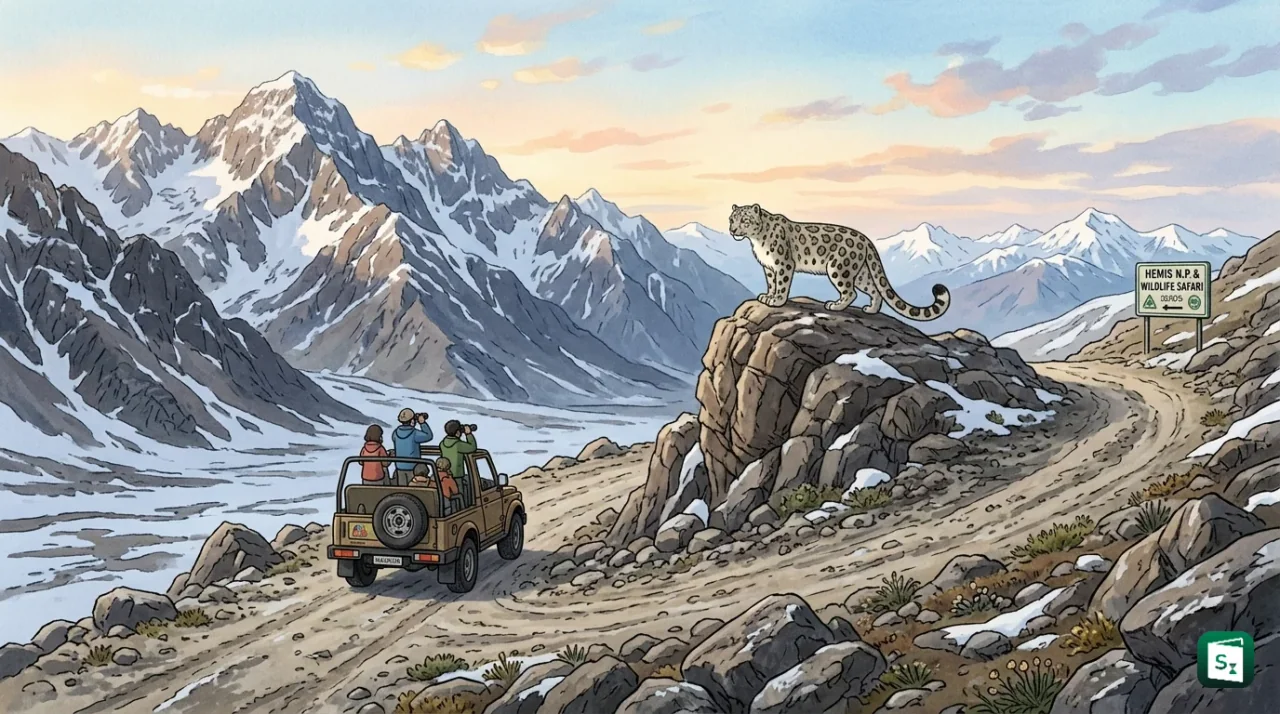
Ladakh is set to launch India’s first high-altitude wildlife safari, with Lieutenant Governor Vinai Kumar Saxena approving guided jeep safaris along snow leopard and birdwatching trails. The initiative, cleared at the first governing body meeting of the newly constituted Snow Leopard and High-Altitude Nature (SHAN) Conservation Society, is designed to promote sustainable eco-tourism while making local communities equal partners in wildlife conservation. The safari will cover the Hemis National Park, the largest national park in South Asia, along with the Changthang and Karakoram Wildlife Sanctuaries.
What the Safari Will Look Like
The guided jeep safari is modelled on the regulated vehicle safaris that operate in parks such as Kaziranga and Ranthambore. Specially designed open-back vehicles, driven by trained local drivers and guides, will take visitors through designated routes instead of allowing private vehicles to roam freely inside protected areas.
The forest department has been directed to identify potential safari routes across the three protected areas, besides wildlife-rich pockets such as Nubra, Zanskar, Sham, Kargil and Drass, which are known for snow leopard sightings and rich birdlife. As part of the same effort, 20 local youths will be selected and trained in birdwatching and bird identification and equipped with binoculars, while 10 birdwatching hides will be set up at major hotspots.
The initiative is being steered by the SHAN Conservation Society, constituted on 16 June 2026 and chaired by the Lieutenant Governor. The society has been tasked with preparing a roadmap for community-led wildlife conservation, waste management, plastic-free tourism, sustainable livelihoods and responsible tourism across Ladakh. The governing body has also approved the installation of 300 colour-coded waste bins across 40 villages, the creation of SHAN Wildlife Clubs in 50 government schools with ₹30,000 each, and wildlife photography fellowships for 10 local youths.
The Three Protected Areas on the Safari Map
The safari will thread together three of the largest protected areas in Ladakh, each with a distinct ecological identity.
Hemis National Park
Established in 1981, Hemis National Park initially covered about 600 sq km around the Rumbak and Markha river catchments and was progressively expanded to its present 4,400 sq km by 1990. It is the largest national park in India and South Asia, the only national park in the country located entirely north of the Great Himalayan range, and one of the largest contiguous protected areas on the continent. Named after the 400-year-old Hemis Monastery, which lies within its boundaries, the park rises from around 3,000 metres to more than 6,000 metres above sea level.
Hemis holds the distinction of having the highest density of snow leopards in any protected area in the world, with an estimated 200 snow leopards concentrated especially in the Rumbak catchment. It is also home to the Tibetan wolf, Eurasian brown bear, Asiatic ibex, bharal or blue sheep, Ladakhi urial and Tibetan argali, alongside birds such as the golden eagle and lammergeier vulture. The famous Markha Valley trek runs through the park, and villages inside it already run a celebrated homestay network, which began in Rumbak in the early 2000s, that gives local families a direct economic stake in protecting the snow leopard.
Changthang Wildlife Sanctuary
Notified in 1987, the Changthang Wildlife Sanctuary covers around 4,000 sq km on the high, cold Changthang plateau, which extends into Tibet. It is among the few places in India where the kiang, or Tibetan wild ass, the world’s largest wild ass, is found, and it is a critical breeding ground for the black-necked crane, the state bird of Ladakh and the world’s only alpine crane. The sanctuary contains some of India’s highest lakes, including Tso Moriri and Tso Kar, the latter declared a Ramsar wetland of international importance in December 2020.
The sanctuary is also home to the snow leopard, Tibetan gazelle, wild yak and migratory waterbirds, and it is traversed by the Changpa pastoralists, whose flocks of pashmina goats produce the fine wool the region is famous for. Parts of the sanctuary fall in border zones that require an Inner Line Permit to visit.
Karakoram Wildlife Sanctuary
Also notified in 1987, the Karakoram Wildlife Sanctuary, also called the Nubra-Shyok Wildlife Sanctuary, stretches over roughly 5,000 sq km in the easternmost reaches of the Karakoram range, along the Nubra and Shyok rivers. It is one of the few places in India with a migratory population of the chiru, or Tibetan antelope, whose wool was historically prized as shahtoosh. Siberian ibex, bharal, Tibetan argali, wild yak and the Himalayan brown bear are among its other inhabitants.
The sanctuary adjoins the Siachen region and parts of the Line of Actual Control with China, making it one of the most remote and least visited protected areas in the country. In September 2025, the Ladakh State Wildlife Board proposed redefining its boundaries to expand it to about 16,550 sq km, reflecting the actual extent of the landscape, while excluding some inhabited river corridors.
The Snow Leopard: Star of the Safari
The snow leopard (Panthera uncia), known as the ghost of the mountains because of its near-perfect camouflage and elusive nature, is the main attraction of the new safari. It lives at elevations of up to 5,500 metres across the high ranges of Central and South Asia, and is found in 12 countries, including India, China, Nepal, Bhutan, Mongolia and Russia. India accounts for an estimated 10 to 15 per cent of the global population of roughly 4,000 to 6,500 wild snow leopards.
The species is classified as Vulnerable on the IUCN Red List and enjoys the highest level of legal protection in India under Schedule I of the Wildlife (Protection) Act, 1972. It is also listed in Appendix I of CITES (Convention on International Trade in Endangered Species) and Appendix I of the Convention on Migratory Species, which ban international trade in the animal and its parts.
Analogy · Why Guided Safaris Matter Expand analogy
Spotting a snow leopard is like spotting a celebrity who never steps out of a guarded mansion; the only way to see one is to let the people who live next door take you there. By hiring trained local guides, visitors get a reliable sighting while giving the villagers a financial reason to protect the cat rather than treat it as a threat to their livestock.
Why the Safari Matters
The safari addresses three concerns at once: ecology, economy and enforcement.
Ecological benefit. Regulated jeep safaris keep vehicles on designated tracks. Vehicles leaving these tracks crush alpine vegetation, damage wetland shores and disturb nesting grounds, scars that can take decades to heal in the fragile cold desert. By replacing illegal off-roading with licensed tours, the initiative directly protects breeding habitats of the snow leopard, black-necked crane and other rare species.
Economic benefit. Tourism is the backbone of Ladakh’s economy, and the safari makes conservation pay for itself. Trained local drivers, guides, birdwatching hosts and homestays will earn from the visitor economy. The plan also includes training 50 women artisans to make wildlife-themed souvenirs, including miniature replicas of the snow leopard and black-necked crane, and setting up souvenir shops across Ladakh.
Community-led conservation. The SHAN model treats villagers, many of them pastoralists, as equal stakeholders. Where snow leopards were once seen as a threat to livestock, compensation-linked tourism and souvenir incomes give communities a direct reason to protect the predator. The administration has directed all agencies to complete preparations before the snow leopard sighting season, which peaks in the winter months of January to March, when the cats descend to valley floors and are easier to observe.
The idea aligns with the national conservation framework set by Project Snow Leopard, launched in 2009 by the Ministry of Environment, Forest and Climate Change, which promotes participatory, landscape-based conservation across the five Himalayan range states. It also builds on the SPAI survey, the first scientific population estimate of snow leopards in India, released in January 2024.
The Way Forward
The safari routes, entry points and booking details are yet to be finalised, with the forest department expected to complete route identification ahead of the coming winter. Several questions will shape its success, including the carrying capacity of the landscape, the number of vehicles allowed per day, and the enforcement of the permit system in remote border zones.
If executed well, Ladakh could emerge as a global model for high-altitude, community-led eco-tourism, much as Bhutan has positioned itself as a high-value, low-impact destination. The experiment is being watched closely not just by conservationists but by every mountain state in India that is trying to balance tourism revenue with protecting fragile ecosystems.
Key Takeaways
- Ladakh will host India’s first high-altitude wildlife safari, approved by Lieutenant Governor Vinai Kumar Saxena at the first meeting of the Snow Leopard and High-Altitude Nature (SHAN) Conservation Society.
- The safari will cover Hemis National Park, the Changthang Wildlife Sanctuary and the Karakoram Wildlife Sanctuary, besides the Nubra, Zanskar, Sham, Kargil and Drass regions.
- Hemis National Park, established in 1981 and spread over 4,400 sq km, is the largest national park in India and South Asia and holds the world’s highest density of snow leopards in a protected area.
- The Snow Leopard Population Assessment in India (SPAI) survey, conducted between 2019 and 2023, estimated 718 snow leopards in India, of which 477 are in Ladakh.
- The snow leopard is classified as Vulnerable on the IUCN Red List, protected under Schedule I of the Wildlife (Protection) Act, 1972, and listed in Appendix I of CITES.
- The SHAN Conservation Society, constituted on 16 June 2026, also approved training for 20 local youths in birdwatching, 10 birdwatching hides and 300 waste bins across 40 villages.