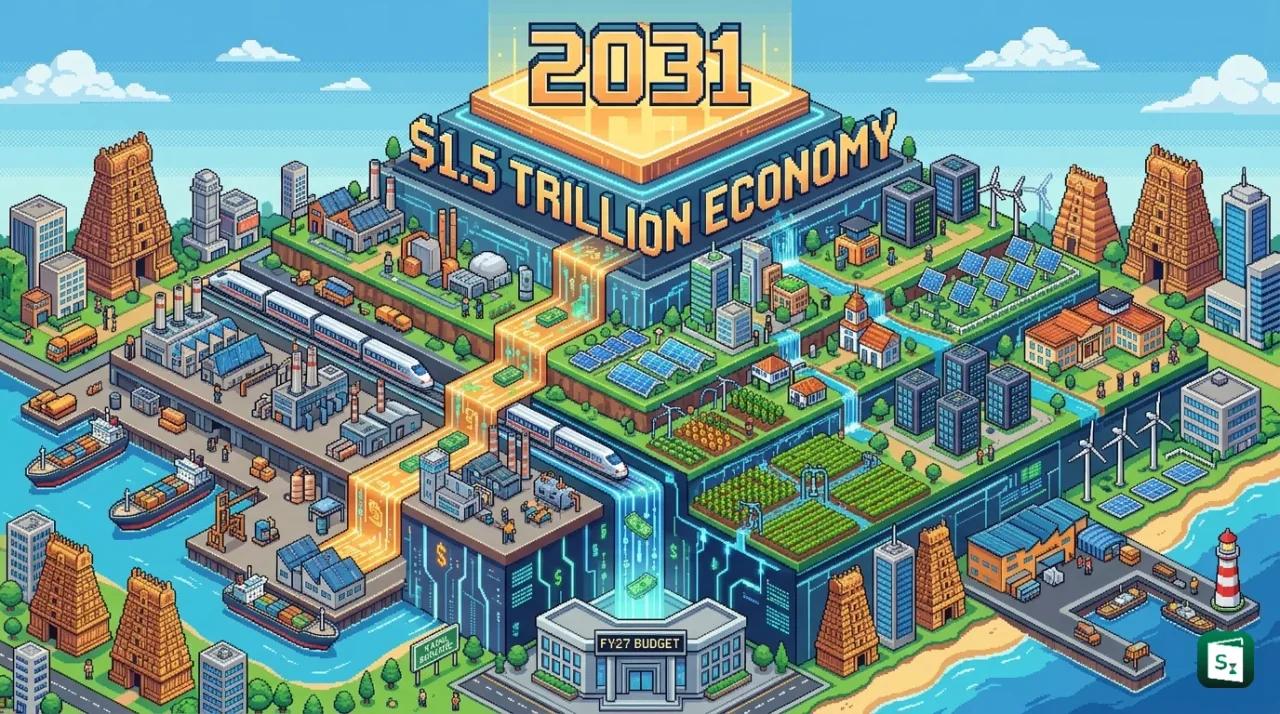
Tamil Nadu Finance Minister N Marie Wilson presented the maiden budget of the Tamilaga Vettri Kazhagam (TVK)-led government for the financial year 2026-27 in the Legislative Assembly on August 5, 2026. The budget, tabled as the Revised Budget Estimates for 2026-27, outlines a roadmap to transform the state into a $1.5 trillion economy by 2031. Presented roughly three months after the TVK came to power under Chief Minister C Joseph Vijay, the document balances welfare commitments with a push for fiscal consolidation amid mounting debt.
The Maiden Budget of the TVK Government
The Tamilaga Vettri Kazhagam (TVK), which translates to the Victory Party of Tamilakam, is a regional party founded on February 2, 2024, by actor-turned-politician C Joseph Vijay, better known by his stage name Thalapathy Vijay. The party, headquartered in Panaiyur, Chennai, made a historic electoral debut in the 2026 Tamil Nadu Legislative Assembly election, winning 108 of the 234 seats and ending nearly six decades of dominance by the Dravidian parties, the DMK and the AIADMK.
Since the party fell short of the majority mark of 118, it formed a coalition government with the support of the Congress, the Left parties, the Viduthalai Chiruthaigal Katchi (VCK) and the Indian Union Muslim League (IUML). Vijay was sworn in as Chief Minister on May 10, 2026. The budget was presented by N Marie Wilson, a first-time MLA from the Radhakrishnan Nagar constituency in Chennai, who holds the portfolio of Finance, Planning and Development.
Wilson, who was born around 1979, joined TVK on June 9, 2025, after a career in education as the Managing Director of the Jeppiaar Institute of Technology and a trustee of the Jeppiaar group of institutions. He won his seat by a margin of nearly 50,000 votes and was entrusted with the finance portfolio during a cabinet expansion in May 2026, succeeding senior leader K A Sengottaiyan, who had held it briefly after the government took office.
The $1.5 Trillion Economy Target
The centrepiece of the budget is the government’s commitment to make Tamil Nadu a $1.5 trillion economy by 2031, articulated through what the government calls its Vetri Tamizhagam Vision Document. The target is far more ambitious than earlier state-level aspirations. The previous DMK administration had aimed for a $1 trillion economy, and Tamil Nadu currently generates a Gross State Domestic Product (GSDP) of roughly ₹35.29 lakh crore in 2025-26, which translates to about $350 billion to $400 billion depending on the exchange rate.
To put the scale of the ambition in context, the state would need to more than triple its current economic output within five years, requiring sustained nominal growth of around 20 percent annually. Tamil Nadu’s recent record, however, gives the target some credibility. The state recorded a real GSDP growth of 11.19 percent in 2024-25, the highest among Indian states and its first double-digit growth in 14 years, followed by an estimated 10.83 percent in 2025-26. It remains the second-largest state economy in India, behind only Maharashtra.
The state’s services sector contributes the largest share of its Gross State Value Added, followed by the secondary and primary sectors. Tamil Nadu is among the most industrialised states in the country, with a strong presence in automobiles, textiles, electronics and manufacturing, factors that the government hopes to build upon to reach the $1.5 trillion mark.
Inherited Financial Stress
The budget was framed against a backdrop of strained public finances, which the new government has been at pains to highlight. Tamil Nadu’s total outstanding liabilities, at around ₹10.99 lakh crore in the Interim Budget Estimates presented by the outgoing DMK government in February 2026, had roughly doubled over the preceding five years. The figure stands at about 27 percent of GSDP, with interest payments projected at ₹78,683 crore for 2026-27, a heavy burden on revenue receipts.
The White Paper on State Finances
Shortly after assuming office, the TVK government released a White Paper on Financial Management in June 2026 that laid out the state’s fiscal troubles. The document claimed that Tamil Nadu’s actual outstanding debt stood at about ₹13.18 lakh crore when the borrowings of public sector undertakings were included, pointing to revenue leakages and unchecked borrowing under the previous regime. It also highlighted the mounting debt of state power utilities, including the four companies under the Tamil Nadu Electricity Board.
The government has blamed successive administrations, both DMK and AIADMK, for what it calls years of high borrowing without matching resource mobilisation. It has promised to restore fiscal discipline through what it describes as clean and transparent governance, with the Finance Minister vowing that not a single paisa of taxpayers’ money would be misused.
Key Fiscal Numbers at a Glance
The Revised Budget Estimates for 2026-27 carry the following headline figures:
| Indicator | Estimate for 2026-27 |
|---|---|
| Outstanding liabilities | ₹10,98,768 crore |
| Liability to GSDP ratio | 27.01 percent |
| Interest payments | ₹78,683 crore |
| Revenue deficit | ₹55,775 crore |
| Fiscal deficit | ₹1,21,819 crore |
| Fiscal deficit to GSDP ratio | 3 percent |
| Projected borrowings | ₹1,73,445 crore |
The fiscal deficit of 3 percent of GSDP is in line with the interim budget figure, while the revenue deficit, at an estimated 1.37 percent of GSDP, is higher than the 1.2 percent projected earlier. The medium-term fiscal consolidation plan for 2026-27 to 2028-29 aims to ease the liability-to-GSDP ratio to about 26.1 percent by 2028-29 and progressively narrow both deficits through better tax collection and spending discipline.
Education and Human Capital in Focus
Education emerged as the single biggest priority of the maiden budget, reflecting the government’s view of human capital as the foundation for the $1.5 trillion goal. The School Education Department has been allocated ₹44,527 crore and the Higher Education Department ₹8,393 crore, together forming a total education outlay of roughly ₹52,000 crore.
Among the key announcements, ₹300 crore has been set aside for modernising 3,734 government schools. A new initiative called the Super Clean, Super Campus scheme, backed by ₹139 crore, will cover 10,000 schools in its first phase, providing daily cleaning, drinking water, toilet maintenance and round-the-clock security. The popular Perunthalaivar Kamarajar Breakfast Scheme is being extended to students in Classes VI to VIII, covering about 15 lakh additional students.
The budget also launched the Vetri Laptop Scheme with an allocation of ₹2,000 crore to provide laptops to college students, and announced modern residential schools under the Perunthalaivar Kamarajar Model Schools scheme with an initial outlay of ₹125 crore. These schools will offer free education, housing and healthcare to students from Classes IX to XII. To expand professional education, the government will set up a Special Law College in Madurai and five new Industrial Training Institutes (ITIs) at an estimated cost of ₹90 crore. It also called on the central government to restore medical admissions based on Class 12 public examination results, a position against the common entrance test for medical courses.
Revenue Measures and Fiscal Reforms
With the state’s revenue base under pressure, the budget relies on a four-pillar strategy to plug leakages, rationalise spending, protect welfare and pursue medium-term consolidation. The State’s Own Tax Revenue is projected to grow by about 9.78 percent in 2026-27, with commercial taxes contributing roughly 68.9 percent of collections, followed by stamps and registration at 15.5 percent and state excise at 6.2 percent.
To raise fresh resources, the government announced a special levy on liquor manufacturers expected to bring in about ₹1,000 crore annually. Technology-driven measures, including faceless assessment under GST, faceless registration and the computerisation of mining, are projected to generate around ₹15,000 crore. On the expenditure side, the government has abolished the requirement of unnecessary certificates in public tenders, opened eligibility to contractors registered with any government department and relaxed criteria for low-value procurements. A high-level Expenditure Reforms Committee has been formed to review schemes for impact and efficiency.
The state’s tax revenue structure also depends on the share it receives from central taxes and its own collection efficiency. Tamil Nadu’s fiscal position has been a matter of debate with the Centre, with successive state governments seeking higher devolution and arguing against restrictions on their borrowing headroom under Article 293 of the Constitution. The Finance Minister has indicated that fully restoring the state’s financial administration would take at least two years.
Welfare and Development Announcements
While fiscal prudence formed the backdrop, the budget carried a substantial list of welfare measures across women, youth, infrastructure and technology. The government said it would deliver its election commitments through a systematic, phased approach.
For Women and Families
Under the Annan Seer Thittam, a promise made during the election campaign, eligible brides will receive an eight-gram gold coin and a silk saree on their wedding day, with an allocation of ₹812 crore. The Thai Maaman Thanga Mothiram Thittam will provide a one-gram gold ring to every newborn delivered in a government hospital, backed by ₹560 crore, in a bid to encourage institutional deliveries. Maternity support centres called Thai Care will be set up across the state for pregnant women. The government also announced Aran shelter homes for transgender persons in five districts, and support for destitute widows, deserted women and persons with disabilities under the Vetri Magalir Goat Rearing Scheme.
For Youth and Skill Development
The Vetri Skill Training Scheme will provide industry-aligned training to about 13 lakh young people, including 12 lakh college students and one lakh unemployed youth. Internships with government and private industry will be offered to 20,000 youth in the first phase, and bicycles with helmets and water bottles, worth ₹277 crore, will be distributed to Class XI students in government and government-aided schools. Youth welfare funding has been nearly doubled to ₹1,051 crore.
Infrastructure and Technology
The budget announced Arivagam, described as India’s first dedicated AI and innovation city, with plans for an AI university, a semiconductor hardware testing laboratory, an international skill development centre and innovation incubators, along with a ₹5 crore feasibility study. A new Rooftop Solar Subsidy Scheme will offer domestic consumers up to ₹1 lakh in convergence with the Pradhan Mantri Surya Ghar Muft Bijli Yojana. In the energy sector, the Coimbatore-Ariyalur 765 KV transmission line project will be implemented on a public-private partnership basis at an estimated ₹4,000 crore.
For transport, 1,000 air-conditioned electric buses will be procured for the Chennai Metropolitan Transport Corporation at ₹500 crore. The government also said the Cauvery-Vaigai-Gundar River Linking Project would commence this year with an initial allocation of ₹150 crore, and announced a Safe Roads Mission using AI for speed enforcement. Thoothukudi and Tirunelveli are to be declared a Space Industrial Investment Zone, anchored by the spaceport at Kulasekarapattinam, and a new Tamil Nadu Industrial Policy is expected to be released soon.
Reactions and the Road Ahead
The maiden budget drew sharp reactions from the opposition. The AIADMK, led by Edappadi K Palaniswami, dismissed it as a rebranding of old schemes and gave it “zero marks”, while questioning how the government plans to manage debt of about ₹10.98 lakh crore. The DMK, under M K Stalin, described it as a “damp squib” that lacked originality, with Leader of Opposition Udhayanidhi Stalin accusing the government of renaming several schemes of the previous DMK administration and calling the budget a “zero budget”.
Several prominent election promises, including the ₹2,500 monthly assistance for eligible women heads of families, six free LPG cylinders per family and free bus travel for women, did not figure in the budget and are expected to be rolled out in phases as the government’s finances improve. The government has committed to continuing flagship programmes such as the 200 units of free electricity for eligible households.
The true test of the budget will lie in whether the state can achieve the revenue growth needed to finance both welfare expansion and the infrastructure push while reining in debt. The $1.5 trillion target by 2031, pursued at a time when the government itself says full fiscal repair will take two years, makes the coming fiscal years a critical period for Tamil Nadu’s economy.
Key Takeaways
- The maiden budget of the Tamilaga Vettri Kazhagam (TVK)-led Tamil Nadu government was presented by Finance Minister N Marie Wilson on August 5, 2026, as the Revised Budget Estimates for 2026-27.
- The budget targets a $1.5 trillion economy by 2031, with Tamil Nadu currently being India’s second-largest state economy with a GSDP of around ₹35.29 lakh crore.
- Outstanding liabilities stand at ₹10,98,768 crore, about 27.01 percent of GSDP, with interest payments of ₹78,683 crore projected for 2026-27.
- The fiscal deficit is pegged at 3 percent of GSDP (₹1,21,819 crore), while the revenue deficit is ₹55,775 crore.
- TVK was founded by actor-turned-politician C Joseph Vijay on February 2, 2024, and won 108 of 234 seats in the 2026 Assembly election to form the government.
- Key schemes announced include the Vetri Laptop Scheme (₹2,000 crore), Annan Seer Thittam (gold coin and saree for brides, ₹812 crore) and the Arivagam AI city in Tamil Nadu.