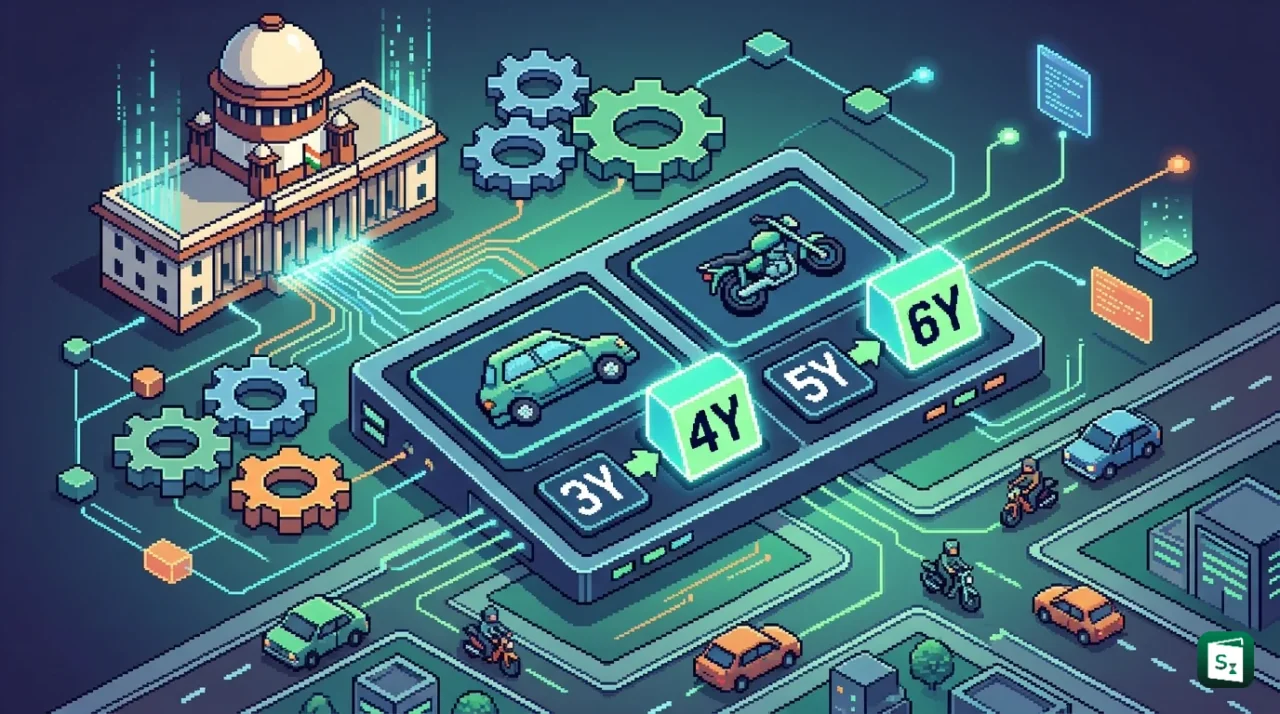
The Supreme Court of India extended the mandatory third-party insurance period for newly purchased vehicles by one year on August 4, 2026. A Bench of Justice Sanjay Karol and Justice Prashant Kumar Mishra directed that new cars must now carry four years of third-party cover and new two-wheelers six years of cover at the time of purchase. The order, issued in the interest of road safety, seeks to rein in the large number of vehicles plying without valid insurance.
What Did the Supreme Court Direct?
The Bench ordered that henceforth, buyers of new vehicles must purchase long-term third-party insurance for four years in the case of cars and six years in the case of two-wheelers. This extends the earlier mandate of three years for cars and five years for two-wheelers by one year each.
The court directed the Insurance Regulatory and Development Authority of India (IRDAI) to issue the necessary regulatory directions immediately so that insurers implement the new tenure. It explicitly rejected the recommendation of IRDAI and the General Insurance Council (GIC), an industry body of general insurers, against extending the period, holding that enhancing the tenure by one year was in the interest of road safety.
The directions came while the court was hearing an appeal by National Insurance Company in a motor accident compensation case. Although the insurer’s appeal was dismissed, the Bench expanded the scope of the proceedings to address the wider problem of uninsured vehicles and enforcement gaps in motor insurance.
Why the Court Stepped In
Despite third-party insurance being compulsory under law, a shocking number of vehicles continue to ply on Indian roads without valid cover. The court observed that nearly 56 percent of vehicles on Indian roads are uninsured, which translates to roughly 16.54 crore of the 30.48 crore registered vehicles in the country.
The consequence falls hardest on accident victims. When the vehicle at fault has no insurance, victims and their families are forced to fight prolonged legal battles for compensation, and often end up with nothing. The financial blow is even more severe when the victim has died or suffered permanent disability, because the family loses its sole breadwinner. The Bench noted that these families often have to “run from pillar to post” and that their recourse to adequate, timely compensation is blocked.
The court also pointed out that the existing fine of ₹2,000 for a first offence and ₹4,000 for repeat offences under the law has not worked as a deterrent, which is why it weighed steeper penalties and stronger enforcement machinery. India records over four lakh road accidents on average every year, and the large share of uninsured vehicles makes speedy justice for victims harder.
What Is Third-Party Insurance and Why Is It Compulsory?
Third-party insurance covers the legal liability of the vehicle owner towards other people. If a car injures a pedestrian or damages another vehicle, this policy pays for the injuries and damages caused to that third party. It is different from comprehensive insurance, which also covers damage to the insured vehicle itself, such as in an accident, theft, or fire.
The compulsion comes from the Motor Vehicles Act, 1988. Section 146 of the Act prohibits the use of a motor vehicle in a public place unless it has a valid insurance policy covering third-party risks. Section 147 lays down the requirements of such policies and the limits of liability, while Section 149 binds the insurer to satisfy awards relating to third-party risks. Driving an uninsured vehicle is punishable under Section 196.
The idea behind the law is simple. Accidents happen every day, and the party at fault may not have the money to compensate the victim. A compulsory insurance pool ensures that accident victims, who are innocent bystanders in most cases, receive compensation from the insurer rather than chasing the at-fault driver for money.
The 2018 Precedent
The current order builds on an earlier Supreme Court judgment in S. Rajaseekaran v. Union of India (2018), delivered in a road safety petition filed by an orthopaedic surgeon. In that case, the court directed that new vehicles sold from September 1, 2018 must come with long-term third-party cover, setting three years for cars and five years for two-wheelers, and told IRDAI to issue implementing regulations.
Eight years on, the court found that a large number of vehicles still remain uninsured. Extending the tenure by one year means that new car buyers will now pay upfront for four years of mandatory cover and new two-wheeler buyers for six years, keeping vehicles insured for a longer stretch of their early life, when accidents are most likely.
Tighter Enforcement Through Technology
The court coupled the longer tenure with a technology-driven push to catch uninsured vehicles. It directed that Automatic Number Plate Recognition (ANPR) cameras, already deployed on highways and city roads for detecting traffic violations, be integrated with the insurance database maintained by the Insurance Information Bureau of India (IIB) and the vehicle registration data on the VAHAN portal.
Under this system, cameras would automatically identify vehicles without valid insurance and generate electronic challans. The court also asked state police forces to equip traffic personnel with handheld devices or mobile applications linked to the IIB and VAHAN databases, allowing officers to verify insurance status in real time during inspections.
The “No Insurance, No Fuel” Proposal
In a notable suggestion, the court directed IRDAI, in consultation with the Ministry of Road Transport and Highways (MoRTH), to explore a pilot project that links fuel purchase to insurance status. Under the proposed model, a vehicle without valid insurance could be denied fuel at petrol pumps until it obtains the required cover. The idea is expected to serve a dual purpose: it helps identify uninsured or unregistered vehicles, and it pushes owners to keep their policies active.
The court did not order immediate implementation. Instead, it asked for a feasibility study and a pilot project, with the matter listed for further hearing on August 18, 2026 to review compliance with its directions.
A Simpler Four-Layer Insurance Structure
To make insurance products easier to understand, the court accepted IRDAI’s proposal for a uniform four-layer policy structure for private vehicles. Buyers would be offered a policy at the point of purchase that clearly separates the mandatory and optional components.
| Layer | Component | Mandatory or Optional | What It Covers |
|---|---|---|---|
| 1 | Third-party insurance | Mandatory | Legal liability towards third parties |
| 2 | Legal liability cover | Optional | Passengers and pillion riders other than the owner, driver and family |
| 3 | Personal accident cover | Optional | Death or permanent disability of the owner, driver and occupants |
| 4 | Own damage cover | Optional | Loss or damage to the insured vehicle itself |
While the premium for the mandatory third-party component will be determined in consultation between IRDAI and the central government, insurers will be free to price the optional covers. The court directed IRDAI, along with the General Insurance Council and insurers, to frame uniform policy wordings for the optional covers.
Every buyer, whether purchasing online or offline, must now receive a standardised Customer Option Form that spells out what is covered under the mandatory insurance, which covers are optional, and the premium payable for each. This is meant to end the confusion that leaves many consumers unaware of what their policy actually includes.
Faster Compensation for Accident Victims
Alongside the insurance changes, the court addressed the mounting backlog of claims before Motor Accident Claims Tribunals (MACTs). These tribunals, constituted under Section 165 of the Motor Vehicles Act by state governments, adjudicate compensation claims arising from motor accidents.
For accidents that occurred before March 31, 2022, the Bench directed state police authorities to promptly file Detailed Accident Reports before the respective tribunals, along with supporting records such as the FIR, medical and post-mortem reports, insurance documents and vehicle permits. It also directed the police to ensure timely service of notices and production of witnesses so that older pending claims are disposed of quickly.
The court also dismissed the insurance company’s appeal in the case at hand and directed it to pay the compensation awarded to the victim’s family. It cautioned that courts dealing with motor accident claims should not adopt a hyper-technical approach that defeats the purpose of compensation. The message was clear: in deciding compensation claims, the interest of accident victims must come first.
Key Takeaways
- The Supreme Court on August 4, 2026 extended the mandatory third-party insurance period for new vehicles, setting four years for cars and six years for two-wheelers.
- The order was issued by a Bench of Justice Sanjay Karol and Justice Prashant Kumar Mishra, overriding the recommendation of IRDAI and the General Insurance Council.
- Nearly 56 percent of vehicles on Indian roads, about 16.54 crore of the 30.48 crore registered vehicles, operate without valid insurance.
- Section 146 of the Motor Vehicles Act, 1988 makes third-party insurance compulsory for the use of any motor vehicle in a public place.
- The earlier mandate of three years for cars and five years for two-wheelers came from the Supreme Court’s S. Rajaseekaran v. Union of India (2018) judgment, effective September 1, 2018.
- The court directed integration of ANPR cameras with the Insurance Information Bureau of India and VAHAN databases, and proposed a pilot no insurance, no fuel project.