Chandannagar’s iconic Jolbhora Sandesh (also known as Jalbhara Sandesh) has been awarded the Geographical Indication (GI) tag, officially recognising the Hooghly district town as its place of origin. The sweet, known for its delicate chhena shell encasing a hidden liquid centre of rose syrup or date palm jaggery, has been a celebrated part of Bengal’s culinary identity for nearly 200 years. With this recognition, the Jolbhora Sandesh joins the select list of West Bengal’s GI-tagged traditional sweets, which already includes Banglar Rosogolla, Joynagarer Moa, and Bardhaman’s Mihidana and Sitabhog.
What Is Jolbhora Sandesh?
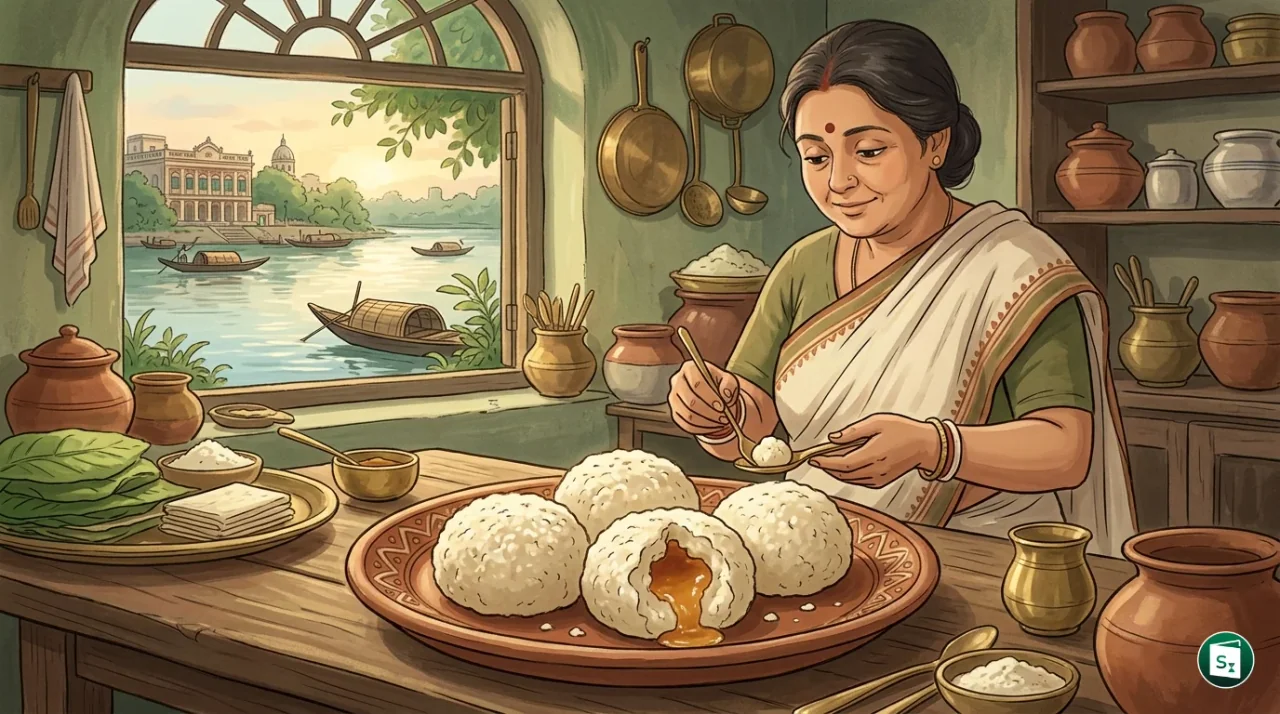
Jolbhora Sandesh is a variant of the classic Bengali sandesh, made from fresh chhena (curdled milk). The name comes from two Bengali words: jol meaning water or liquid, and bhora meaning filled. As the name suggests, the sweet features a soft, delicate outer shell of chhena that hides a liquid centre. Traditionally, the filling is made with nolen gur (date palm jaggery syrup) during winter months or rose-scented sugar syrup at other times of the year.
What makes this sweet extraordinary is the technical skill required to make it. The chhena shell must be firm enough to hold the syrup inside without leakage, yet tender enough to burst open when bitten. The sweet makers, or moiras, achieve this through precise kneading and the right balance of ingredients. A typical Jolbhora measures about 4 to 5 cm in length and is shaped like the kernel of a talshansh (ice apple or palm fruit), which inspired its original shape.
The sweet is particularly popular during winter when nolen gur is harvested from date palm trees between December and January. During summer, a white sugar syrup or flavoured variations such as mango, chocolate, and strawberry are used instead.
A 200-Year-Old Origin Story
The story of Jolbhora Sandesh begins around 1843-44 in the Telinipara neighbourhood of Chandannagar, then a French colony. According to local lore, the zamindar (landlord) of Telinipara, at the request of his wife, commissioned the renowned confectioner Surjya Kumar Modak to create a sweet that would playfully surprise their newly married son-in-law. It was a common tradition in Bengali households to tease the new groom during family gatherings.
Modak, along with his son Siddheshwar Modak, experimented until they created a sandesh shaped like a talshansh (ice apple kernel), with a hollow centre filled with rose-scented jaggery syrup. When the unsuspecting groom bit into the sweet, the syrup burst out and spilled onto his clothes, filling the household with laughter. The sweet was thus named Jalbhara Talsansh Sandesh, later shortened to Jolbhora or Jalbhara, meaning water-filled. The sweet soon became known locally as Jamai Thokano Mishti (the sweet that tricks the son-in-law).
Surjya Kumar Modak was not just a confectioner but also a poet. His poetry collection, Geet Gobindo, is preserved in the French Museum in Chandannagar, reflecting how 19th-century Bengal often blended craft with culture.
The Tagore Connection
The Jolbhora’s fame spread far beyond Chandannagar. During one of his stays at Chandannagar’s historic Patal Bari overlooking the Hooghly River, Nobel laureate Rabindranath Tagore sampled several sweets from the Modak household. While the Jolbhora delighted him, another creation by the Modaks caught his special attention. Its delicate grains of chhena reminded him of tiny pearls, or moti. Tagore himself christened it Motichur Sandesh, a name that survives to this day and has no connection to the north Indian Motichoor Ladoo.
The Portuguese Connection
The use of chhena in Bengali confectionery can be traced back to the Portuguese, who settled in nearby Bandel in the Hooghly district during the 16th century. The Portuguese introduced the technique of curdling milk with acidic agents to make cheese, which local moiras (sweet makers) adapted brilliantly. This technique eventually became the foundation of Bengal’s rich sandesh tradition, of which the Jolbhora is one of the finest expressions.
What Is a Geographical Indication Tag?
A Geographical Indication (GI) tag is a form of intellectual property right that identifies a product as originating from a specific geographical location, where its quality, reputation, or other characteristics are essentially attributable to that place of origin.
In India, GI tags are governed by the Geographical Indications of Goods (Registration and Protection) Act, 1999. The tags are granted by the Geographical Indication Registry, which operates under the Department for Promotion of Industry and Internal Trade (DPIIT), Ministry of Commerce and Industry. The GI tag is valid for 10 years and can be renewed.
Once a product receives a GI tag, only authorised producers from the designated geographical area can use the registered name. This protects the product from imitation and counterfeit versions sold under the same name. Some well-known Indian GI products include Darjeeling Tea (first Indian product to get a GI tag), Basmati Rice, Banarasi Brocade, and Mysore Silk.
Why the GI Tag Matters for Chandannagar
The application for the GI tag for Jolbhora Sandesh was filed in September 2022 by the Hooghly District Industries Centre along with Saibal Kumar Modak, the fifth-generation owner of the original Surjya Kumar Modak shop. After four years of procedural scrutiny including five hearings, the tag was finally granted in June 2026.
The Jolbhora Sandesh was among 23 products from West Bengal that received the GI tag in the latest round announced in June 2026. Four of these are from the Hooghly district alone, including Janai’s Monohara (another traditional sweet), Balagarh’s traditional wooden boats, and Hooghly’s Babnan Chikan embroidery. Other notable products in the list include Krishnanagar’s clay dolls, Natungram’s wooden dolls, Shantiniketan Batik, Shantiniketan Ektara, Fulia Jamdani, Murshidabad silk, Mecha Sandesh from Beliatore in Bankura, Banglar Nolen Gur, Cooch Behar Sitalpati, Kolkatti jewellery, and Kanakchur popped rice.
Economic and Export Potential
The GI tag is especially significant for the sweet’s export prospects. Saibal Kumar Modak has noted that without a GI tag, international trade at the government level is not possible. The recognition establishes Jolbhora as a product with a certified origin, opening doors for export under government initiatives.
However, a key challenge remains the sweet’s limited shelf life of five to six days at room temperature. Extending this will require scientific research and support from institutions such as Jadavpur University or the University of Calcutta. The sweet can last up to 15 days under refrigeration.
Heritage and Craftsmanship
Researcher and author Ishita Dey, whose book Sweet Excess: Crafting Mishti in Bengal explores the social history of Bengali sweets, has emphasised that the GI tag recognition belongs not only to the shop owners but also to the karigars (artisans) who have preserved the technique across generations. The mark of an authentic Jolbhora is that it must be held correctly, or the filling may spill.
The sweet is already shipped weekly to major Indian cities including Bengaluru, Hyderabad, Delhi, and Mumbai. There is also strong demand in the United States, where a distributor supplies the product across America through DHL exports.
West Bengal’s GI-Tagged Sweets Legacy
West Bengal has built an impressive portfolio of GI-tagged traditional sweets. Here are some of the most notable ones:
| Sweet | Place of Origin | Year of GI Tag |
|---|---|---|
| Banglar Rosogolla | West Bengal (entire state) | 2017 |
| Joynagarer Moa | Joynagar, South 24 Parganas | 2015 |
| Bardhaman Mihidana | Bardhaman | 2017 |
| Bardhaman Sitabhog | Bardhaman | 2017 |
| Banglar Nolen Gur Sandesh | West Bengal | 2023 |
| Jolbhora Sandesh | Chandannagar, Hooghly | 2026 |
The most famous of these was Banglar Rosogolla, which received its GI tag in 2017 after a prolonged debate with Odisha over the sweet’s origin. The Banglar Rosogolla GI tag specifically covers the variant made in West Bengal, distinct from Odisha’s Rasagola.
Key Takeaways
- The Jolbhora Sandesh from Chandannagar, Hooghly district, West Bengal, has been awarded the Geographical Indication (GI) tag in June 2026.
- The sweet was created around 1843-44 by confectioner Surjya Kumar Modak as a playful prank to surprise a newly married son-in-law with a hidden syrup filling.
- Rabindranath Tagore, during his stay in Chandannagar, is said to have named the Motichur Sandesh, another creation from the same shop.
- GI tags in India are governed by the Geographical Indications of Goods (Registration and Protection) Act, 1999 and granted by the Geographical Indication Registry under the Ministry of Commerce and Industry.
- A total of 23 products from West Bengal received the GI tag in this round (June 2026), including Janai’s Monohara, Balagarh’s traditional wooden boats, Krishnanagar’s clay dolls, and many others.
- The GI tag is valid for 10 years and can be renewed, offering legal protection and export opportunities for authorised producers from the designated region.