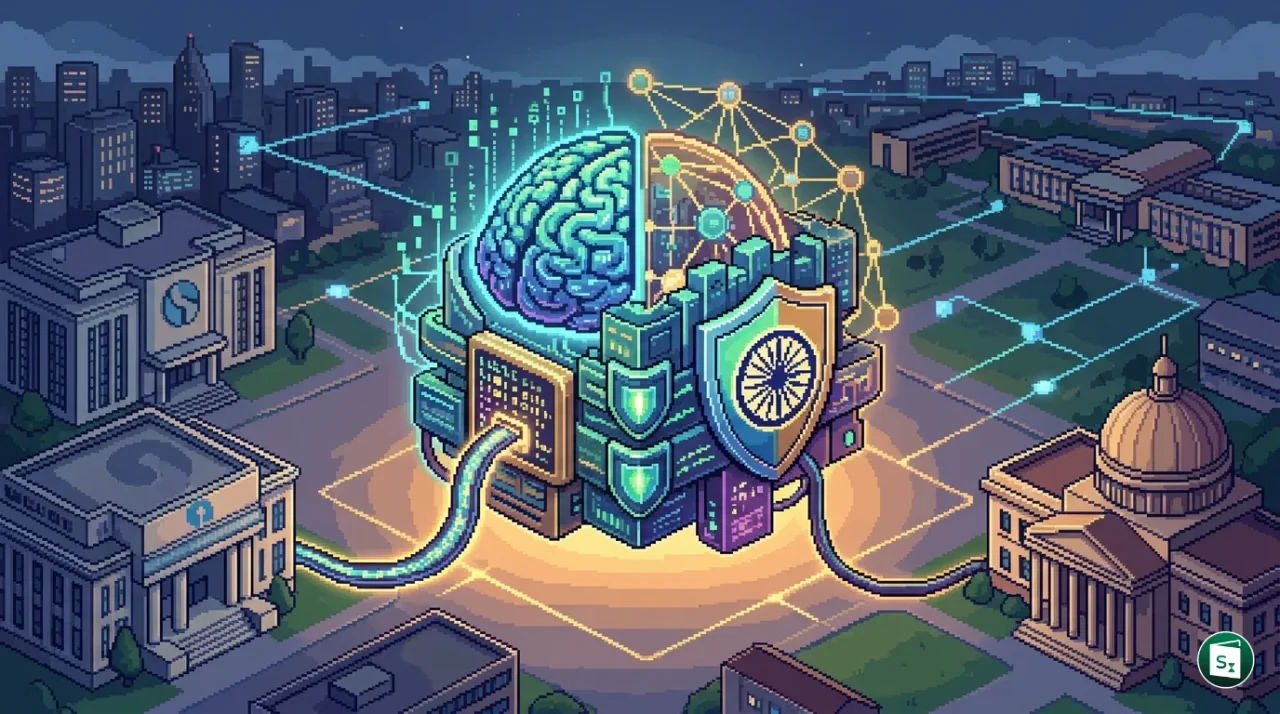
SBI Life Insurance has signed a Memorandum of Understanding with the Indian Institute of Technology Bombay to establish the Bharat AI and Cyber Innovation Hub for Insurance, a joint research centre dedicated to building indigenous deep-technology defence systems for the insurance sector. The hub marks a decisive move away from India’s dependence on imported cybersecurity frameworks towards homegrown capabilities that are designed, built, and owned in the country. Aligned with the government’s vision of Atmanirbhar Bharat, the partnership brings together IIT Bombay’s academic and scientific expertise with SBI Life’s domain knowledge in insurance and customer service.
The Two Institutions
IIT Bombay, established in 1958, was the second Indian Institute of Technology to be founded and the first with foreign assistance, funded by UNESCO through the Soviet Union. Located in Powai, Mumbai, the institute has 17 academic departments, over 30 research centres, and was designated an Institution of Eminence in 2018. It is recognised as a leader in engineering education and research, with its Department of Computer Science and Engineering driving major national AI initiatives such as BharatGen, the government-owned sovereign multilingual AI platform.
SBI Life Insurance Company Ltd, incorporated in October 2000 and registered with the Insurance Regulatory and Development Authority of India (IRDAI) in March 2001, is a joint venture between the State Bank of India and BNP Paribas Cardif. Headquartered in Mumbai, the company has a pan-India presence with over 1,230 offices, more than 29,000 employees, and a network of over 2.8 lakh agents. It is among India’s most trusted life insurers and a constituent of the NIFTY 50 index. The company’s Managing Director and CEO is Amit Jhingran.
Scope of the Bharat Innovation Hub
The Bharat AI and Cyber Innovation Hub for Insurance will function as a joint research and innovation centre dedicated to developing deep-technology solutions across multiple cutting-edge domains. The MoU was signed by Prof. S.V. Kulkarni, Dean of Research and Development at IIT Bombay, and Vishal Bhatia, Chief Information and Digital Officer of SBI Life Insurance, in the presence of senior officials from both institutions including Prof. Shireesh B. Kedare, Director of IIT Bombay, and Abhijit Gulanikar, President of Operations and IT at SBI Life.
Key Research Areas
The hub will focus on developing technologies in Artificial Intelligence, Cyber Security, Quantum Technologies, and Digital Risk Management, along with Insurance Technology (InsurTech). The collaboration spans cyber defence innovation to build indigenous security systems tailored to the insurance sector’s vulnerabilities, and AI-driven tools for fraud detection, risk assessment, and customer service. It also covers talent development to create a skilled pipeline in AI and cybersecurity, executive education for industry professionals, and innovation incubation to support startups and research projects in insurance technology.
The hub also aims to serve as a collaborative template for the broader financial services sector, demonstrating how a regulated financial organisation and a leading academic institution can work together effectively.
The Push Toward an AI-Native Insurer
The partnership marks a significant step in SBI Life’s transformation into an AI-native insurer. Rather than merely adopting off-the-shelf technology from foreign vendors, the company intends to actively research, develop, and commercialise technology solutions in-house. This approach allows the insurer to build scalable and resilient systems that meet both customer expectations and regulatory requirements in an increasingly digital environment.
Why Indigenous Cyber Defence Matters for Insurance
India’s insurance market is projected to grow at a compound annual growth rate of 6.9 per cent between 2026 and 2030, making it the strongest growing major insurance market globally, according to a Swiss Re report. This outpaces China, which is expected to grow at around 4 per cent, and the United States at 2 per cent during the same period.
As insurance penetration deepens and more policyholders come online, the volume of sensitive personal and financial data being processed by insurers is expanding rapidly. This growing data pool makes the sector an attractive target for cyberattacks. The IRDAI has recognised this risk and issued revised Information and Cyber Security Guidelines in April 2026, mandating stricter governance, enhanced board accountability, and quarterly risk reviews for regulated entities. The regulator has also required insurers to comply with the Digital Personal Data Protection (DPDP) Act, with penalties of up to ₹250 crore for serious data breaches.
| Factor | Implication for Insurance Sector |
|---|---|
| Market growth at 6.9% CAGR | More policies, more customer data to protect |
| IRDAI 2026 Cyber Security Guidelines | Stricter compliance, quarterly reviews, higher board accountability |
| DPDP Act compliance | Up to ₹250 crore penalty for serious data breaches |
| Rising cyber threat landscape | Need for real-time threat detection and response |
| Dependence on imported security frameworks | Vulnerability to supply chain disruptions and foreign control |
The Bharat Innovation Hub directly addresses this challenge by reducing dependence on imported cybersecurity solutions. Most Indian insurers currently rely on foreign security frameworks and software, creating potential vulnerabilities in supply chain integrity and limiting the ability to respond to threats specific to India’s digital ecosystem. By building homegrown capabilities, the hub seeks to create institutionally sovereign cyber defence systems that can be tailored to India’s regulatory environment and threat landscape.
Alignment with National Policy Goals
The Bharat Innovation Hub is rooted in the government’s Atmanirbhar Bharat vision, which emphasises self-reliance in critical technology sectors. It also supports the broader objective of Viksit Bharat 2047 by anchoring advanced technology capabilities within the country.
IIT Bombay has been at the forefront of India’s AI ambitions. The institute leads BharatGen, India’s first government-owned sovereign large language model and multilingual AI stack, which was unveiled at Bharat Innovates 2026 in Nice, France, in June 2026. BharatGen, led by Prof. Ganesh Ramakrishnan who also serves as Chair Professor at IIT Bombay’s Department of Computer Science and Engineering, has received funding of ₹1,058 crore through the IndiaAI Mission and ₹235 crore through the National Mission on Interdisciplinary Cyber-Physical Systems. The Bharat Innovation Hub can leverage this existing AI infrastructure to build sector-specific applications for insurance.
Furthermore, the IRDAI has set an ambitious target of Insurance for All by 2047, aiming to provide comprehensive insurance coverage to every citizen. Achieving this goal will require massive digital transformation, making robust cybersecurity infrastructure a prerequisite rather than an option. The hub’s work in building secure digital systems directly supports this regulatory vision.
Key Takeaways
- SBI Life Insurance signed an MoU with IIT Bombay to establish the Bharat AI and Cyber Innovation Hub for Insurance, a joint research centre for indigenous deep-tech defence systems.
- IIT Bombay, established in 1958, is the second IIT to be founded and was declared an Institution of Eminence in 2018. It is located in Powai, Mumbai.
- SBI Life Insurance, incorporated in 2000 and registered with IRDAI in 2001, is headquartered in Mumbai with Amit Jhingran as its Managing Director and CEO.
- The hub will focus on Artificial Intelligence, Cyber Security, Quantum Technologies, and Digital Risk Management for the insurance sector.
- India’s insurance market is projected to grow at 6.9 per cent CAGR between 2026 and 2030, the fastest among major insurance markets globally.
- The initiative aligns with Atmanirbhar Bharat, Viksit Bharat 2047, and the IndiaAI Mission, and supports IRDAI’s Insurance for All by 2047 target.