Nalanda University in Bihar has signed a Memorandum of Understanding with the Traditional Knowledge Digital Library (TKDL) Unit of the Council of Scientific and Industrial Research (CSIR) to work together on traditional knowledge, Intellectual Property Rights, people’s rights and cultural heritage. The collaboration covers Traditional Cultural Expressions such as music, dance, crafts and rituals alongside classical systems of medicine. It links an ancient centre of learning at Rajgir with India’s modern digital system for stopping biopiracy and protecting community knowledge.
What Does the Nalanda University and CSIR TKDL Partnership Cover?
The Nalanda University and CSIR-TKDL Unit agreement brings academic research and scientific documentation together on four connected themes. These are Traditional Knowledge (TK), Intellectual Property Rights (IPR), people’s rights and cultural heritage, including Traditional Cultural Expressions (TCEs). The focus is both protective and educational. Nalanda University will provide research depth in history, philosophy, ecology, languages and Buddhist studies, while the CSIR-TKDL Unit will provide scientific tools for documentation, classification and defensive protection of knowledge.
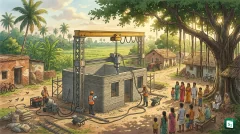
In practice, the partnership is expected to support joint research, documentation of traditional practices, training in IPR, workshops and academic exchange. A similar thrust was visible in the earlier collaboration between Nalanda University and the Council of Scientific and Industrial Research (CSIR) in July 2026 on sustainable development and technology outreach, which proposed a technology gallery and village level pilots around Rajgir. The new MoU with the TKDL Unit takes that science and society link further into law, ethics and culture. It treats community knowledge not as raw data to be collected, but as living heritage whose holders have rights over its use.
What Is the Traditional Knowledge Digital Library?
The Traditional Knowledge Digital Library (TKDL) is India’s prior art database of traditional medicine, jointly built by the Council of Scientific and Industrial Research (CSIR) and the Ministry of AYUSH in 2001. It converts formulations from Ayurveda, Unani, Siddha, Sowa Rigpa and Yoga practices into five international languages for patent examiners.
TKDL stands for Traditional Knowledge Digital Library. The TKDL Unit is based in New Delhi and functions under CSIR, which works under the Ministry of Science and Technology. The library was created after India had to fight costly legal battles abroad to cancel wrong patents, most famously the United States patent on the wound healing use of turmeric. That case showed a simple problem. India’s medical knowledge existed in Sanskrit, Hindi, Tamil, Urdu, Arabic, Persian and other languages and scripts, which foreign patent offices could not read or search.
TKDL solved the language and format barrier. Experts transcribed texts available in the public domain and structured them with information technology tools and a special classification system called the Traditional Knowledge Resource Classification (TKRC). The content is available in English, French, German, Spanish and Japanese. Patent offices can use it only after signing a non-disclosure access agreement with CSIR, and the knowledge itself remains free for traditional use. The purpose is limited and sharp. It stops the grant of wrong patents by giving examiners proof that the claimed invention already exists as prior art.
How TKDL Works Against Biopiracy
Biopiracy is the grant or claim of exclusive rights over biological resources or community knowledge without permission or benefit sharing. TKDL provides defensive protection. It does not itself grant patents. It helps patent examiners reject claims that copy Indian formulations, and it helps the CSIR-TKDL Unit file third party observations and pre-grant oppositions.
The scale is large. The database holds more than 5.19 lakh formulations and practices, including about 1,48,846 in Ayurveda, 2,65,496 in Unani, 89,403 in Siddha, 9,097 in Sowa Rigpa and 7,136 Yoga practices, along with surgical methods and dietary interventions. Since 2009, more than 375 patent applications worldwide have been refused, withdrawn, amended or set aside based on TKDL evidence. Access has been given to 18 patent offices worldwide, including recent agreements with Brazil in February 2026 and Australia in July 2026. The model was adopted by the World Intellectual Property Organization (WIPO) Intergovernmental Committee in 2003 as a standard for building traditional knowledge databases.
| Indian System in TKDL | Brief Meaning |
|---|---|
| Ayurveda | Science of life, India’s holistic system based on classical Sanskrit texts such as Charaka and Sushruta |
| Unani | System with Greek roots practised widely in India, based on humoral theory |
| Siddha | Early system rooted in ancient Tamil culture, practised mainly in South India |
| Sowa Rigpa | Himalayan medical tradition, popularly known as Amchi medicine |
| Yoga | Discipline for harmony of mind and body, documented here as practices and techniques |
What Is IPR and Why Is It Important?
Intellectual Property Rights (IPR) are legal rights that give creators and inventors exclusive control over their creations for a fixed period. They cover inventions, brands, designs and artistic works, and allow owners to stop copying, earn from licences and share knowledge through public disclosure.
IPR is the short form of Intellectual Property Rights. The question of why such rights matter has a direct answer for communities. Without documented proof and legal tools, outside firms can patent traditional remedies and folk practices and earn profits while the original holders get nothing. Defensive systems like TKDL, along with positive laws on biodiversity and farmers’ rights, help correct that imbalance.
India administers IPR through the Department for Promotion of Industry and Internal Trade (DPIIT) under the Ministry of Commerce and Industry. The guiding vision is set by the National IPR Policy of 2016, whose slogan is Creative India, Innovative India. The main laws include the Patents Act of 1970, the Copyright Act of 1957, the Trade Marks Act of 1999, the Designs Act of 2000, the Geographical Indications of Goods Act of 1999, the Semiconductor Integrated Circuits Layout Design Act of 2000 and the Protection of Plant Varieties and Farmers’ Rights Act of 2001.
| Type of IPR | What It Protects | Term in India |
|---|---|---|
| Patent | New, inventive and industrially useful invention | 20 years |
| Copyright | Literary, artistic, musical and audio-visual works | Author lifetime plus 60 years |
| Trademark | Brand name, logo and trade dress | 10 years, renewable |
| Industrial design | Ornamental appearance of a product | 10 years plus 5 years |
| Geographical Indication | Goods linked to a place, such as crafts and farm products | 10 years, renewable |
| Plant variety | New plant varieties, with rights for farmers | 6 to 10 years depending on crop |
| Semiconductor layout design | Layout of transistors and circuits | 10 years |
| Trade secret | Confidential business information | As long as secrecy is kept |
Traditional Knowledge, People’s Rights and Traditional Cultural Expressions
Traditional knowledge is the skill, practice and understanding that communities build over generations by living with nature and passing lessons by word, example and custom. It includes medicine, farming, food, water management, building methods and healing rituals. Traditional knowledge in India supports the health needs of a large share of the population and the livelihoods of millions who depend on forests, farms and artisanal work.
People’s rights in this context mean the rights of those holder communities to be recognised, consulted and fairly rewarded. Documentation can create a risk if outsiders treat records as free for commercial use. The MoU therefore pairs documentation with ethics. It stresses consent, attribution and benefit sharing, in line with debates at WIPO and with Indian laws on biodiversity and tribal rights. Students and researchers learn not only how to record knowledge, but when recording needs permission and how commercial use must respect customary rules.
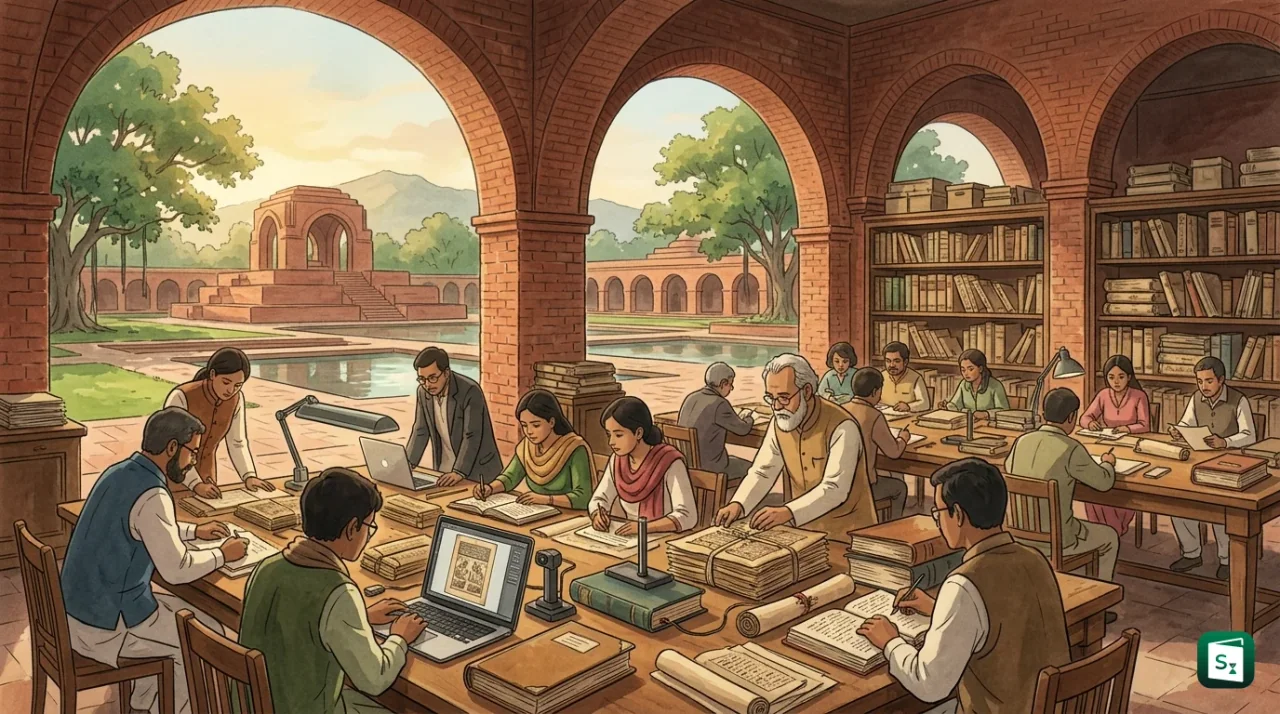
Traditional Cultural Expressions (TCEs), also called expressions of folklore, are the forms in which living culture is shown. The term covers stories, songs, dances, performances, ceremonies, designs, symbols, handicrafts, architectural forms and narratives. These expressions carry the identity of a community and move from one generation to the next. Nalanda University, with schools in historical studies, Buddhist philosophy, languages and literature, ecology and management, offers a natural home for such study. It can connect a folk song or craft pattern to its history, meaning and present livelihood value, while CSIR-TKDL brings methods for careful classification and protection.
Standard IPR fits TCEs only in part. A new painting based on folklore can get copyright, a performance can get related rights, and an authentic craft can use a trademark or geographical indication. Old community owned songs or motifs often fail tests of single authorship, fixed date and limited term. That gap is why WIPO’s Intergovernmental Committee on Intellectual Property and Genetic Resources, Traditional Knowledge and Folklore is negotiating a separate international instrument for TCEs and traditional knowledge. The Nalanda and TKDL work feeds directly into this unfinished global task.
Nalanda University in Which State? Location, History and Modern Revival
Nalanda University is located at Rajgir in Nalanda district of Bihar, about 95 kilometres southeast of Patna and close to the ruins of the ancient Mahavihara. The new campus is spread over 455 acres allotted by the Bihar government. The Prime Minister formally inaugurated the new campus in June 2024. The Vice Chancellor of Nalanda University (as of October 2026) is Sachin Chaturvedi.
Ancient Nalanda was founded in 427 CE by Gupta emperor Kumaragupta, and flourished for more than 800 years till the 12th century. Chinese travellers Xuan Zang, who studied there in the 7th century, and I-Tsing, who visited in 670 CE, recorded around 2,000 teachers and 10,000 students, with support from 200 villages. Subjects went far beyond Buddhist philosophy to include logic, medicine, astronomy, grammar and metaphysics. Scholars came from China, Korea, Japan, Tibet, Mongolia, Sri Lanka and Southeast Asia. Great names linked to the tradition include Nagarjuna, Aryabhatta and Dharmakirti. The library is said to have held lakhs of manuscripts. The Mahavihara declined after attacks, including the final destruction in 1193 by Bakhtiyar Khalji, and was rediscovered in the 19th century by Francis Buchanan-Hamilton and identified by Alexander Cunningham.
The revival began with a proposal by former President A. P. J. Abdul Kalam to the Bihar legislature in March 2006. The idea won backing from Singapore and from the leaders of the East Asia Summit in 2007 and 2009. Parliament passed the Nalanda University Act in 2010, and the first batch of students joined in September 2014. The university is an international institution supported by the Ministry of External Affairs, with students and faculty from many countries. Its schools now cover historical studies, ecology and environment, Buddhist studies and comparative religions, languages and literature, Hindu studies, management for sustainable development, international relations and data science. This breadth explains why a TKDL partnership fits. Nalanda University studies both texts and living traditions, from Pali and Sanskrit manuscripts to village ecology.
Council of Scientific and Industrial Research: Institutional Framework
CSIR is the short form of the Council of Scientific and Industrial Research. It is India’s largest publicly funded research and development body, constituted in 1942 and registered as an autonomous society. It works under the Department of Scientific and Industrial Research in the Ministry of Science and Technology and is headquartered in New Delhi. The Director General of CSIR (as of October 2026) also serves as Secretary of the department. CSIR runs a network of 37 national laboratories, 39 outreach centres and three special units across India, covering drugs, genomics, oceanography, mining, aerospace, food, leather, roads and instruments.
CSIR is often described as the pioneer of India’s intellectual property movement. Its laboratories file hundreds of patents each year and develop low cost technologies for water, waste, soil, health and rural industry. The CSIR-TKDL Unit at 14 Satsang Vihar Marg in New Delhi is one such unit. It was built with the Ministry of AYUSH, which handles Ayurveda, Yoga, Unani, Siddha, Sowa Rigpa and Homoeopathy. TKDL work now extends beyond medicine to documentation of traditional agriculture and metallurgy practices. For Nalanda University students, CSIR offers a bridge from classroom theory to field science, patent search method and technology outreach.
Indian Knowledge System Link and Cultural Heritage Significance
The Indian Knowledge System (IKS) is the organised effort to study, teach and apply India’s classical and folk knowledge in modern education. The IKS Division in the Ministry of Education, set up in 2020, funds research centres, internships, textbooks and workshops. CSIR-TKDL has already partnered with the division for national workshops on Traditional Knowledge, Intellectual Property and People’s Rights. The Nalanda University MoU extends this classroom to campus link. It can feed into courses, joint certificates, internships and documentation projects where students learn patent search, TKRC coding and community interview ethics side by side.
The cultural stake is high. India’s tangible and intangible heritage ranges from ancient monastic ruins, which earned Nalanda the UNESCO World Heritage tag in 2016, to living crafts, music and healing practices that still support rural incomes. Defensive protection keeps this heritage from being fenced off by wrong patents abroad. Positive recognition through geographical indications, community museums and fair licences helps artisans earn a living. By placing heritage study inside a university that hosts international students, the partnership also carries India’s position on biopiracy and fair use to a global audience.
The Way Forward
The value of the MoU will depend on clear outputs. Joint teams can publish a documented inventory of selected practices around Bihar with consent records, train a first cohort of students in patent prior art search, and build course modules on IPR for traditional knowledge holders. Links with the Indian Journal of Traditional Knowledge, AYUSH research councils and patent offices can turn student work into citable prior art that actually blocks biopiracy.
Two cautions will need attention. Documentation must not expose sensitive community details without safeguards, and academic calendars must allow long field stays that such work demands. If those rules are built in from the start, Nalanda University can become a model for how a humanities led university and a science led database protect the past while creating jobs, research careers and community pride in the present.
Key Takeaways
- Nalanda University in Bihar signed an MoU with the CSIR-TKDL Unit to collaborate on traditional knowledge, IPR, people’s rights and cultural heritage including TCEs.
- TKDL stands for the Traditional Knowledge Digital Library, jointly set up by CSIR and the Ministry of AYUSH in 2001 to block wrong patents on Indian medicine.
- TKDL holds more than 5.19 lakh formulations from Ayurveda, Unani, Siddha, Sowa Rigpa and Yoga, transcribed in English, French, German, Spanish and Japanese.
- More than 375 patent applications have been refused, withdrawn or amended on TKDL evidence, with access given to 18 patent offices worldwide.
- Ancient Nalanda was founded in 427 CE by Kumaragupta and destroyed in 1193 by Bakhtiyar Khalji, while modern Nalanda University was created by the Nalanda University Act of 2010 at Rajgir in Bihar.