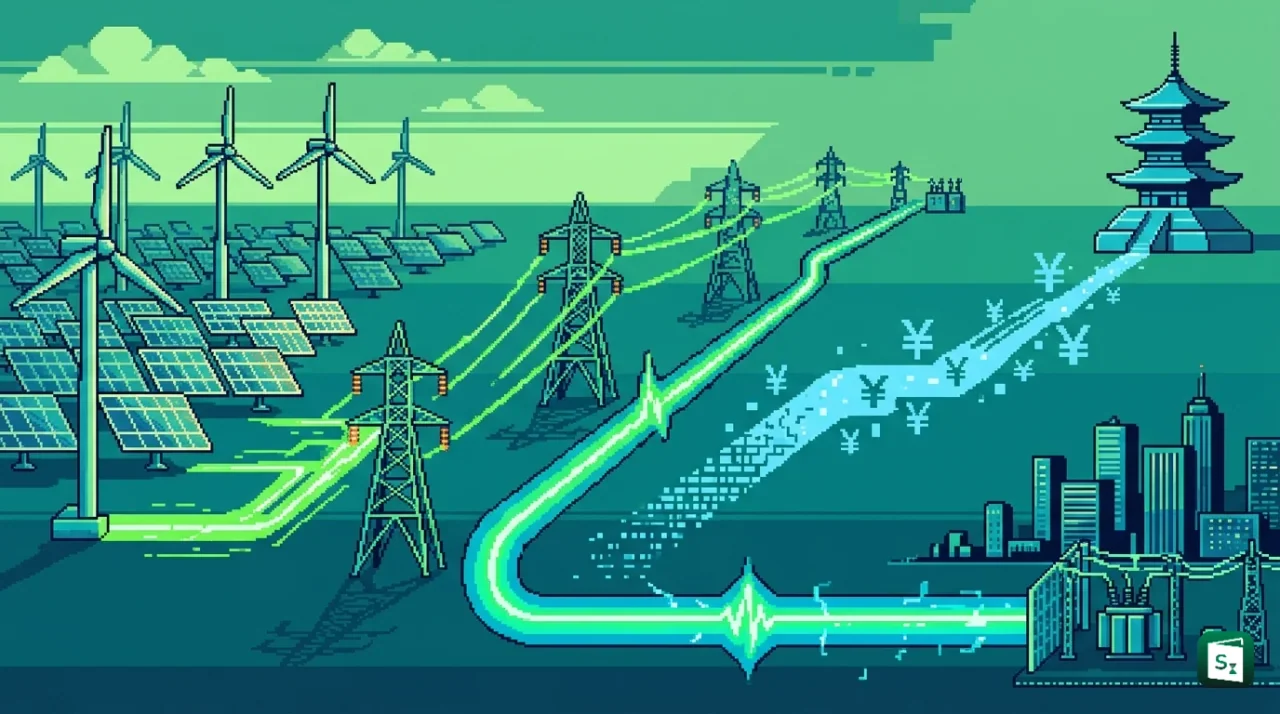
Power Grid Corporation of India Ltd (POWERGRID) has secured a green loan of ¥80 billion (approximately ₹4,700 crore) from the Japan Bank for International Cooperation (JBIC) to build the Khavda Nagpur High Voltage Direct Current (HVDC) transmission project. The loan agreement was signed on June 17, 2026, and will finance one of the world’s largest HVDC corridors, designed to carry renewable power from Gujarat to Maharashtra. This marks a significant step in India’s push to build transmission infrastructure capable of handling its ambitious 500 GW renewable energy target by 2030.
What Is the Khavda Nagpur HVDC Project?
The Khavda Nagpur HVDC project is a ±800 kV, 6,000 MW high voltage direct current transmission corridor spanning approximately 1,200 km across Gujarat and Maharashtra. It connects the Khavda Pooling Station 2 (KPS2) in Gujarat to a terminal station in Nagpur, Maharashtra. The project is designed to evacuate bulk renewable power generated at the Khavda Renewable Energy Park in the Rann of Kutch and feed it into the national grid at Nagpur.
This is the first-ever HVDC project to be awarded through the Tariff-Based Competitive Bidding (TBCB) route in India. POWERGRID acquired the project special purpose vehicle, Khavda V-A Power Transmission Limited, in November 2024 from REC Power Development and Consultancy Limited (RECPDCL). The project has an estimated cost of around ₹25,000 crore and is being executed by a consortium of Bharat Heavy Electricals Limited (BHEL) and Hitachi Energy India Limited, who were awarded the contract to design and build the terminal stations.
The HVDC link is part of a larger scheme to evacuate 8 GW of renewable energy under Phase V: Part A from the Khavda Renewable Energy Zone, a crucial element of India’s interstate transmission system plan.
The Khavda Renewable Energy Park: World’s Largest
The Khavda Renewable Energy Park, officially named the Gujarat Hybrid Renewable Energy Park, is being built on 72,600 hectares of barren wasteland in the Rann of Kutch, Gujarat. Located near the Vighakot village close to the India-Pakistan border, it is set to become the world’s largest renewable energy installation at a single location with a planned capacity of 30 GW. The park is larger than five times the size of Paris.
Prime Minister Narendra Modi laid the foundation stone on December 15, 2020. As of March 2026, the installed capacity has reached 9.4 GW. The project is spearheaded by Adani Green Energy Limited (AGEL), which is developing 30 GW (26 GW solar and 4 GW wind) at an estimated investment of ₹1.5 lakh crore. The park employs nearly 60 million solar modules and 770 advanced wind turbines, and once fully operational by 2029, it is expected to generate 87.4 billion units of clean electricity annually, enough to power around 18 million Indian homes.
The park combines solar and wind generation in a hybrid configuration, allowing daytime solar output to be complemented by strong winds that sweep the Rann of Kutch, ensuring more stable power production. This makes the need for robust evacuation infrastructure like the Khavda Nagpur HVDC link all the more critical.
Understanding the Green Loan
What Is a Green Loan?
A green loan is a form of financing where the proceeds are earmarked exclusively for projects that deliver clear environmental benefits. These loans follow the Green Loan Principles and require borrowers to meet environmental, social, and governance (ESG) criteria. POWERGRID’s green loan from JBIC is a reflection of the company’s commitment to sustainable development, with the company having set targets of net zero emissions by 2047, zero waste to landfill by 2030, and being net water positive by 2030.
JBIC and the GREEN Operations
The Japan Bank for International Cooperation (JBIC) is a policy-based financial institution wholly owned by the Government of Japan. Established on October 1, 1999, through the merger of the Japan Export Import Bank and the Overseas Economic Cooperation Fund, JBIC is headquartered in Tokyo. It promotes Japan’s economic cooperation by supporting overseas projects through loans, guarantees, and equity participation.
In April 2010, JBIC launched its GREEN operations (Global action for Reconciling Economic growth and ENvironmental preservation), a dedicated framework to finance projects that contribute to global environmental protection. Under this facility, JBIC has extended multiple loans to Indian entities, including Power Finance Corporation (₹120 billion credit line in 2024), NTPC Renewable Energy, NHPC, and SJVN.
Loan Structure
The loan agreement was signed on June 17, 2026. The total facility of ¥80 billion is structured as follows:
| Component | Amount | Lender |
|---|---|---|
| JBIC portion | ¥48 billion (~$296 million) | JBIC |
| Co-financed portion | ¥32 billion (~$197 million) | Sumitomo Mitsui Banking Corporation, Kansai Mirai Bank, Kiraboshi Bank, Joyo Bank |
JBIC is also providing a guarantee for the portion co-financed by the private financial institutions.
POWERR Asia and Strategic Context
The loan also aligns with Japan’s broader strategic initiative, the Partnership on Wide Energy and Resources Resilience Asia (POWERR Asia), launched in April 2026. POWERR Asia aims to strengthen the resilience of energy supply chains across Asian countries, particularly in light of disruptions caused by geopolitical tensions in the Middle East and the Strait of Hormuz. The Khavda Nagpur HVDC project supports India’s efforts to secure alternative energy sources and reduce its dependence on fossil fuel imports, which JBIC noted as a key rationale for the financing.
Why HVDC Technology Matters
High Voltage Direct Current (HVDC) technology is preferred over conventional Alternating Current (AC) transmission for specific applications, particularly long distance bulk power transfer.
Advantages of HVDC over AC
| Parameter | HVDC | AC |
|---|---|---|
| Losses | Around 3.5% per 1,000 km | Around 6.7% per 1,000 km |
| Conductor requirement | Two conductors (one bipole) | Three conductors (three phases) |
| Synchronization | Can connect unsynchronized grids | Requires frequency synchronization |
| Power flow control | Fully controllable | Limited by phase angle |
| Right of way | Narrower corridor | Wider corridor for same capacity |
HVDC in India
India has several operational HVDC links, including Rihand Dadri (1991), Talcher Kolar (2003), Ballia Bhiwadi (2010), and Mundra Mohindergarh (2012). The Khavda Nagpur link, at 6,000 MW capacity and ±800 kV voltage, will be among the highest capacity HVDC links in the country once completed by 2029. It uses Line Commutated Converter (LCC) technology, also known as HVDC Classic, which is well suited for bulk power transfer over long distances.
HVDC is particularly important for renewable energy integration because solar and wind farms are often located far from consumption centres. The technology allows efficient long distance transmission with minimal losses and provides the ability to rapidly control power flow, helping stabilise the grid against fluctuations inherent in renewable generation.
Significance for India’s Energy Transition
India has set ambitious climate targets under its Nationally Determined Contribution (NDC) to the Paris Agreement: achieving 500 GW of non-fossil fuel energy capacity by 2030 and net zero emissions by 2070. The government also aims for 50% of cumulative electric power generation from non-fossil fuel sources by 2030.
The Khavda Nagpur HVDC project directly supports these goals. The Khavda Renewable Energy Park alone will contribute 30 GW to the national target, but that power must reach load centres in Maharashtra and beyond. The HVDC corridor is designed to transmit this clean electricity with minimal losses over 1,200 km, effectively bridging the gap between the remote wind and solar rich wastelands of Kutch and the industrial and residential demand centres of central and western India.
POWERGRID, as the country’s principal transmission utility, operates 185,750 circuit km of transmission lines and 291 substations with a transformation capacity of 630,516 MVA as of May 2026. It transmits about 50% of India’s total power generation. The company’s transmission system availability has remained consistently above 99.5%, making it one of the most reliable grid operators globally. Its Maharatna status, conferred in October 2019, reflects its strategic importance to India’s infrastructure development.
The loan also strengthens India-Japan economic cooperation. JBIC has been a consistent financier of India’s power sector, and the POWERR Asia initiative signals Japan’s intent to deepen energy security partnerships across Asia, with India as a key partner in the Quad and the Free and Open Indo-Pacific (FOIP) vision.
Key Takeaways
- POWERGRID secured a ¥80 billion (~₹4,700 crore) green loan from JBIC for the Khavda Nagpur HVDC transmission project, with the agreement signed on June 17, 2026.
- The Khavda Nagpur HVDC project is a ±800 kV, 6,000 MW bipole transmission line spanning 1,200 km, linking Gujarat’s Khavda Renewable Energy Park to Nagpur, Maharashtra.
- This is the first HVDC project in India tendered through the Tariff-Based Competitive Bidding (TBCB) route, with an estimated project cost of ₹25,000 crore.
- The Khavda Renewable Energy Park (Gujarat Hybrid Renewable Energy Park) is the world’s largest single site renewable energy installation, targeting 30 GW capacity on 72,600 hectares in the Rann of Kutch.
- JBIC, established in 1999 and headquartered in Tokyo, extended the loan under its GREEN operations framework launched in 2010, with ¥48 billion from JBIC and ¥32 billion co-financed by Japanese private banks.
- POWERGRID, a Maharatna PSU under the Ministry of Power incorporated in 1989 and headquartered in Gurugram, operates 185,750 circuit km of transmission lines across India.