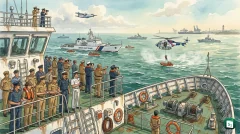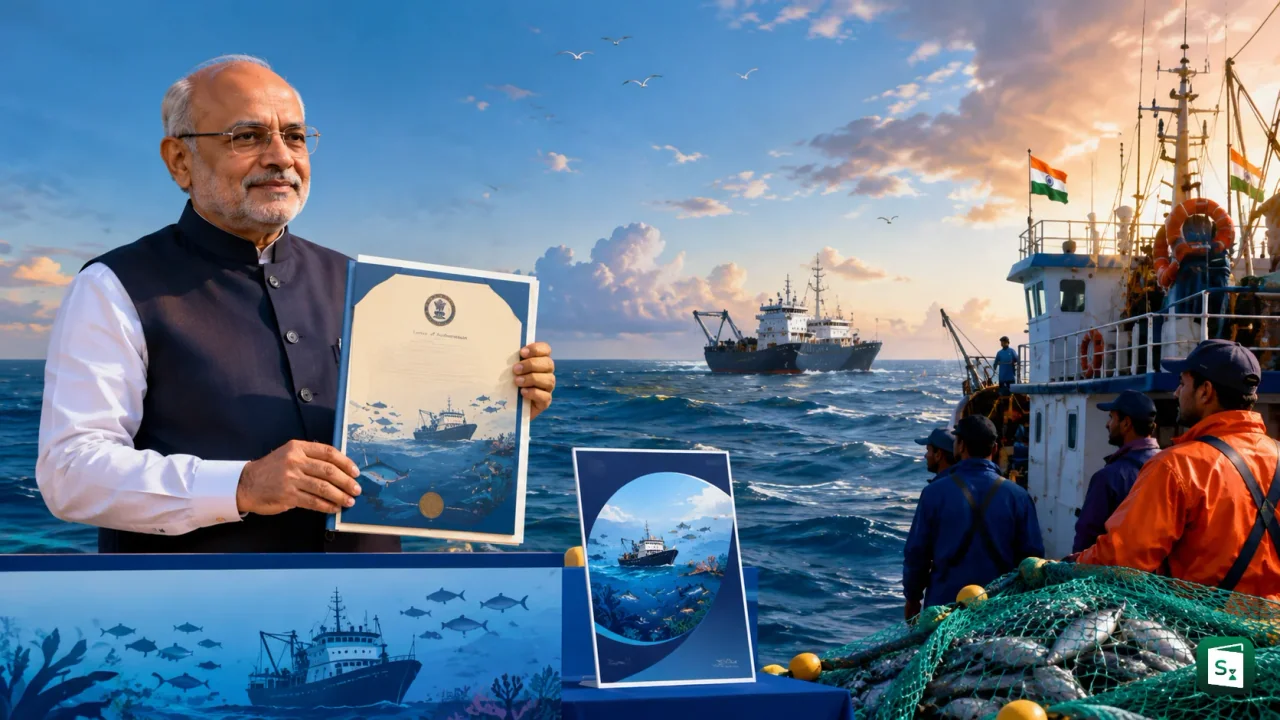
Vice President C.P. Radhakrishnan launched the national Letter of Authorisation (LoA) framework for Sustainable Harnessing of Fisheries in the High Seas on 9 July 2026 in Bhubaneswar, Odisha. He also unveiled the Odisha Deep Sea Fishing Mission Document (2026-2036), a decade-long initiative to transform the state into a leading marine export hub. Together, these two launches mark India’s first comprehensive regulatory framework for high-seas fishing, opening vast untapped marine resources to Indian fishermen while aligning with the country’s Blue Economy vision.
Why a Framework for High Seas Fishing Was Needed
India is endowed with one of the world’s largest marine territories. Its coastline stretches over 11,099 km and its Exclusive Economic Zone (EEZ) covers nearly 2.4 million sq km, including the waters around the Andaman and Nicobar Islands and Lakshadweep, which together account for nearly 49% of India’s EEZ area. Despite this enormous maritime wealth, Indian fishing activity has traditionally remained confined to waters within 40 to 50 nautical miles from the coast.
The vast EEZ extending beyond this range, and the high seas beyond India’s national jurisdiction, have remained largely underutilised. Scientific assessments have confirmed substantial potential for high-value oceanic species such as tuna, billfish, oceanic squid, and other pelagic resources in these deeper waters. The Union Budget 2025-26 recognised this gap and announced the creation of an enabling framework for sustainable harnessing of fisheries from the EEZ and high seas.
Following this announcement, the government notified the EEZ Rules, 2025 on 4 November 2025 and the Guidelines for Sustainable Harnessing of Fisheries in the High Seas by Indian-Flagged Fishing Vessels, 2025. An Access Pass system for fishing within the EEZ was launched from Veraval, Gujarat in February 2026, under which nearly 5,000 fishermen have already received passes. The LoA framework is the next logical step, extending regulated fishing access beyond the EEZ into the high seas.
What Is the Letter of Authorisation (LoA)?
The Letter of Authorisation (LoA) is a vessel-specific regulatory permit that allows eligible Indian-flagged fishing vessels to undertake commercial fishing and fishing-related activities in the high seas, which are areas beyond any country’s national jurisdiction. It is a mandatory requirement under the High Seas Fisheries Guidelines, 2025 and is designed to bring transparency, traceability, and accountability to India’s high-seas fishing operations.
The Department of Fisheries, under the Ministry of Fisheries, Animal Husbandry and Dairying, is the issuing authority for the LoA. The framework was developed to implement the Union Budget 2025-26 announcement and builds on the constitutional powers of the central government under Article 73(1)(b) of the Constitution and Entry 57 of List I of the Seventh Schedule, which pertain to fishing and fisheries beyond territorial waters.
During the launch event, LoAs were distributed to fisheries cooperative societies including National Cooperative Exports Limited (NCEL) and fishing vessel owners. Recipients included societies from Gujarat, Goa, Odisha, Kerala, Karnataka, and Maharashtra, reflecting the national scope of the initiative. Approximately 1,000 fish farmers and fishers, including women, attended the event, along with officials from states and union territories.
How the LoA System Works
The LoA is fully integrated with the ReALCraft Fishing Vessel Registration Portal, the national online platform for registration and licensing of fishing craft developed by the Department of Fisheries. The entire application, issuance, and renewal process is digital, end-to-end online, and time-bound, with real-time application tracking. The LoA is vessel-specific and non-transferable, issued and renewed at minimal cost with no procedural constraints.
Authorised vessels must comply with conservation and management measures prescribed by relevant Regional Fisheries Management Organisations (RFMOs), which are international bodies that regulate fishing on the high seas. These measures include catch limits, gear regulations, bycatch mitigation protocols, Fish Aggregating Device (FAD) management, voyage reporting, and other requirements for responsible and sustainable fishing.
| Feature | Description |
|---|---|
| Issuing Authority | Department of Fisheries, Ministry of Fisheries, Animal Husbandry and Dairying |
| Digital Platform | ReALCraft Fishing Vessel Registration Portal |
| Validity | Vessel-specific, non-transferable |
| Cost | Minimal, with no procedural constraints |
| Compliance | Mandatory adherence to RFMO conservation measures |
| Monitoring | Real-time tracking and traceability |
The framework gives priority to Fisheries Cooperatives and Fish Farmer Producer Organisations (FFPOs), enabling collective participation in high-seas fisheries. This ensures that smaller fishers and traditional fishing communities can access high-value offshore resources that would otherwise require significant capital investment. The Department of Fisheries has also constituted a Joint Working Group (JWG) with the Ministry of Cooperation to further strengthen fisheries cooperatives in deep-sea fishing and its entire value chain.
Odisha Deep Sea Fishing Mission (2026-2036)
Alongside the national LoA framework, Vice President Radhakrishnan unveiled the Odisha Deep Sea Fishing Mission Document, a flagship Blue Economy initiative of the Odisha government. The mission was approved by the Odisha Cabinet on 1 July 2026 with an outlay of ₹2,295.45 crore and a 10-year implementation period from 2026 to 2036.
Odisha, located on the eastern coast along the Bay of Bengal, has a coastline of about 575 km and a marine fisher population of over 5 lakh. The state produced 12.70 lakh metric tonnes (MT) of fish in 2025-26, supporting livelihoods of over 16 lakh fishers and fish farmers. Its fisheries resources encompass approximately 7.12 lakh hectares of freshwater resources, 4.18 lakh hectares of brackish water resources, and a 24,000 sq km continental shelf area. During 2025-26, Odisha exported 1,00,897 MT of seafood valued at ₹5,428.67 crore.
The mission aims to transition Odisha from near-shore fishing to a modern, technology-driven marine export hub. It targets generating an additional 2 lakh MT of marine fish production annually, creating 50,000 new employment opportunities, increasing marine exports to approximately ₹25,000 crore annually by 2036, and substantially enhancing the income of marine fishers.
The mission envisages investments across the entire marine fisheries value chain, including modern deep-sea fishing vessels, upgradation of existing mechanised vessels, deployment of mother vessels, modernisation of fishing harbours and fish landing centres, establishment of seafood parks, integrated cold-chain infrastructure, and seafood processing and value-addition hubs. A dedicated Blue Economy Hub will be established as the mission’s knowledge, innovation, and coordination centre.
The mission will be implemented in a phased manner with convergence of central government schemes, state government support, beneficiary participation, institutional finance, and public-private partnerships under the administrative control of the Fisheries and Animal Resources Development Department of Odisha. It is aligned with Odisha Vision 2036, Viksit Bharat 2047, the National Blue Economy framework, and Sustainable Development Goal 14 (Life Below Water).
Strengthening India’s Blue Economy
The LoA framework and the Odisha Deep Sea Fishing Mission together represent a significant step in India’s transition from coastal fisheries management to regulated offshore and high-seas fisheries. This shift is central to India’s Blue Economy strategy, which seeks to harness marine resources sustainably for economic growth, livelihood security, and environmental preservation.
India’s fisheries sector has already demonstrated remarkable growth. From 96 lakh tonnes in 2013-14, fish production more than doubled to 195 lakh tonnes in 2024-25, driven largely by inland aquaculture. The government has invested over ₹39,000 crore through flagship programmes such as the Pradhan Mantri Matsya Sampada Yojana (PMMSY) , launched in September 2020 with an initial investment of ₹20,050 crore. These investments have resulted in record seafood exports of ₹73,891 crore in 2025-26 despite global trade disruptions.
The sector supports the livelihoods of nearly 3 crore fishers and fish farmers across the country. Beyond fishing itself, the high-seas initiative is expected to create employment across the entire value chain, including fish processing, cold-chain infrastructure, transportation, packaging, logistics, and export services. The Union Budget 2026-27 further strengthened the sector by making fish catch by Indian vessels in the EEZ and high seas duty-free and treating foreign port landings as exports.
The framework also positions India to better engage with Regional Fisheries Management Organisations and meet international sustainability standards, which are increasingly important for accessing premium global seafood markets. This alignment with global best practices strengthens India’s credentials as a responsible fishing nation while opening doors to higher-value export destinations.
Key Takeaways
- Vice President C.P. Radhakrishnan launched the national Letter of Authorisation (LoA) for Sustainable Harnessing of Fisheries in the High Seas on 9 July 2026 in Bhubaneswar, Odisha.
- The LoA is a vessel-specific, non-transferable permit integrated with the ReALCraft Fishing Vessel Registration Portal, enabling digital, end-to-end online applications and real-time monitoring.
- The framework is established under the High Seas Fisheries Guidelines, 2025 and the EEZ Rules, 2025, which were notified following the Union Budget 2025-26 announcement.
- The Odisha Deep Sea Fishing Mission (2026-2036) was unveiled with an outlay of ₹2,295.45 crore, aiming to generate 50,000 jobs and increase marine exports to ₹25,000 crore annually by 2036.
- India is the world’s second-largest fish producer, with fish production doubling to 195 lakh tonnes in 2024-25 and seafood exports reaching ₹73,891 crore in 2025-26.
- The Department of Fisheries, under the Ministry of Fisheries, Animal Husbandry and Dairying, is the nodal agency for implementing the LoA framework, which gives priority to Fisheries Cooperatives and Fish Farmer Producer Organisations (FFPOs).