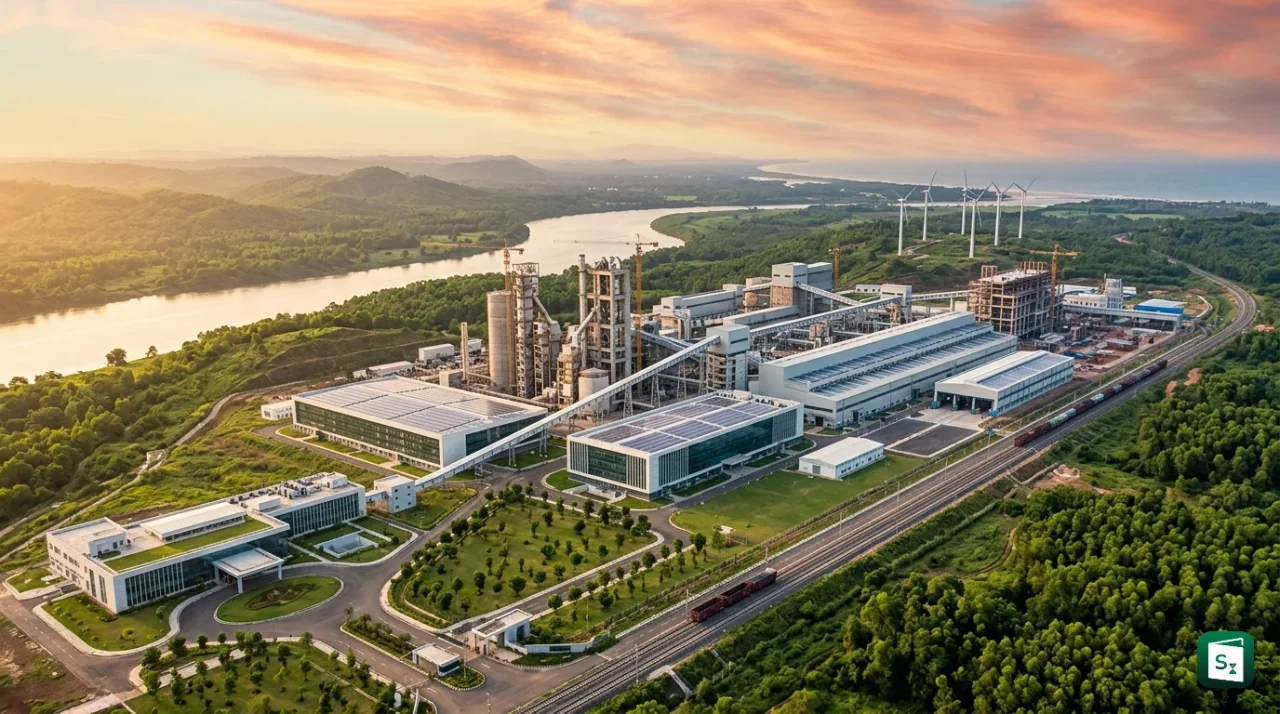
Adani Enterprises Ltd (AEL) and International Resources Holding (IRH), a subsidiary of Abu Dhabi’s International Holding Company (IHC), signed a memorandum of understanding with the Odisha government on July 2, 2026 to build an integrated greenfield aluminium project worth $11.5 billion (₹1.08 lakh crore). The project, structured as a 50:50 joint venture, is set to become Odisha’s largest foreign direct investment proposal and India’s largest FDI in the metallurgy sector. With a projected employment of 53,500 jobs across construction and operations, the investment marks the Adani Group’s entry into aluminium manufacturing while deepening the strategic India-UAE economic partnership.
The Joint Venture and Investment Structure
The MoU was signed in Bhubaneswar in the presence of Odisha Chief Minister Mohan Charan Majhi and Industries Minister Sampad Chandra Swain. AEL and IRH will establish a 50:50 joint venture to execute the project, with each partner contributing equally to the equity component. According to Karan Adani, Managing Director of Adani Ports and Special Economic Zone, the total investment will be financed through a 70:30 debt-to-equity ratio, with Adani’s share of equity coming from AEL’s internal accruals.
The investment will be deployed in two phases. Phase I carries an estimated outlay of ₹66,000 crore, while Phase II accounts for the remaining ₹44,000 crore. State officials have described the proposal as Odisha’s largest-ever FDI and the single largest foreign investment in India’s metals and mining sector.
IRH is the natural resources investment platform within IHC, operating through 2PointZero, a holding unit established by IHC in 2024 with assets exceeding $27 billion. IHC itself is one of the world’s largest investment firms, with a market capitalisation of $233 billion and a portfolio spanning over 1,300 subsidiaries across technology, infrastructure, financial services, and consumer sectors. Headquartered in Abu Dhabi and founded in 1998, IHC is chaired by Sheikh Tahnoon bin Zayed al-Nahyan, who also serves as the UAE’s National Security Advisor.
What the Integrated Aluminium Complex Includes
The proposed complex is designed to cover the full aluminium value chain from raw material processing to finished products. The core components are:
| Component | Capacity | Purpose |
|---|---|---|
| Alumina Refinery | 4 MMTPA | Converts bauxite into alumina (aluminium oxide) |
| Aluminium Smelter | 2 MMTPA | Electrolytically reduces alumina into primary aluminium |
| Captive Power Plant | 4,000 MW | Supplies the massive electricity required for smelting |
| Downstream Manufacturing Park | 1 MMTPA | Produces finished aluminium products for various industries |
A 4 million metric tonnes per annum (MMTPA) alumina refinery will be located in Rayagada district across approximately 3,200 acres, closer to the bauxite mines that will supply the raw material. The 2 MMTPA aluminium smelter and downstream park will come up in Sundargarh district across 4,100 acres. The 4,000 MW captive power plant is essential because aluminium smelting is among the most energy-intensive industrial processes in the world.
Bauxite, the raw ore from which aluminium is derived, will be sourced through a long-term linkage with the state-owned Odisha Mining Corporation (OMC) from its Sasubahumali mines, supplemented by Adani’s own bauxite blocks at Kutrumali and Bahalda in Odisha. The downstream manufacturing park is expected to attract industries producing components for transportation, construction, power transmission, packaging, renewable energy, and advanced engineering, thereby supporting the growth of MSMEs across the state.
Why Odisha? The Strategic Advantage
Odisha’s centrality to this project is no coincidence. The state holds more than 50% of India’s total bauxite reserves, the primary raw material for aluminium production, and accounts for approximately 54% of the country’s aluminium output. It is already home to the integrated operations of India’s three major aluminium producers: NALCO (a central public sector enterprise), Hindalco (Aditya Birla Group), and Vedanta Ltd.
The state has emerged as the cornerstone of India’s aluminium industry thanks to its rich mineral endowment, established industrial infrastructure, and proximity to major ports such as Paradip and Dhamra. Notably, Dhamra Port is operated by Adani Ports and SEZ and handled a record 5 million metric tonnes of cargo in March 2026 alone. This ready export and import infrastructure gives the project significant logistical advantages.
Odisha also offers a stable power supply framework, which is critical given that electricity accounts for roughly 30-40% of aluminium production costs. The state government, under Chief Minister Mohan Charan Majhi, has committed to providing time-bound clearances for land, power, water, logistics, and statutory approvals.
India’s Aluminium Demand Supply Gap
The project must be understood against the backdrop of a widening gap between India’s aluminium production and consumption. India produced approximately 4.2 million tonnes of primary aluminium in FY2024-25 against a domestic consumption of nearly 5.5 million tonnes, forcing the country to rely on imports to bridge the deficit. Per capita aluminium consumption in India stands at just 2.2 kg, far below the global average of 11 kg and the developed world average of 22-25 kg.
| Metric | Current | Projected |
|---|---|---|
| Annual aluminium consumption | ~5.5 MT | ~8.5 MT by 2030 |
| Annual primary production | ~4.2 MT | ~6-6.5 MT (with new capacities) |
| Per capita consumption | 2.2 kg | Expected to rise with infrastructure push |
| Import dependence | Significant value-added product imports | Target: reduce through domestic capacity |
The government has set a target of tripling domestic aluminium production to meet a projected demand of 28 million tonnes by 2047 as part of the Viksit Bharat 2047 vision. This Odisha project, with its 2 MTPA smelting capacity, could boost India’s total aluminium capacity by nearly 50%, making a major dent in the import requirement.
Adani Group’s Metals Strategy
The Odisha aluminium project represents the Adani Group’s second major foray into metals after copper. Kutch Copper Ltd, a subsidiary of AEL, commissioned the first phase of its $1.2 billion copper smelter at Mundra, Gujarat in March 2024. That facility, with an initial capacity of 0.5 million tonnes per annum, is being scaled to 1 million tonnes and positions Adani as a significant player in India’s copper sector. The aluminium venture follows the same playbook: backward integration into critical metals where India faces a supply deficit.
The move also brings the Adani Group into direct competition with India’s two largest aluminium producers. Vedanta Ltd operates a 1.7 million tonne smelter at Jharsuguda, Odisha and has announced a ₹1 lakh crore plan for an alumina refinery and green aluminium plant in the same state. Hindalco, the metals flagship of the Aditya Birla Group, operates smelters at Hirakud (Odisha) and Mahan (Madhya Pradesh) and recently announced a ₹21,000 crore expansion of its Aditya Aluminium complex in Sambalpur, Odisha, including battery-grade aluminium foil capacity for EVs. The Adani-IHC project, with its integrated refinery-to-downstream model, will compete directly with both incumbents.
Adani’s existing infrastructure assets provide significant competitive advantages. The Group’s Dhamra Port, located just 215 km from Bhubaneswar, offers deep-draft berths capable of handling super cape-size vessels, enabling efficient import of raw materials and export of finished products. The Group’s growing renewable energy portfolio through Adani Green Energy can also supply cleaner power to the smelter, aligning with the global shift toward low-carbon aluminium.
IHC and the Deeper India-UAE Partnership
The Adani-IHC partnership extends well beyond this single project. The two groups have built strong strategic ties over recent years, rooted in IHC’s emergence as a key backer of the Adani Group after the Hindenburg-induced market turmoil in early 2023. IHC later increased its stake in AEL to above 5%, with investments valued at over $1.7 billion across Adani Enterprises, Adani Green Energy, and Adani Energy Solutions.
In early 2026, IHC’s subsidiary ePointZero entered into a joint venture with Adani Green Energy to develop renewable energy projects across India. The aluminium JV through IRH now deepens this collaboration into the natural resources domain. Syed Basar Shueb, CEO of IHC, described the project as part of the Group’s previously announced multi-billion-dollar investment strategy for India, reinforcing its commitment across strategically important sectors.
IRH itself has been on a global expansion spree, acquiring a 51% stake in Zambia’s Mopani Copper Mines for $1.1 billion in 2024 and a 56% stake in Congo’s Alphamin Resources for $367 million in 2025. The Odisha project marks IRH’s first major investment in India’s metals sector, giving it a foothold in one of the world’s fastest-growing aluminium markets.
Phased Execution and Timeline
The project will follow a multi-stage execution path over several years. Karan Adani has indicated that site finalisation and regulatory approvals will take approximately 12 to 18 months from the signing of the MoU. Following clearances, the construction and commissioning of the complex is expected to require an additional 3.5 to 4 years, meaning the first batch of aluminium is unlikely before 2031.
| Milestone | Expected Timeline |
|---|---|
| MoU signing | July 2, 2026 |
| Site finalisation and statutory approvals | Next 12-18 months |
| Phase I construction and commissioning | ~3.5-4 years after approvals |
| First aluminium output | Approx. 4.5-5 years from MoU |
| Phase II deployment | Sequential, post Phase I |
The project is expected to generate around 35,000 jobs during construction and 18,500 permanent jobs during operations across mining, refining, smelting, downstream manufacturing, logistics, engineering, and ancillary services. The Odisha government has committed to facilitating land acquisition, infrastructure connectivity, and a skilled workforce through its existing industrial promotion framework under IPICOL (Industrial Promotion and Investment Corporation of Odisha Limited).
Key Takeaways
- Adani Enterprises Ltd (AEL) and International Resources Holding (IRH), part of Abu Dhabi’s IHC Group, signed an MoU on July 2, 2026 for an integrated greenfield aluminium project in Odisha valued at $11.5 billion (₹1.08 lakh crore).
- The project is structured as a 50:50 joint venture and is Odisha’s largest FDI proposal as well as India’s largest foreign investment in the metallurgy sector.
- The complex will include a 4 MMTPA alumina refinery (Rayagada), a 2 MMTPA aluminium smelter (Sundargarh), a 4,000 MW captive power plant, and a 1 MMTPA downstream manufacturing park.
- The investment will be executed in two phases: ₹66,000 crore in Phase I and ₹44,000 crore in Phase II.
- The project is expected to generate 53,500 jobs (35,000 during construction and 18,500 during operations).
- India’s aluminium consumption stands at 5.5 million tonnes annually against domestic production of 4.2 million tonnes, with demand projected to reach 8.5 million tonnes by 2030.
- Odisha accounts for over 50% of India’s bauxite reserves and approximately 54% of its aluminium output.
- IHC, chaired by Sheikh Tahnoon bin Zayed al-Nahyan, is headquartered in Abu Dhabi, was founded in 1998, and has a market capitalisation of $233 billion.