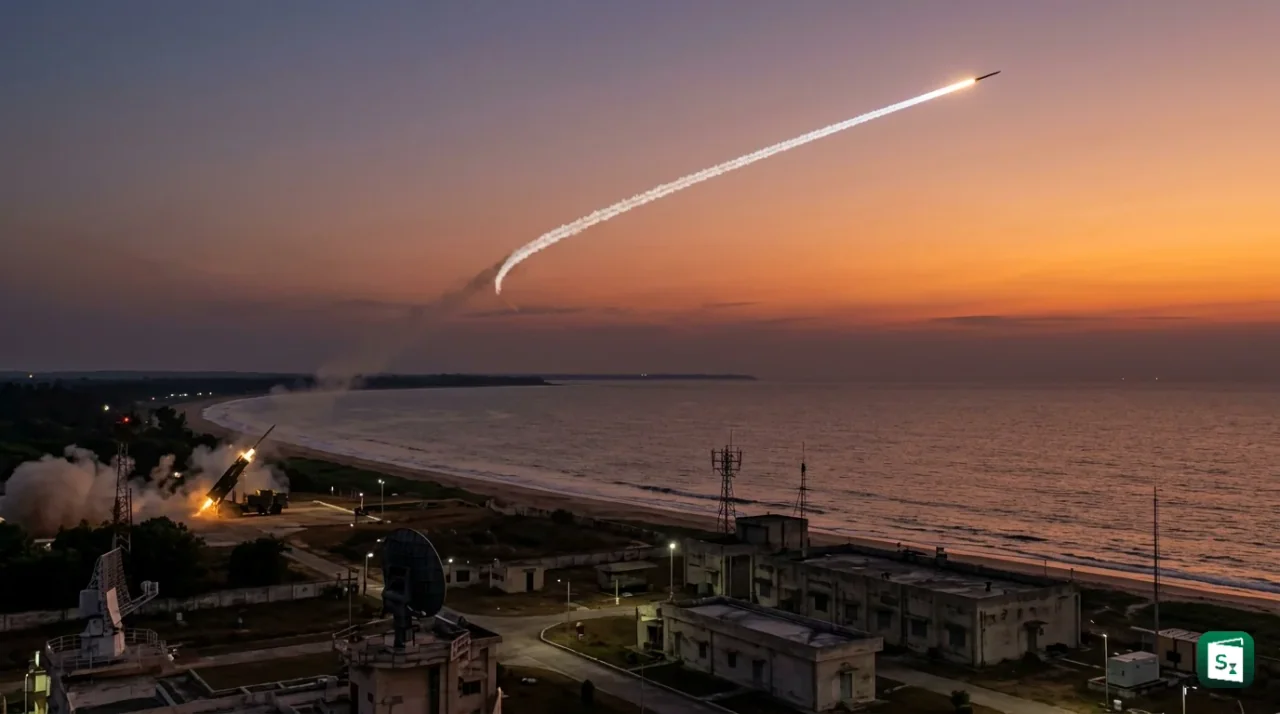
India’s Defence Research and Development Organisation (DRDO) successfully flight-tested the Pinaka Long Range Guided Rocket (LRGR) at the Integrated Test Range (ITR) in Chandipur, Odisha, validating the weapon at a user-defined minimum range of 60 km. The rocket executed all planned in-flight manoeuvres and struck its target with textbook precision, marking a crucial step towards full operational clearance for the system. This test complements the earlier maiden trial of the LRGR-120 variant in December 2025, which demonstrated the rocket’s maximum strike range of 120 km.
The Latest Flight Test
The Ministry of Defence confirmed that the rocket was launched from an in-service Pinaka launcher, proving that the existing platform can fire multiple Pinaka variants across different ranges without requiring modifications. The LRGR followed its predicted trajectory throughout the flight, and all deployed range instruments tracked the rocket from launch to impact.
The trial was coordinated by the ITR and the Proof and Experimental Establishment (PXE), while four DRDO laboratories contributed to the effort. The Armament Research and Development Establishment (ARDE) in Pune led the design and development in association with the High Energy Materials Research Laboratory (HEMRL). Hyderabad-based Defence Research and Development Laboratory (DRDL) and Research Centre Imarat (RCI) provided crucial engineering support.
Defence Minister Rajnath Singh congratulated DRDO, the Indian Army, and industry partners on the successful test. Defence Secretary and DRDO Chairman Rajesh Kumar Singh closely monitored the trial and praised the engineering teams for the flawless execution.
The Pinaka Multi-Barrel Rocket Launcher System
The Pinaka system is an indigenous multi-barrel rocket launcher (MBRL) developed by DRDO as a replacement for the older Russian-origin BM-21 Grad and Smerch systems in service with the Indian Army. Named after the bow of Lord Shiva, the system is mounted on an 8x8 Tatra truck chassis and can fire a salvo of 12 rockets in just 44 seconds. Its rapid response time and high pointing accuracy allow it to engage time-sensitive targets with devastating effect.
The launcher carries two pods mounted side by side, each containing six launch tubes arranged in a 2x3 matrix. The system is stabilised by four hydraulically actuated outriggers during firing and can be operated through a Fire Control Computer, a Launcher Computer, or manually. An Automatic Gun Alignment and Pointing System handles targeting, giving the platform a shoot-and-scoot capability that enhances survivability on the battlefield.
Pinaka first saw combat during the Kargil War of 1999, where it played a decisive role in neutralising enemy positions at high altitudes. Its effectiveness alongside the Bofors artillery gun cemented its place in India’s artillery arsenal. Since then, the system has been inducted in large numbers and has become one of the country’s most successful indigenous weapon programmes.
How Pinaka Evolved: From Mk-I to LRGR
The Pinaka rocket system has undergone several upgrades over the years, with each new variant delivering greater range and accuracy. The original Pinaka Mk-I, which entered service in the early 2000s, had a maximum range of around 40 km and carried an unguided 100 kg warhead. The Mk-I Enhanced variant extended this to 50 km with improved aerodynamics.
The Guided Pinaka, also referred to as the Mk-II, was the first variant to incorporate a navigation, guidance, and control kit. It achieved a range of 75 to 80 km with an accuracy of 60 to 80 metres Circular Error Probable (CEP) at all ranges, using an Inertial Navigation System (INS) combined with GPS and India’s own NavIC satellite navigation. This variant was inducted into the Army in late 2024.
The LRGR, or Mark-III, represents a generational leap. It uses a larger 300 mm calibre compared to the 214 mm of earlier variants, carries a 110 kg warhead, and reaches a maximum range of 120 km. Its guidance system combines inertial navigation with mid-course updates and terminal correction, delivering a CEP of just 2 to 3 metres as confirmed by ARDE officials.
| Variant | Calibre | Range | Guidance | Warhead |
|---|---|---|---|---|
| Pinaka Mk-I | 214 mm | 40 km | Unguided | 100 kg |
| Pinaka Mk-I Enhanced | 214 mm | 50 km | Aerodynamic fins | 100 kg |
| Guided Pinaka (Mk-II) | 214 mm | 75-80 km | INS + GPS / NavIC | 100 kg |
| LRGR (Mk-III) | 300 mm | 60-120 km | INS + mid-course + terminal | 110 kg |
Why Guided Precision Matters for the Army
The LRGR fills a critical gap in India’s artillery hierarchy. Traditional unguided rocket systems like the Pinaka Mk-I are area saturation weapons that cover large grids with fire but lack the precision to engage specific targets. At the other end, tactical ballistic missiles like Pralay or cruise missiles like BrahMos deliver pinpoint strikes but cost significantly more per shot. The LRGR sits between these two categories, offering precision strike capability at a fraction of the cost of a missile.
A single Pinaka battery can now carry a mix-and-match loadout, firing 40 km rockets for close support and 120 km guided rockets for deep strikes from the same vehicle. This flexibility simplifies logistics and makes each unit far more versatile on the battlefield. The rocket’s flight profile peaks at an altitude of around 45 km before descending towards its target, enabling it to strike fortified positions, command nodes, and logistics hubs deep behind enemy lines.
The Indian Army currently operates around six Pinaka regiments, with plans to expand this to ten regiments by the end of 2026 and a long-term goal of 22 regiments. A Pinaka regiment typically consists of 18 launchers organised into three batteries. The induction of the LRGR into these regiments will substantially enhance the Army’s deep-strike capabilities along both the western and northern borders.
An Indigenous Success Story
The Pinaka programme is one of the brightest examples of India’s defence indigenisation under the Atmanirbhar Bharat initiative. The LRGR costs approximately ₹1.5 crore per unit, significantly lower than comparable foreign systems such as Israel’s EXTRA rocket, which cost around ₹2.4 crore per unit in 2018. The Guided Pinaka currently in service costs even less at about ₹70 lakh per rocket.
Production of Pinaka rockets is handled by Indian private sector partners including Solar Industries Limited and Economic Explosives Limited, while launcher components are developed by Larsen and Toubro and Tata Advanced Systems. Bharat Earth Movers Limited supplies the truck chassis. This domestic supply chain reduces dependence on foreign suppliers and strengthens the country’s defence manufacturing ecosystem.
The success of the Pinaka system has also opened export opportunities. Armenia became the first foreign customer, signing a deal worth around ₹2,000 crore to acquire launchers, rockets, and ammunition. France is in advanced evaluations to procure the system, and several other countries across Southeast Asia, the Middle East, and South America have expressed interest. DRDO is also developing longer-range variants of 300 km and 450 km, positioning the Pinaka family as a cost-effective deep-strike platform for future conflicts.
Key Takeaways
- The DRDO successfully flight-tested the Pinaka Long Range Guided Rocket (LRGR) at the Integrated Test Range (ITR) in Chandipur, Odisha, validating a user-defined minimum range of 60 km.
- The LRGR is designed by the Armament Research and Development Establishment (ARDE) in Pune in collaboration with the High Energy Materials Research Laboratory (HEMRL), with support from DRDL and RCI.
- The LRGR (Mk-III) uses a 300 mm calibre, carries a 110 kg warhead, and achieves a maximum range of 120 km with a guidance system combining INS, GPS/NavIC, mid-course updates, and terminal correction.
- The rocket was launched from an in-service Pinaka launcher, proving that multiple Pinaka variants can be fired from the same platform without modifications.
- The LRGR costs approximately ₹1.5 crore per unit, significantly cheaper than comparable foreign systems like Israel’s EXTRA rocket (₹2.4 crore).
- The Indian Army plans to expand its Pinaka regiments from the current six to ten by 2026, with a long-term goal of 22 regiments.