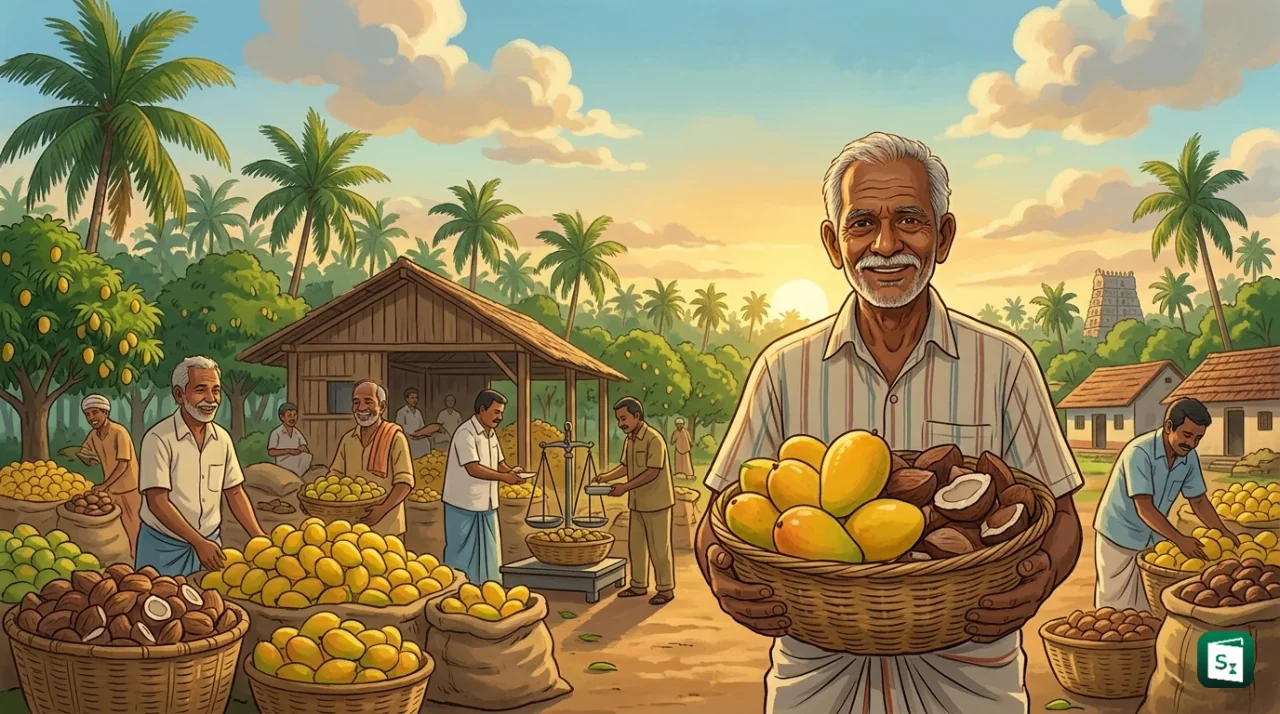
The Centre has approved large-scale procurement of copra and Totapuri mangoes from farmers in Tamil Nadu, deploying two distinct price support mechanisms to shield growers from distress sales. Union Agriculture Minister Shivraj Singh Chouhan cleared the procurement of 87,226 metric tonnes of copra under the Price Support Scheme (PSS) and 96,879 metric tonnes of Totapuri mangoes under the Market Intervention Scheme (MIS). Together, the two interventions represent over ₹1,000 crore in government-backed price assurance for the state’s farmers.
Copra Procurement Under the Price Support Scheme
Copra is the dried kernel of coconut from which coconut oil is extracted. It is a notified commodity under the Price Support Scheme (PSS), which is implemented by the Ministry of Agriculture and Farmers Welfare to protect farmers of oilseeds, pulses, and copra from distress sales when market prices fall below the Minimum Support Price (MSP).
Based on a proposal from the Tamil Nadu government, the Centre has approved the procurement of 87,226 MT of copra for the 2026 season. This total comprises 87,000 MT of milling copra (used for oil extraction) and 226 MT of ball copra (used for edible purposes). The entire procurement will be carried out at the notified MSP, and the total MSP value of the approved quantity exceeds ₹1,049.16 crore.
The procurement is executed through NAFED (National Agricultural Cooperative Marketing Federation of India), which acts as the central nodal agency for copra under the PSS. NAFED, established in 1958 and headquartered in New Delhi, works through state-level cooperative networks to purchase directly from pre-registered farmers, ensuring that payments are made digitally and intermediaries are eliminated. The Tamil Nadu Cooperative Marketing Federation (TANFED) serves as the state-level designated agency to facilitate ground-level operations.
Totapuri Mango Procurement Under Market Intervention Scheme
Totapuri (also known as Bangalora or Ginimoothi) is a major commercial mango variety grown extensively in Tamil Nadu, Andhra Pradesh, and Karnataka. It is instantly recognizable by its elongated shape with a curved, beak-like tip, which gives it its name (Tota means parrot). Totapuri mangoes are the backbone of India’s mango processing industry, accounting for nearly 76% of all mangoes used for processing into pulp, juice concentrate, and puree. Brands such as Maaza and Slice source heavily from this variety.
Unlike dessert mangoes such as Alphonso, Totapuri has a firm, fibreless flesh with a tangy flavour profile and moderate sweetness, making it ideal for industrial processing. It also has a thick skin that gives it excellent post-harvest shelf life and transport resilience.
The Centre has approved the procurement of 96,879 MT of Totapuri mangoes under the Market Intervention Scheme (MIS) at a Market Intervention Price (MIP) of ₹1,545.41 per quintal. The scheme is activated on the request of the state government when market prices fall by at least 10% compared to the previous normal season. The intervention protects farmers from being forced to sell at a loss during peak harvest periods when market gluts drive prices down.
PM-AASHA: The Umbrella Framework for Price Assurance
Both the Price Support Scheme and the Market Intervention Scheme operate under the umbrella of Pradhan Mantri Annadata Aay Sanrakshan Abhiyan (PM-AASHA). Launched in September 2018 by the Ministry of Agriculture and Farmers Welfare, PM-AASHA was designed to move beyond mere MSP declaration towards tangible price assurance for farmers. The scheme underwent a major restructuring in September 2024, when the Cabinet approved its continuation with a ₹35,000 crore outlay and converged it into an integrated framework.
PM-AASHA currently has four components, each targeting different crop categories and market conditions.
Price Support Scheme (PSS)
The PSS covers notified pulses, oilseeds, and copra for which MSP is declared by the government. The scheme mandates physical procurement of Fair Average Quality (FAQ) produce directly from farmers by central nodal agencies such as NAFED and NCCF (National Cooperative Consumers Federation of India). Procurement is triggered when market prices fall at or below the MSP and continues until prices stabilize above MSP or for a maximum of 90 days from the start of the harvest season. From the 2024-25 season onwards, the procurement ceiling was set at 25% of state production for most crops, with a complete removal of ceiling for Tur, Urad, and Masur to boost self-sufficiency.
Market Intervention Scheme (MIS)
The MIS is designed for perishable horticultural commodities such as tomato, onion, potato, and fruits, which are not covered by MSP. It is implemented at the request of a state government when market prices fall by at least 10% compared to the previous normal year. The procurement coverage was increased from 20% to 25% of production in 2024-25. Under the revised guidelines, states also have the option to make direct differential payments to farmers’ bank accounts between the Market Intervention Price and the selling price, instead of physical procurement. For TOP crops (tomato, onion, potato), the government also bears transportation and storage costs incurred by central nodal agencies to move produce from surplus to deficit regions.
Significance for Tamil Nadu’s Agricultural Economy
Tamil Nadu is the second-largest coconut producer in India, contributing about 28.5% of the nation’s coconut output, after Kerala. The major coconut-growing districts include Coimbatore, Tiruppur, Thanjavur, Dindigul, and Kanyakumari. Copra processing is a significant economic activity in these regions, with numerous oil extraction and desiccated coconut production units concentrated in Coimbatore, Tiruppur, and Salem.
Similarly, mango cultivation occupies approximately 1.25 lakh hectares in Tamil Nadu, with major production in Dharmapuri, Krishnagiri, Vellore, Dindigul, Thiruvallur, and Theni districts. Totapuri is one of the most widely grown commercial varieties in the state and is the primary source of raw material for the mango processing industry across South India.
The approval for large-scale procurement of both commodities comes as a significant relief for Tamil Nadu farmers at a time when market prices have fallen below sustainable levels. For copra, the assured procurement at MSP with a total value exceeding ₹1,049 crore provides income stability to thousands of coconut farmers. For Totapuri mango growers, the MIS intervention at ₹1,545.41 per quintal ensures that they do not have to accept distress sale prices during the peak harvest season.
These interventions also have a broader stabilizing effect on local rural economies. When farmers receive remunerative prices, they have greater purchasing power, which benefits the entire supply chain, including labour, transporters, and processing units.
Key Takeaways
- The Centre has approved procurement of 87,226 MT of copra under the Price Support Scheme (PSS) and 96,879 MT of Totapuri mangoes under the Market Intervention Scheme (MIS) for Tamil Nadu.
- Union Agriculture Minister Shivraj Singh Chouhan cleared the procurement based on a proposal from the Tamil Nadu government.
- Copra procurement comprises 87,000 MT of milling copra and 226 MT of ball copra, with a combined MSP value exceeding ₹1,049 crore.
- Totapuri mangoes will be procured at a Market Intervention Price of ₹1,545.41 per quintal.
- NAFED (established in 1958, HQ in New Delhi) acts as the central nodal agency for copra procurement under the PSS.
- Both PSS and MIS are components of the PM-AASHA umbrella scheme, launched in September 2018 and restructured in 2024 with a ₹35,000 crore outlay.
- Tamil Nadu is the second-largest coconut producer in India, contributing 28.5% of national output, and a major producer of Totapuri mangoes for the processing industry.