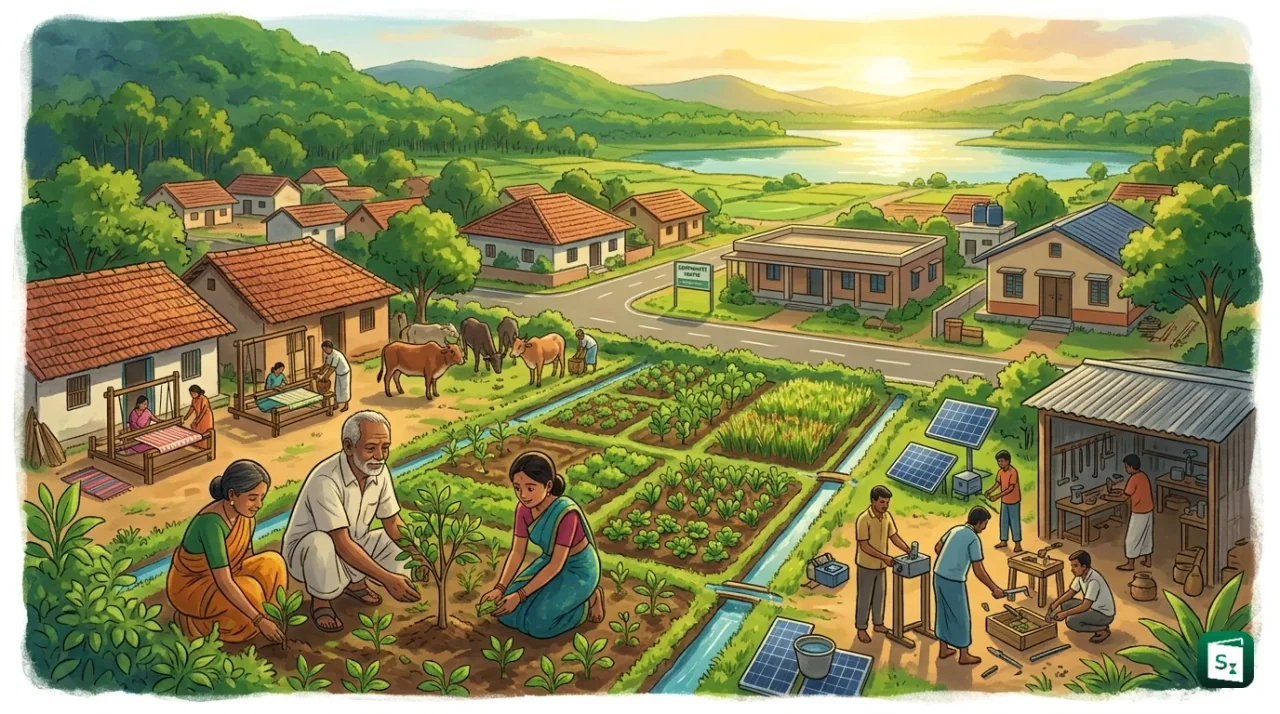
The Viksit Bharat Guarantee for Rozgar and Ajeevika Mission (Gramin) Yojana (VB-G RAM G) has been launched nationwide from Mukkavaripalli village in Tirupati, Andhra Pradesh, by Chief Minister N Chandrababu Naidu and Union Minister Shivraj Singh Chouhan. The scheme replaces the two-decade-old Mahatma Gandhi National Rural Employment Guarantee Act (MGNREGA) and enhances the statutory employment guarantee from 100 to 125 days per rural household per year. The Centre has committed a total financial outlay of ₹7.5 lakh crore over five years, with an annual outlay of ₹1.51 lakh crore, of which the Centre will contribute ₹95,692 crore and states will bear the remaining 40%.
From MGNREGA to VB-G RAM G: A New Framework for Rural Employment
The Mahatma Gandhi National Rural Employment Guarantee Act (MGNREGA) was enacted in 2005 and provided a legal guarantee of 100 days of unskilled wage employment to rural households. Over nearly two decades, MGNREGA played a key role in stabilizing rural incomes and creating basic infrastructure. However, the government argued that rural India had undergone significant changes in terms of income levels, digital penetration, and infrastructure, making a legislative overhaul necessary.
The VB-G RAM G Act, 2025 was passed by Parliament on 18 December 2025 after extensive debate and received the President’s assent on 21 December 2025. It came into force on 1 July 2026, repealing MGNREGA in its entirety. The Act is administered by the Ministry of Rural Development and is designed to align rural employment with the national vision of Viksit Bharat @ 2047.
The transition introduces several structural departures from MGNREGA. The new law shifts the funding model from a fully Centre-funded wage bill to a centrally sponsored scheme with shared financial responsibility between the Centre and states. It also replaces the earlier demand-driven allocation model with a normative allocation framework, where the Centre determines state-wise allocations based on objective parameters.
Key Provisions of the Act
The VB-G RAM G Act introduces several major changes to India’s rural employment framework. The most significant is the increase in the statutory employment guarantee from 100 to 125 days per financial year for every rural household whose adult members volunteer to undertake unskilled manual work. This expanded guarantee is designed to provide greater income security to rural families.
The Act allows states to pause scheme work for up to 60 days in a year during peak sowing and harvesting seasons. This provision is intended to ensure that enough labour remains available for agricultural operations when they are most needed. The guaranteed 125 days of employment are to be provided within the remaining 305 days of the year.
A crucial change is in the funding pattern. Under MGNREGA, the Centre paid 100% of the wage component. Under VB-G RAM G, the cost is shared between the Centre and states in a 60:40 ratio for most states. For North-Eastern and Himalayan states, the ratio is 90:10, and for Union Territories without a legislature, the Centre bears the full cost. This shift places a higher financial burden on states, which must now contribute 40% of wages, material costs, and administrative expenses.
Wages under the scheme will not be less than ₹300 per day, with rates varying across states. In Andhra Pradesh, the notified wage rate is between ₹312 and ₹315 per day. The Act mandates that wages be paid on a weekly basis, or within a maximum of 15 days from the date of work, with compensation for delays set at 0.05% of unpaid wages per day beyond the sixteenth day.
If employment is not provided within 15 days of application, the worker becomes entitled to an unemployment allowance. This allowance is set at one-fourth of the notified wage rate for the first 30 days and one-half of the wage rate for the remaining period of the financial year.
Financial Architecture: ₹7.5 Lakh Crore Over Five Years
The Government of India has committed a total outlay of ₹7.5 lakh crore for the implementation of VB-G RAM G over a five-year period. The annual outlay is estimated at ₹1.51 lakh crore, of which the Central share is ₹95,692 crore and the remaining 40% is to be contributed by the states. For the financial year 2026-27, the Centre has made an interim allocation of ₹95,692.31 crore, the largest budget estimate for a rural employment programme to date.
For Andhra Pradesh, the state where the scheme was launched, the Centre has allocated ₹7,707 crore over a nine-month period. The state government will add ₹4,000 crore, bringing the total programme outlay in AP to more than ₹11,700 crore. Andhra Pradesh secured the third-highest allocation among states.
| Metric | Amount |
|---|---|
| Total outlay (5 years) | ₹7.5 lakh crore |
| Annual outlay | ₹1.51 lakh crore |
| Central share (annual) | ₹95,692 crore |
| State share (annual) | 40% of total |
| AP allocation (Central) | ₹7,707 crore |
| AP allocation (State) | ₹4,000 crore |
| Minimum daily wage | ₹300 |
Union Minister Shivraj Singh Chouhan noted that while the previous UPA government spent ₹2.13 lakh crore on MGNREGA over its tenure, the NDA government spent ₹8.63 lakh crore in 10 years and is committing another ₹7.5 lakh crore in five years under the new scheme. On the first day of implementation (1 July 2026), more than 5 lakh people were provided employment at over 50,000 locations across the country.
The funding model also introduces a normative allocation system, replacing MGNREGA’s demand-driven approach. Under this system, the Centre determines each state’s allocation based on objective parameters such as rural population, poverty ratios, and past performance. Any expenditure beyond the normative allocation must be fully borne by the state government. This shift is intended to bring predictability to budgeting and prevent the accumulation of unpaid liabilities.
Nationwide Launch from Mukkavaripalli
The nationwide rollout of VB-G RAM G was held at Mukkavaripalli village in Obulavaripalli mandal, Tirupati district, Andhra Pradesh. The choice of location carried symbolic weight. Chief Minister Naidu noted that MGNREGA itself had originated from Anantapur in the Rayalaseema region, and the new mission was also being launched from the same region, now from the Railway Kodur Assembly constituency.
The launch event was attended by Andhra Pradesh Chief Minister N Chandrababu Naidu, Union Minister for Rural Development Shivraj Singh Chouhan, Deputy Chief Minister Pawan Kalyan, and Union Ministers of State Dr Chandrasekhar Pemmasani and Kamlesh Paswan. The programme was formally inaugurated by laying the foundation stone for a farm pond, signalling that farmer welfare and water conservation are central priorities under the new framework.
At the event, Chouhan announced additional central assistance for Andhra Pradesh, including 74,212 houses under the Pradhan Mantri Awas Yojana (PMAY) and ₹422 crore for rural road connectivity under the PM Gram Sadak Yojana (PMGSY). The Centre also offered to procure 2.16 lakh metric tonnes of Totapuri mangoes through the Market Intervention Scheme to support the state’s horticulture ambitions.
The event also saw the launch of the VB-G RAM G portal and the distribution of VB-G RAM G cards to beneficiaries. Deputy CM Pawan Kalyan, who holds the Panchayat Raj portfolio, unveiled an information booklet detailing the scheme’s features.
Thematic Focus and Planning Framework
A distinctive feature of the VB-G RAM G framework is the creation of the Viksit Bharat National Rural Infrastructure Stack, which aggregates all works undertaken under the scheme into a unified national development plan. This stack is organized around four thematic domains:
| Category | Theme | Focus Areas |
|---|---|---|
| Category I | Water Security | Farm ponds, check dams, water harvesting, canal renovation |
| Category II | Core Rural Infrastructure | All-weather roads, drainage systems, community buildings |
| Category III | Livelihood Infrastructure | Cattle sheds, go-downs, horticulture plantations |
| Category IV | Extreme Weather Mitigation | Flood control, drought proofing, climate-resilient structures |
Works under the scheme are planned through Viksit Gram Panchayat Plans (VGPPs), which are prepared by Gram Panchayats and integrated with the PM Gati Shakti National Master Plan for spatially optimized infrastructure development. These plans are aggregated at the block, district, and state levels before being consolidated into the national stack. Gram Panchayats are categorized into Category A, B, and C based on their development needs, with differentiated planning requirements for each.
The Act mandates that at least 50% of works (in terms of cost) must be implemented by Gram Panchayats, ensuring that local bodies remain the primary execution agencies. The administrative expenditure ceiling has been raised from 6% to 9% under the new framework, providing greater resources for staffing, training, and technical capacity at the implementation level.
Governance and Transparency
The VB-G RAM G Act establishes a multi-layered institutional framework for oversight and accountability. At the national level, a Central Gramin Rozgar Guarantee Council and a National Steering Committee provide policy guidance and strategic direction. Similar bodies are to be constituted at the state level. These bodies are tasked with reviewing implementation, driving convergence across schemes, and ensuring performance standards are met.
A comprehensive digital ecosystem underpins the scheme’s implementation. This includes biometric authentication for worker identification, GPS-based worksite monitoring, real-time MIS dashboards for fund flow tracking, and proactive public disclosure of all works and payments at the Gram Panchayat level. The Act also authorizes the use of Artificial Intelligence for planning, audits, and fraud risk mitigation.
The Act grants the Central Government strong enforcement powers. It can investigate complaints relating to implementation, suspend fund releases where serious irregularities are found, and direct corrective measures to address deficiencies. Social audits remain a mandatory feature, with Gram Sabhas empowered to review all works and expenditure.
Existing MGNREGA job cards with completed e-KYC remain valid until new Gramin Rozgar Guarantee Cards are issued. Workers will not be denied employment solely because their e-KYC is pending, ensuring continuity during the transition period.
Key Takeaways
- The VB-G RAM G Act, 2025 replaced the Mahatma Gandhi National Rural Employment Guarantee Act (MGNREGA), 2005, and came into force on 1 July 2026.
- The scheme guarantees 125 days of wage employment per rural household per year, up from 100 days under MGNREGA.
- The Centre committed ₹7.5 lakh crore over five years, with an annual outlay of ₹1.51 lakh crore and the Central share fixed at ₹95,692 crore.
- The funding pattern shifts to a 60:40 Centre-State ratio for most states, with 90:10 for North-Eastern and Himalayan states.
- The scheme was launched nationwide at Mukkavaripalli village in Tirupati, Andhra Pradesh, by CM Chandrababu Naidu and Union Minister Shivraj Singh Chouhan.
- Works are planned through Viksit Gram Panchayat Plans and aggregated into the Viksit Bharat National Rural Infrastructure Stack across four thematic domains.