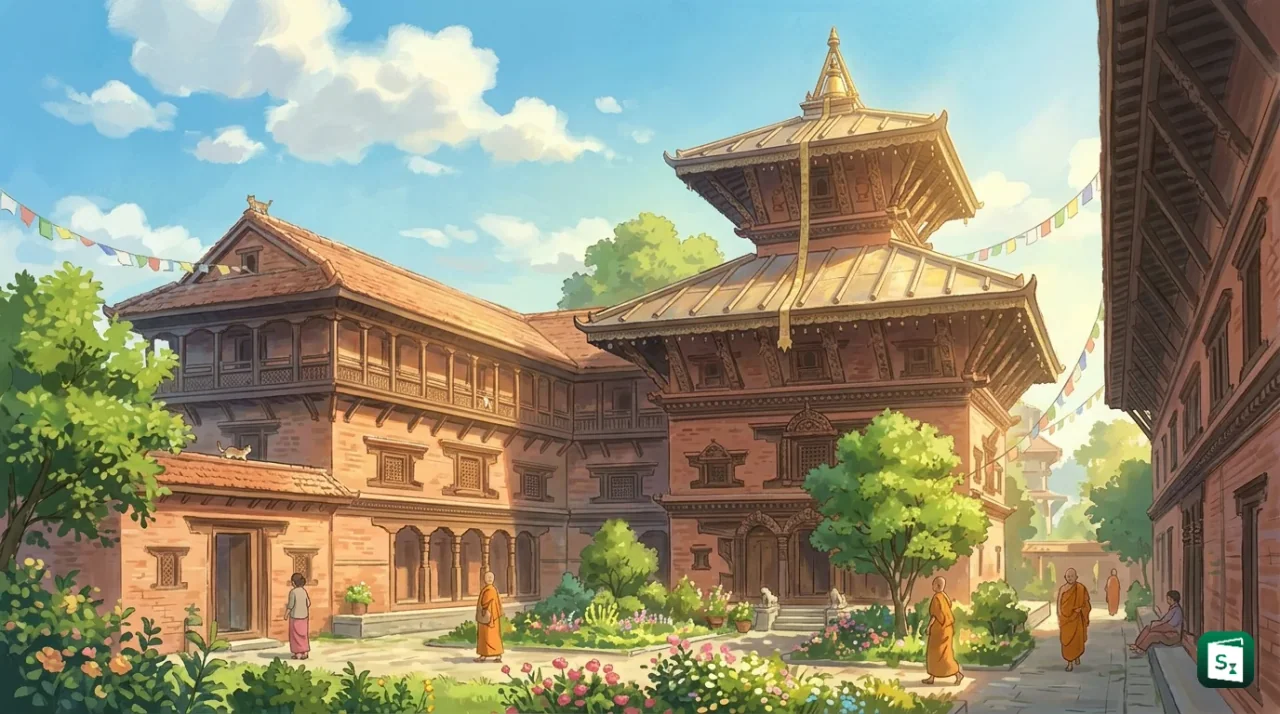
Jestha Varna Mahavihar, a 17th century Buddhist monastery in Lalitpur, Nepal, has been awarded the 2025 UNESCO Asia-Pacific Heritage Award of Merit for its post-earthquake restoration. The monastery, also known as Jyaba Bahi or Chakrabahil, was damaged in the 2015 Gorkha earthquake and rebuilt with NPR 13.78 crore in financial assistance from the Government of India. The award was presented on July 3, 2026 by Jaco Du Toit, UNESCO Representative in Nepal, to the monastery’s user committee in a ceremony attended by officials from both India and Nepal.
What Is the UNESCO Asia-Pacific Heritage Award?
The UNESCO Asia-Pacific Awards for Cultural Heritage Conservation are a flagship programme of the United Nations Educational, Scientific and Cultural Organization, established in 2000 to recognize outstanding efforts by the private sector and public-private partnerships in conserving and restoring heritage structures across the Asia-Pacific region. Administered by the UNESCO Regional Office in Bangkok, the awards have honoured more than 300 projects from 28 countries since their inception.
The awards have multiple categories. The Award of Merit, which Jestha Varna Mahavihar received, is given to projects that demonstrate superior achievement in understanding the site, technical conservation excellence, and sustainability impact. This is the third tier of recognition, below the Award of Distinction and the highest honour, the Award of Excellence. The 2025 cycle attracted 90 entries from 16 countries, and only 12 projects were selected for recognition across all categories.
Jestha Varna Mahavihar: A Historic Buddhist Monastery
Jestha Varna Mahavihar, also called Jyaba Bahi or Chakrabahil, is located just 300 metres from the Patan Durbar Square, a UNESCO World Heritage site in Lalitpur (also known as Patan). It belongs to a group of 15 historical Bahis in Patan, which are traditional Buddhist monastery courtyards unique to Newar architecture in the Kathmandu Valley. The oldest inscription found at the site, dated N.S. 772 (mid-17th century), commemorates an earlier renovation, though the monastery’s foundation is believed to be much older.
The monastery follows the classic Bahi layout featuring a main shrine and adjoining sattals (rest houses) arranged around a sunken central courtyard. Its architecture showcases the remarkable craftsmanship of the Newar community, with intricate timber works, stone sculptures, and wall paintings at the shrine entrance. For centuries, Jestha Varna Mahavihar has served as a living monastery where daily rituals, community gatherings, and festivals keep Buddhist traditions alive. It is also a centre for monastic learning where ordination ceremonies for Shakya community members are performed.
The Restoration After the 2015 Gorkha Earthquake
The April 2015 Gorkha earthquake (magnitude 7.8) caused widespread devastation across Nepal, killing nearly 9,000 people and damaging or destroying over 691 historic monuments across 16 districts. Jestha Varna Mahavihar was among the affected heritage sites. The monastery was originally two storeys high, and its entire top floor collapsed during the earthquake, leaving it structurally unstable. Incompatible repairs over previous decades had also introduced alterations that compromised the building’s authenticity.
Funding and Key Stakeholders
The restoration project was taken up under the Government of India’s post-earthquake reconstruction grant for Nepal’s cultural heritage sector. India committed USD 1 billion for Nepal’s overall post-earthquake reconstruction, and the cultural heritage component covered seven projects selected in August 2017 for implementation in Lalitpur district.
The project had a total cost of NPR 13.78 crore (approximately USD 1.18 million). The contract was awarded in March 2021 to M/s CM-Pachali JV. The implementing agency was the Central Level Project Implementation Unit (CLPIU Building and Housing) under the Government of Nepal. The Government of India appointed the Indian National Trust for Art and Cultural Heritage (INTACH) as the Project Management Consultant in December 2019. INTACH, founded in 1984 and headquartered in New Delhi, is one of the world’s largest heritage organizations with over 228 chapters across India. It provided design and project management consultancy services, directly monitoring both conservation and construction works. The restored monastery was inaugurated on March 22, 2024 by Naveen Srivastava, Indian Ambassador to Nepal, and Dhan Bahadur Budha, Nepal’s then Minister of Urban Development.
Balancing Heritage with Seismic Safety
The conservation approach was guided by the need to balance modern earthquake safety standards with the preservation of the monastery’s historical character. Major works included the reconstruction of the historic shrine and sattals in their original form and layout while incorporating seismic retrofitting. The project involved careful documentation and conservation of decorative art surfaces, including historic timber works, stone sculptures, and the restoration of wall paintings at the shrine entrance. Building services such as illumination, sanitation, and rainwater harvesting systems were also upgraded.
UNESCO recognised the project for its exemplary community-centred approach. Throughout the restoration, the living heritage of the monastery continued uninterrupted. Daily rituals, cultural practices, and festivals of the Newar Buddhist community were maintained. The local Jestha Varna Mahavihar User Committee played an active role in the process, ensuring that the conservation was not just a technical exercise but a community-driven effort.
Significance: Deepening India-Nepal Cultural Ties
The UNESCO recognition of Jestha Varna Mahavihar carries significance beyond the conservation of a single monument. It highlights the deep cultural and historical ties between India and Nepal, two neighbouring countries that share centuries of Buddhist heritage and architectural traditions. The restoration project demonstrates how cultural cooperation can serve as a pillar of bilateral development partnership.
Speaking at the award ceremony, Rakesh Pandey, Deputy Chief of Mission at the Indian Embassy in Kathmandu, noted that the project’s success underscored the deep-rooted cultural links between the two countries. Chiri Babu Maharjan, Mayor of Lalitpur Metropolitan City, thanked the Government of India for extending financial assistance for the restoration of multiple cultural heritage sites in Lalitpur.
India’s post-earthquake reconstruction assistance to Nepal extends well beyond cultural heritage. Under its broader reconstruction commitment, India has supported the rebuilding of 70 schools across eight districts and the Tribhuvan University Central Library, which were completed and handed over to the Government of Nepal in January 2024. These projects together represent India’s sustained commitment to Nepal’s long-term recovery and development.
Key Takeaways
- The Jestha Varna Mahavihar (also known as Jyaba Bahi or Chakrabahil) in Lalitpur, Nepal received the 2025 UNESCO Asia-Pacific Heritage Award of Merit for post-earthquake conservation.
- The restoration project was funded by the Government of India under its post-earthquake reconstruction grant at a cost of NPR 13.78 crore (approximately USD 1.18 million).
- INTACH (Indian National Trust for Art and Cultural Heritage), founded in 1984 and headquartered in New Delhi, served as the Project Management Consultant for the restoration.
- The monastery, dating from the 17th century, is one of 15 historical Bahis in Patan and is located 300 metres from Patan Durbar Square, a UNESCO World Heritage site.
- The UNESCO Asia-Pacific Awards for Cultural Heritage Conservation were established in 2000 and have recognised over 300 projects from 28 countries across the region.