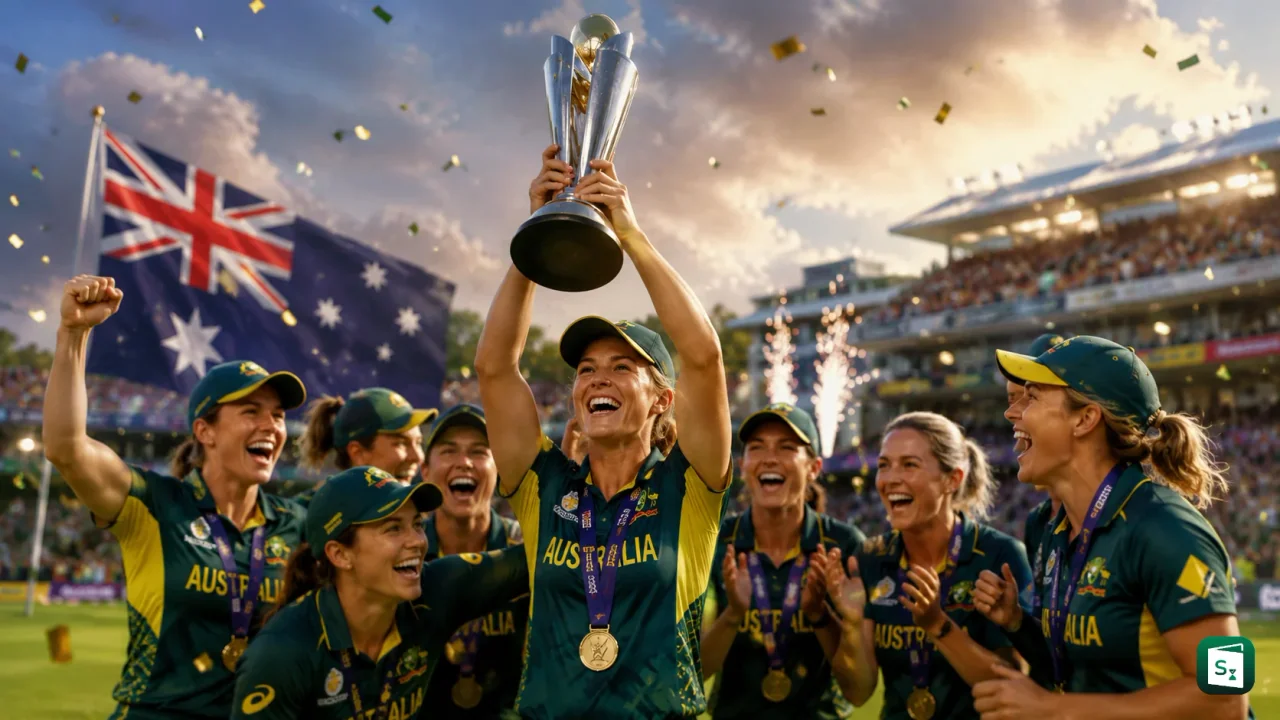
Australia lifted the ICC Women’s T20 World Cup for a record seventh time on 5 July 2026, beating hosts England by seven wickets in front of more than 28,000 fans at Lord’s Cricket Ground in London. Chasing 151, Beth Mooney anchored the innings with an unbeaten 64 off 49 balls to seal the highest successful run chase in a Women’s T20 World Cup final. The victory capped an unbeaten campaign for Sophie Molineux’s side, who reclaimed the trophy they last won in 2023.
Australia’s Record Seventh Title
Australia’s triumph in the 2026 edition extends their already unmatched record in the competition. With seven titles from 10 editions, the team has won in 2010, 2012, 2014, 2018, 2020, 2023, and now 2026. Only three other nations have ever won the trophy: England (2009), West Indies (2016), and New Zealand (2024).
The win also marked Australia’s 14th women’s World Cup title overall, combining seven T20 World Cup crowns with seven ODI World Cup titles. This tally makes Australia the most successful team in the history of women’s international cricket across both formats. The 2016 edition, where they lost to West Indies in the final, and the 2024 edition, where they were eliminated in the semi-finals, remain the only two tournaments in which Australia have failed to lift the trophy.
Sophie Molineux, the 28 year old left-arm spinner, led the team in her first ICC tournament as captain. She took over the role after the retirement of Alyssa Healy and had previously been part of Australia’s title-winning squads in 2018 and 2020.
The Final at Lord’s: A Commanding Chase
England won six out of six matches heading into the final and entered the contest on home soil with strong momentum. However, Australia’s all-round brilliance proved too much for the hosts on the day.
England’s Innings
Winning the toss and electing to field first, Australia struck early through left-arm quick Lucy Hamilton, who claimed her first wicket in a T20 World Cup by removing opener Amy Jones in the second over. Danni Wyatt-Hodge, the tournament’s leading run-scorer, fell soon after to Annabel Sutherland for a low score.
England captain Nat Sciver-Brunt, who had missed three group stage matches due to a calf injury, anchored the innings with a composed 58 off 53 balls. She found support from Freya Kemp, who smashed a quickfire 44 off 28 balls with four fours and a six. The pair added an unbeaten 80 runs off 55 balls to push England to 150 for 4 in 20 overs. For Australia, Kim Garth, Hamilton, Sutherland, and Molineux each took one wicket.
Australia’s Chase
Australia’s reply began aggressively when Georgia Voll struck the first ball of the innings for four. Although Voll departed early, Beth Mooney and Phoebe Litchfield took command. The pair added 100 runs in 67 balls, with Litchfield playing the more aggressive role, scoring 48 off 35 balls with two sixes and six fours.
Australia reached 62 for 1 at the end of the powerplay, the second-highest powerplay score in a Women’s T20 World Cup knockout match. Mooney brought up her ninth T20 World Cup half-century off 38 balls, continuing her reputation as a player for big occasions. This was her third half-century in a T20 World Cup final, following similar knocks in the 2020 and 2023 finals.
Australia chased down the target in 17.1 overs at 153 for 3, completing the highest successful run chase in a Women’s T20 World Cup final. Mooney finished on 64 off 49 balls with 10 boundaries, earning her both the Player of the Match award and the Aramco Player of the Tournament award for the second time, after previously winning it in 2020.
A Tournament of Firsts: Expansion to 12 Teams
The 2026 edition was the 10th edition of the ICC Women’s T20 World Cup and the first to feature 12 teams, up from 10 in previous tournaments. The expansion brought Netherlands into the competition for the first time, alongside Scotland and Ireland who qualified through the global qualifier.
The 12 teams were divided into two groups of six, with the top two from each group advancing to the semi-finals. The tournament was hosted across seven venues in England, with Lord’s hosting its second Women’s T20 World Cup final after previously staging the inaugural edition in 2009.
Group Stage Highlights
In Group 1, Australia dominated with five wins out of five matches, followed by South Africa with four wins. India finished third with three wins, despite strong performances from Smriti Mandhana, who scored 205 runs, and Shree Charani, who consistently took wickets. New Zealand, the defending champions from 2024, were eliminated in the group stage after finishing fourth in Group 2.
Group 2 was topped by hosts England, who also won all five group matches. West Indies finished second, while Sri Lanka, New Zealand, Scotland, and Ireland completed the group. The tournament produced five scores of 200 or more, the most in any single edition, compared to just one before 2026.
Individual Brilliance: Performers Who Shone
Danni Wyatt-Hodge: Leading Run-Scorer
England opener Danni Wyatt-Hodge finished as the tournament’s top run-scorer with 302 runs across seven matches at an average of 75.50. She became the first player in Women’s T20 World Cup history to cross the 300-run mark in a single edition, surpassing Beth Mooney’s previous record of 259 from 2020. Her tournament highlight was an unbeaten 105 off 62 balls against Sri Lanka in the opening match, the highest individual score of the tournament and the seventh century in Women’s T20 World Cup history.
N Shree Charani: Leading Wicket-Taker
India’s N Shree Charani, a 21 year old left-arm orthodox spinner playing in her maiden T20 World Cup, emerged as the leading wicket-taker with 14 wickets in five matches at an average of 8.35. She broke the record for most wickets by an Indian in a single Women’s T20 World Cup edition, surpassing Poonam Yadav’s 10 wickets from 2020. Charani was also the first Asian player to take more than 10 wickets in a single edition of the tournament. Her best figures of 4 for 19 came against the Netherlands.
Beth Mooney: Player of the Tournament
Beth Mooney was named the Aramco Player of the Tournament after scoring 238 runs in seven matches at an average of 47.60. She finished second in the run-scoring charts behind Wyatt-Hodge. Mooney’s tournament featured a string of consistent scores, including her match-winning 64 in the final. The 32 year old wicketkeeper-batter became the first player across men’s and women’s T20 World Cups to reach 50 appearances in the tournament when she took the field against the Netherlands.
Other Notable Performances
Ellyse Perry accumulated 185 runs for Australia and was pivotal in the semi-final against West Indies. Smriti Mandhana scored 205 runs for India with a tournament strike rate above 140. Three centuries were scored during the tournament: Wyatt-Hodge’s 105 not out, Chamari Athapaththu’s 106 not out for Sri Lanka against Ireland, and Tazmin Brits’s 114 not out for South Africa against the Netherlands.
Record-Breaking Tournament Statistics
| Record | Detail |
|---|---|
| Most runs in a single edition | 302 by Danni Wyatt-Hodge (England) |
| First to cross 300 runs in an edition | Danni Wyatt-Hodge |
| Most wickets in a single edition | 14 by N Shree Charani (India) |
| Highest team total | 219/1 by England vs Sri Lanka (matched by Australia vs Netherlands) |
| Highest match aggregate | 362 runs (England vs Scotland) |
| Most centuries in one edition | 3 (previous best: 2 in 2020) |
| Most 200+ totals in one edition | 5 (previous best: 1) |
Australia’s Legacy in Women’s Cricket
Australia’s seventh title cements their position as the dominant force in women’s international cricket. The team has won seven of the 10 T20 World Cups held since 2009, a success rate unmatched in any form of international cricket. Their 14 World Cup titles overall (seven T20, seven ODI) place them ahead of every other nation in women’s cricket history.
The 2026 victory was particularly significant as it marked a transition in leadership. Sophie Molineux became the third Australian captain to lift the T20 World Cup trophy, following Alex Blackwell (2010) and Meg Lanning (2012, 2014, 2018, 2020, 2023). The team’s ability to seamlessly integrate new talent such as Phoebe Litchfield, Georgia Voll, and Lucy Hamilton alongside experienced campaigners like Beth Mooney and Ellyse Perry highlighted the depth of Australian cricket.
The ICC has approved further expansion of the Women’s T20 World Cup to 16 teams from 2030, reflecting the growing global reach of women’s cricket. The success of the 2026 edition, with record crowds and television viewership, underscored the rapid rise in popularity of the women’s game.
Key Takeaways
- Australia won their seventh ICC Women’s T20 World Cup title, beating England by seven wickets in the final at Lord’s, London on 5 July 2026.
- Sophie Molineux captained Australia to victory in her first ICC tournament as captain, becoming the third Australian captain to lift the trophy.
- Beth Mooney was named both Player of the Match (64 off 49) and Aramco Player of the Tournament for scoring 238 runs in seven matches.
- Danni Wyatt-Hodge of England set a new record for the most runs in a single Women’s T20 World Cup edition with 302 runs, becoming the first to cross 300.
- N Shree Charani of India was the leading wicket-taker with 14 wickets, breaking the Indian record for most wickets in a single edition.
- The 2026 edition expanded to 12 teams for the first time, with Netherlands making their tournament debut.
- Australia’s seven T20 World Cup titles and 14 women’s World Cup titles overall (seven T20, seven ODI) are both records in women’s international cricket.